Featuring the creations of Castro's own designer and the "Alicia Alonso" of Cuban Haute Couture
I didn't know there was a "National Day of Cuban Culture" in Jamaica. The idea itself is not incongruous; the two Caribbean islands share a long and complex history, though their roots and colonial experiences are not identical. At the center are two of the most important figures in Cuban history — José Martí, who journeyed to Jamaica to solicit the support of Cuban expatriates and Jamaicans for Cuba's war of independence; and Maceo's mother, Mariana Grajales, who died and was buried there. Many Cuban blacks also trace their roots to Jamaica. Their ancestors migrated to Cuba to cut the sugar cane and stayed. Their English last names still distinguish them from the rest of the Cuban population as do the French surnames of 19th century creole refugees from the Haitian Revolution (1801). Yes, Cuba was a place of asylum for the region's needy as well as for Europe's throughout Cuba's history, that is, until 1959, when it became a place that produced refugeees rather than received them.
A "Cuban National Day in Jamaica," therefore, makes the greatest sense to those acquainted with the shared history of our two islands: Cuba, the largest Spanish-speaking island in the Caribbean; and Jamaica, the largest English-speaking one.
The celebration of this holiday did take a rather unexpected twist this year. The focus of the festivities was a fashion show which featured the latest innovations from Cuba's so-called "fashion industry." Now, the island's chancletera aristocracy has never been obsessed with dressing to the nines. There is nary an Evita Perón among them. On the contrary, though their confiscated pre-Castro mansions have the latest appliances from K-Mart and their larders may be stocked with precious delicacies from a typical American Dollar Store, their wardrobes are not noted for great extravagance. Just as Cuban elites would never be featured on a local version of "Lifestyles of the Rich and Famous," neither would they parade before the proles in the latest Paris fashions, though they may exhibit them in Paris itself. Proletarian drab is still the preferred attire of Cuba's "haves" in order not to inspire resentment among the "have nots." In a society where these are so clearly delineated, it is best for the "haves" to maintain a low profile outside their protected sanctuaries.
Nor is Jamaica the place to exhibit that side of the Revolution. The Cuban fashions featured at the show were aimed at an audience prosperous enough to afford the simple Cuban creations and sophisticated enough to see something chic or even trendy in wearing the Cuban version of the Mao jacket (wait till you see what that is!) The Jamaica Gleaner (founded, 1834) described the show as "short and spicy" (the "short" no doubt being provided by the designers and the "spicy" by the Cuban musicians who entertained the audience). The show was hosted by Castro's ambassador to the island, Gisela García Rivera, who said that it was intended to showcase "Cuba's culture and history." What a novel concept, fashion as propaganda.
The show featured the work of two designers — Carmen Fiol and Emiliano Nelson. No doubt there are many conceptual fashion designers in Cuba, that is, those who doodle designs which are never produced for lack of materia prima or official sponsorship. This show was not about them, but Cuba's recognized designers (that is, recognized by the government). In Cuba, of course, if you want to be an approved (that is, a published) writer you must belong to the "Writers Union;" or if an artist to the "Artists Union" or journalist to the "Journalists Union" (there are no real unions in Cuba because all are governmental entities); and, of course, to design clothes in Cuba you must also have official approval or patronage although there is no official union to enforce revolutionary concepts of fashion technology.
Described as a veteran of Cuba's "fashion industry" with 20 years experience, Nelson boasts such glamorous clients as Fidel Castro and Prince Albert of Monaco. That's it. It would have been interesting to see either of them in one of Nelson's crochet creations. Yes, crochet, which is perfect for the tropics and highly ventilated as climactic conditions dictate, also, all those little spaces greatly economize on yarn. I won't go into elaborate details, but it seems Nelson has designed a crochet bush jacket, something that both mighty white hunters (Fidel and Prince Albert) must sport on safaris.
The other designer is named Carmen Fiol, who, at 83, is the Alicia Alonso of Cuba's so-called fashion industry. Her creations were described as "highly practical," which I take to mean drab and nearly corrugated. Her stuff must really have been awful beyond all description. The Gleaner's politic reviewer was even forced to acknowledge that "the most striking thing about Carmen Fiol is not necessarily her designs but that she still manages to design at her age," much as the most striking thing about Alicia Alonso nowadays is certainly not her dancing but her ability to stand up. Fiol's main attraction was an "all white" line of clothing, which included many free-flowing dresses. Her boldest design were khaki capris with a matching sequined blouse. Bet Prince Albert grabbed those.
"The models," The Gleaner assured its readers, "were just as outstanding as the designs." At this moment, I started replaying in my mind that old tv commercial about a Soviet fashion show, where the models were all huge and stolid and wore the same identical dress, which was transformed into evening wear with the addition of a flashlight and beachwear with a beach ball. But, surely Cuba, at least, still produces beautiful people that could make rags look good, right? I mean, Cuba could match and surpass the protruding bones, hollowed stomachs and prominent cheekbones of the world's most famous models without the necessity of recoursing to anorexia or bulimia. I am surprised that Cuba's models have not been conscripted into service for the fatherland as have its doctors and teamsters, etc. I suppose the models are needed for Cuba's sex tourism industry.
POSTSCRIPT:
Anonymous says ...
I attended this show. I have covered fashion shows for the past 23 years. The designs from All three designers one Jamaican and 2 Cubans showcased high fashions which were sexy, sophisticated, alluring and elegant.
This blogger who relies on second hand information from the Gleaner has the temerity to present his opinions as facts and accuse the Cubans of using fashion as propaganda. He just hates the idea that there are nations outside of the USA who beleive in the peaceful coexistence of nations and peoples.
11/01/2007 5:24 AM
Manuel A.Tellechea said...
Anonymous:
Ah, you're funny, do stick around. Our resident jester, fantomas, essentially agrees with me on everything except on my approach to other Cuban-American bloggers. But you, rara avis, seem to be the genuine article — an unreconstructed Stalinist, and they are so few nowadays that we must tend to each as an endangered species.
First, let me refer to your snobbism: the Jamaica Gleaner is not a good enough source for an event that took place in Jamaica. I get it, the colonials are not to be trusted. I used the word "colonials," but you, of course, are thinking of something else. A Jamaican designer did indeed exhibit his creations at the show, but as my article was about the Cuban fashion industry, he had no place in it.
Our opinions may differ about the quality of these utilatarian-proletarian fashions (the Gleaner reviewer did say they were practical); but that disagreement is only superficial. The real difference between us is that you do not find it in the least ironic that a regime which allows the Cuban people to buy only one pair of underwear per year could still claim to have a fashion industry. But why not? That same regime cuts off the milk ration to children at age 7 and still claims that Cuba's children are the special concern of the state.
The "peaceful coexistence of nations and peoples" is just fine, but what you actually mean is the peaceful coexistence of tyrannies and democracies as a means of preserving the former.
http://www.jamaica-gleaner.com/gleaner/20071031/ent/ent3.html
Wednesday, October 31, 2007

Tuesday, October 30, 2007
Notable & Reprehensible: Liberty Is Not for All, Says Ron Paul
Libertarian Candidate for President
"Let's stop the hysterics about the freedom of Cubans – which is not our government's responsibility – and consider freedom of the American people, which is. Americans want the freedom to travel and trade with their Cuban neighbors, as they are free to travel and trade with Vietnam and China. Those Americans who do not wish to interact with a country whose model of governance they oppose are free to boycott." — Ron Paul, Libertarian candidate for president and mountebank, quoted approvingly on Stuck on the Palmetto by Rick, October 29, 2007
Quite a few Cuban bloggers are self-avowed libertarians. I suppose many regard it as some kind of compromise between being a Democrat and Republican, which it is not. "Libertarianism" is derived from the word "liberty" and that fact may have fooled others into believing that liberty in the collective is what libertarians want. It is not. They are interested only in their own personal liberty, not their neighbor's across the street or across an ocean except where it impacts their own. Therefore, it should surprise no one that Ron Paul doesn't care if Cubans are free so long as they are available for his diversion. Slavery doesn't concern the libertarian unless it infrinches on his own personal freedom. A libertarian may complain about seeing a man whipped because it causes him stress not because it pains the man. This is why libertarianism will always be a fad with no practical applications. Where there is no fellow feeling for others there can be no fellowship, and without fellowship you can't found a church or a party, much less a state. Communism is itself a more restricted variant of libertarianism. In Communist society, the libertarians are the party elite, who enjoy rights and privileges in a vaccum and at the expense of those not as favorably situated. Ultimately, a libertarian government — were such a thing possible — would also tend towards tyranny, since the maximum freedom for some will always mean a minimum of freedom for most.
"Let's stop the hysterics about the freedom of Cubans – which is not our government's responsibility – and consider freedom of the American people, which is. Americans want the freedom to travel and trade with their Cuban neighbors, as they are free to travel and trade with Vietnam and China. Those Americans who do not wish to interact with a country whose model of governance they oppose are free to boycott." — Ron Paul, Libertarian candidate for president and mountebank, quoted approvingly on Stuck on the Palmetto by Rick, October 29, 2007
Quite a few Cuban bloggers are self-avowed libertarians. I suppose many regard it as some kind of compromise between being a Democrat and Republican, which it is not. "Libertarianism" is derived from the word "liberty" and that fact may have fooled others into believing that liberty in the collective is what libertarians want. It is not. They are interested only in their own personal liberty, not their neighbor's across the street or across an ocean except where it impacts their own. Therefore, it should surprise no one that Ron Paul doesn't care if Cubans are free so long as they are available for his diversion. Slavery doesn't concern the libertarian unless it infrinches on his own personal freedom. A libertarian may complain about seeing a man whipped because it causes him stress not because it pains the man. This is why libertarianism will always be a fad with no practical applications. Where there is no fellow feeling for others there can be no fellowship, and without fellowship you can't found a church or a party, much less a state. Communism is itself a more restricted variant of libertarianism. In Communist society, the libertarians are the party elite, who enjoy rights and privileges in a vaccum and at the expense of those not as favorably situated. Ultimately, a libertarian government — were such a thing possible — would also tend towards tyranny, since the maximum freedom for some will always mean a minimum of freedom for most.
Oscar Biscet Awarded Presidential Medal of Freedom
It is heartening to know that Ileana Ros Lehtinen does have some influence with the president after all. One would suppose that she would have a great deal of influence, since her constituency is responsible for making George Bush president, as he has acknowledged. Her influence and that of the other Cuban congressmen is not enough to get the president to rescind Clinton's "Wet Foot/Dry Foot" policy. It is not enough for him to offer the Cuban people more than empty platitudes which most of his predecessor could have uttered and many did. It did suffice, however, to get Dr. Oscar Biscet the Presidential Medal of Freedom at Ros Lehtinen's recommendation. We have discussed that recommendation already; in it she calls Biscet the new "Titan de Bronce" [Maceo], which is pretty much giving with one hand and taking with the other. Still, even if the Presidential Medal has been degraded by past recipients, which include Mandela [terrorist], Robert McNamara [traitor], Robert Baldwin [Communist] , Jesse Jackson [con-man], Jimmy Carter [shill for tyrants], it still retains enough symbolism and cachet to be worth receiving; certainly the award to Biscet will restore some of its lost luster. I can't help observing, however, that if past recipients had the right to blackball new recipients, poor Biscet wouldn't have a chance of joining the confraternity.
Still, it's irksome that even in the last days of his administration, when he literally has nothing to lose — having already lost everything including honor — Bush will not go beyond a symbolic gesture when it comes to Cuba. In the end as in the beginning, we get words, honeyed words, spirited words, even martial words, but, ultimately, just words, words, words; and our beleagured countrymen, or at least one of them, gets a medal. Not much to show for nearly 8 years of unconditional fealty to Bush, but still as much as we have ever gotten from any American president.
The Medal may also provide additional protection to Biscet (though not as much as Gore's Nobel would have). The Castro regime may think twice before imprisoning him again because of the additional publicity. Or not. It depends on their whims, as do the lives of all our countrymen. In the last seven years those lives have not been improved in any way because George Bush was president.
Still, it's irksome that even in the last days of his administration, when he literally has nothing to lose — having already lost everything including honor — Bush will not go beyond a symbolic gesture when it comes to Cuba. In the end as in the beginning, we get words, honeyed words, spirited words, even martial words, but, ultimately, just words, words, words; and our beleagured countrymen, or at least one of them, gets a medal. Not much to show for nearly 8 years of unconditional fealty to Bush, but still as much as we have ever gotten from any American president.
The Medal may also provide additional protection to Biscet (though not as much as Gore's Nobel would have). The Castro regime may think twice before imprisoning him again because of the additional publicity. Or not. It depends on their whims, as do the lives of all our countrymen. In the last seven years those lives have not been improved in any way because George Bush was president.
Judge Jeri B. Cohen Stopped Dead in Her Tracks By Appellate Court
The party is over for Judge Jeri B. Cohen; she'll have to find another Cuban child to victimize: her attempt to resurrect Dred Scott and apply it to the youngest Cuban refugee has backfired in the worst possible way for her future prospects as a judge or dogcatcher. Miami's Third District Court of Appeals, in a ruling which The Miami Herald described as "terse" and which we will translate as devastating, held that Judge Cohen could not resume deliberations in the Elenita case, as she intended to do on Monday while the Appellate Court was still considering whether to vacate her decision in the first phase of the custody trial, where she found Rafael Izquierdo a marginally-fit father and set the stage for Elenita's return to him and eventual repatriation to Cuba.
The last time the lawless judge delivered herself of an opinion on this case it was to excoriate the Florida Department of Children and Families for having "misled" her in requesting that the trial be put on hold while the Appellate Court reviewed Judge Cohen's holding. But a week or so away from the spotlight was more than she could bear, and even though you can't restart the clock while the referees are in the field debating a play, she nonetheless challenged the authority of her superiors in order to reinstate her own in this case. She's probably berating herself as we speak because she did not make a summary judgment granting Izquierdo custody while she could.
Having set herself up a long time ago as an antagonist of the Cuban community, she obviously believes that it is as such that she will carry Janet Reno's banner in Florida. But it was not be. Her credentials as a Cuban-hater, however, are still formidable and it is not unlikely that she will she seek and obtain preferment now, if not from the voters at least from President Hillary Clinton. Judge Cohen is the kind of woman Hillary admires: she has no scrupples and a vulture's eye for the main chance (didn't I use that phrase to describe Val Prieto recently? No matter, it fits Cohen better).
The second phase of the case, called an endangerment hearing, will not proceed if the Appellate Court reverses Cohen's bootless decision that Rafael Izquierdo did not abandon or contribute to the abuse of his daughter. The evidence is so overwhelming that he did that it is inconceivable that the judges on the appellate court will be unanimous in their indifference to that fact. A rebuke from the appellate court is what Judge Cohen feared most. Time time and time again she justified her deficient magistracy by asserting that she was determined to do nothing that would cause an appeals court to overturn her findings. Clearly, it was never about doing what was in Elenita's bests interest, but, rather, what most served Judge Cohen's. The appellate court will, hopefully, redress that balance. It has started to do so already by rebuking Judge Cohen for her latest assault on the Constitution.
The last time the lawless judge delivered herself of an opinion on this case it was to excoriate the Florida Department of Children and Families for having "misled" her in requesting that the trial be put on hold while the Appellate Court reviewed Judge Cohen's holding. But a week or so away from the spotlight was more than she could bear, and even though you can't restart the clock while the referees are in the field debating a play, she nonetheless challenged the authority of her superiors in order to reinstate her own in this case. She's probably berating herself as we speak because she did not make a summary judgment granting Izquierdo custody while she could.
Having set herself up a long time ago as an antagonist of the Cuban community, she obviously believes that it is as such that she will carry Janet Reno's banner in Florida. But it was not be. Her credentials as a Cuban-hater, however, are still formidable and it is not unlikely that she will she seek and obtain preferment now, if not from the voters at least from President Hillary Clinton. Judge Cohen is the kind of woman Hillary admires: she has no scrupples and a vulture's eye for the main chance (didn't I use that phrase to describe Val Prieto recently? No matter, it fits Cohen better).
The second phase of the case, called an endangerment hearing, will not proceed if the Appellate Court reverses Cohen's bootless decision that Rafael Izquierdo did not abandon or contribute to the abuse of his daughter. The evidence is so overwhelming that he did that it is inconceivable that the judges on the appellate court will be unanimous in their indifference to that fact. A rebuke from the appellate court is what Judge Cohen feared most. Time time and time again she justified her deficient magistracy by asserting that she was determined to do nothing that would cause an appeals court to overturn her findings. Clearly, it was never about doing what was in Elenita's bests interest, but, rather, what most served Judge Cohen's. The appellate court will, hopefully, redress that balance. It has started to do so already by rebuking Judge Cohen for her latest assault on the Constitution.
Notable & Quotable: A Message to Al Gore
"You do not deserve the [Nobel] Peace Prize. The Ladies in White in Cuba do, the Monks in Burma do. Learn some humility from them and RETURN the prize already." — Charlie Bravo, "My Message to Al Gore," Black Sheep of Exile, October 13, 2007
I never asked Al Gore to return his Nobel Peace Prize; but now that I think about it, it makes perfect sense. An isolated act does not make an honorable man. Still, he has to start somewhere and it's late in the game. This gesture, at least, would show the world that he respects human suffering more than he does his own whining, and values humans themselves more than his father the tree. Those who confuse abstractions for truths will in time forget what truth is and fasten their hopes to the abstractions. If such a thing as global warning exists, there would be no more reason to consider it a threat than a blessing. In fact, life tends to prosper where warmth prevails and decline where cold does. One of the world's oldest jokes is the Vikings' name for the huge frozen island atop Denmark — Greenland. Yet the joke is not so funny anymore. In fact, it is no joke at all anymore. We are living in the age of the greening of Greenland. If this is any indication of what the future holds, global warming, supposing such a thing exists, could be the greatest boon that ever befell this planet. Nevertheless, Gore and his co-religionists have evolved their own brand of secular Christian Science and Seventh-Day Adventism which is at heart a millenarian cult for the New Age. 30 years ago Gore and his ilk thought that the planet would die from overpopulation: too few resources and too many mouths at the table. These even breaker Malthusians were wrong. What happened, on the contrary, at least in the places they inhabited — that is, the West — was a precipitous drop in the birth rate which threatens to wipe out within another 50 years the tribe of Goths and Huns, indeed, most of Western Europe. Too worried about Indians and Chinese reproducing, they stopped reproducing themselves; the Arabs and Africans took up the slack in their very countries and now democratic Europe will belong to them in 50 years if Europe remains democratic. What was forestalled at Lepanto has been consummated without wars or unacceptable levels of social upheaval in three generations. Bush is refighting the Crusades when the demographic war has already been lost and the crusaders are in full retreat. If ever there was a scenario that invited Westerners to "Make Love Not War," this is it.
So, no, Al Gore's fantasies about the earth are no more tenable than any other Utopian's conceptions of the future. Gore is a Utopian, too, but his dream, like the superannuated dream of the Marxists, cannot be realized except by turning the world on its head and the consequent headache is likely to last for decades while the world again sorts out the eternal verities.
Spare the world the trouble, Al Gore, and renounce your ridiculous pretensions to relevancy; decline the award, or, at least, dedicate it to those like the Cuban dissidents who actually believe that peace is possible, that a better world is possible; not those, like yourself, who are actually counting on the destruction of the world through climactic changes as a vindication of your improvisations on a "Brave New World."
Al Gore has until December 10, 2007, the date of the Awards Ceremony, to reconsider whether he should decline the Nobel Peace Prize. Too bad the Nobel Committee doesn't have until then to re-consider its award.
I never asked Al Gore to return his Nobel Peace Prize; but now that I think about it, it makes perfect sense. An isolated act does not make an honorable man. Still, he has to start somewhere and it's late in the game. This gesture, at least, would show the world that he respects human suffering more than he does his own whining, and values humans themselves more than his father the tree. Those who confuse abstractions for truths will in time forget what truth is and fasten their hopes to the abstractions. If such a thing as global warning exists, there would be no more reason to consider it a threat than a blessing. In fact, life tends to prosper where warmth prevails and decline where cold does. One of the world's oldest jokes is the Vikings' name for the huge frozen island atop Denmark — Greenland. Yet the joke is not so funny anymore. In fact, it is no joke at all anymore. We are living in the age of the greening of Greenland. If this is any indication of what the future holds, global warming, supposing such a thing exists, could be the greatest boon that ever befell this planet. Nevertheless, Gore and his co-religionists have evolved their own brand of secular Christian Science and Seventh-Day Adventism which is at heart a millenarian cult for the New Age. 30 years ago Gore and his ilk thought that the planet would die from overpopulation: too few resources and too many mouths at the table. These even breaker Malthusians were wrong. What happened, on the contrary, at least in the places they inhabited — that is, the West — was a precipitous drop in the birth rate which threatens to wipe out within another 50 years the tribe of Goths and Huns, indeed, most of Western Europe. Too worried about Indians and Chinese reproducing, they stopped reproducing themselves; the Arabs and Africans took up the slack in their very countries and now democratic Europe will belong to them in 50 years if Europe remains democratic. What was forestalled at Lepanto has been consummated without wars or unacceptable levels of social upheaval in three generations. Bush is refighting the Crusades when the demographic war has already been lost and the crusaders are in full retreat. If ever there was a scenario that invited Westerners to "Make Love Not War," this is it.
So, no, Al Gore's fantasies about the earth are no more tenable than any other Utopian's conceptions of the future. Gore is a Utopian, too, but his dream, like the superannuated dream of the Marxists, cannot be realized except by turning the world on its head and the consequent headache is likely to last for decades while the world again sorts out the eternal verities.
Spare the world the trouble, Al Gore, and renounce your ridiculous pretensions to relevancy; decline the award, or, at least, dedicate it to those like the Cuban dissidents who actually believe that peace is possible, that a better world is possible; not those, like yourself, who are actually counting on the destruction of the world through climactic changes as a vindication of your improvisations on a "Brave New World."
Al Gore has until December 10, 2007, the date of the Awards Ceremony, to reconsider whether he should decline the Nobel Peace Prize. Too bad the Nobel Committee doesn't have until then to re-consider its award.
Monday, October 29, 2007
More Horrible Than You Imagined: The Poetry of Jimmy Carter
We shall not offer you much of it. That would be cruel, and public sinners interested in expiating their crimes can recourse to Carter's books, poetical or prosaic, and administer as much tonic as will purge their minds of evil thoughts and replace them with blessed vacuity. The presidential poet (or should that be poetical president) has writing 7 books of verse, which can best be described as the musings of Dr. Seuss in a serious mood. Our personal favorite is "Of Possum and Fatback," but the following is undoubtedly his masterpiece. The payoff is in the last line (but don't read it till the end):
Considering the Void
When I behold the charm
of evening skies, their lulling endurance;
the patterns of stars with names
of bears and dogs, a swan, a virgin;
other planets that the Voyager showed
were like and so unlike our own,
with all their diverse moons,
bright discs, weird rings, and cratered faces;
comets with their streaming tails
bent by pressure from our sun;
the skyscape of our Milky Way
holding in its shimmering disc
an infinity of suns
(or say a thousand billion);
knowing there are holes of darkness
gulping mass and even light,
knowing that this galaxy of ours
is one of multitudes
in what we call the heavens,
it troubles me. It troubles me.
BTW, the Baptist evangelical's cosmic poem of uncertainty has been adopted by Atheists United as their "catechism." It goes to show you. It goes to show you.
*** This is one of our Jimmy Carter filler posts, which we insert when we are going to proceed from a light to a serious subject. Expect a very serious post forthcoming.
Considering the Void
When I behold the charm
of evening skies, their lulling endurance;
the patterns of stars with names
of bears and dogs, a swan, a virgin;
other planets that the Voyager showed
were like and so unlike our own,
with all their diverse moons,
bright discs, weird rings, and cratered faces;
comets with their streaming tails
bent by pressure from our sun;
the skyscape of our Milky Way
holding in its shimmering disc
an infinity of suns
(or say a thousand billion);
knowing there are holes of darkness
gulping mass and even light,
knowing that this galaxy of ours
is one of multitudes
in what we call the heavens,
it troubles me. It troubles me.
BTW, the Baptist evangelical's cosmic poem of uncertainty has been adopted by Atheists United as their "catechism." It goes to show you. It goes to show you.
Notable & Quotable: A Hipster Blasts Val & Henry
"Having Henry or Val speak for the hardliner ideology is comparable to having 50 Cent represent rap music... there may be an important message there but the messenger is intellectually incapable of delivering it in a proper manner. Hardliners desperately need someone who can take the high road and articulate their position without resorting to the scatological attacks that those two inevitably resort to when discussing the issues. That alone would add some credibility to their views and opinions." Alfredo, Stuck on the Palmetto, October 28, 2007
"Saint Louis" Redux
If you have not read enough already about the St. Louis, the famous "ship of the damned" by FDR, the thread has increased exponentially since you last visited it, as have the insults and acrimonious air of the discussion. Cuba's detractors cannot and will never get the better of me in an argument, but that doesn't stop them from trying.
Here a sample from a recent exchange at Klotz As In Blood:
Sean Says:
October 29th, 2007 at 9:13 am
The whole thrust of the Nurenberg trials was that “just following orders” is an insufficient justification for commiting immoral acts. If the excuse offered above that President Bru is innocent of evil because all he was doing was following orders — presumably from the United States — then I fear he comes out the worse, not exonerated.
When it comes to handling the woes of European Jews, my people (the Irish) behaved no better than anybody else in this episode. At one time or another we are all guilty of something, lads, and in this sordid affair we share the shame. Manuel A Tellechea seems unable to own up to it, which sadly reflects on his grasp of the lesson.
Manuel A. Tellechea Says:
October 29th, 2007 at 9:44 am
Sean:
The Archbishop of Armagh and primate of Ireland ordered all church bells to be rung in Ireland when the news of Hitler’s death was announced over German Radio. Hitler, after all, was a Catholic leader and enemy of perfidious Albion. The Archbishop later regretted it — not because Hitler was Hitler but because Hitler was a suicide.
P.S.: Sean, if Cuban President Laredo Bru was guilty of following Roosevelt’s orders, then whose orders was Roosevelt following? Hitler’s?
Here a sample from a recent exchange at Klotz As In Blood:
Sean Says:
October 29th, 2007 at 9:13 am
The whole thrust of the Nurenberg trials was that “just following orders” is an insufficient justification for commiting immoral acts. If the excuse offered above that President Bru is innocent of evil because all he was doing was following orders — presumably from the United States — then I fear he comes out the worse, not exonerated.
When it comes to handling the woes of European Jews, my people (the Irish) behaved no better than anybody else in this episode. At one time or another we are all guilty of something, lads, and in this sordid affair we share the shame. Manuel A Tellechea seems unable to own up to it, which sadly reflects on his grasp of the lesson.
Manuel A. Tellechea Says:
October 29th, 2007 at 9:44 am
Sean:
The Archbishop of Armagh and primate of Ireland ordered all church bells to be rung in Ireland when the news of Hitler’s death was announced over German Radio. Hitler, after all, was a Catholic leader and enemy of perfidious Albion. The Archbishop later regretted it — not because Hitler was Hitler but because Hitler was a suicide.
P.S.: Sean, if Cuban President Laredo Bru was guilty of following Roosevelt’s orders, then whose orders was Roosevelt following? Hitler’s?
The Voyage of the "St. Louis" (1939): FDR's "Hour of Infamy" (Among Many)
Sunday, October 28, 2007
Notable & Quotable: George Bush's Contribution to Bilingual Education
"I've enjoyed a lot your Bushisms, and I certainly use them in my everyday conversation just to spice it up a tad, and for that I am grateful, since they have served to mask my mistakes in English. At this point, I don't pretend to speak the King's English anymore, I am versed and fluent in the English of the President." — Charlie Bravo, "Presidential Advice" [Letter to George W. Bush], Killcastro blog, October 28, 2007
Na, Charlie, you could teach GW quite a few things about English. Remember, no child left behind.
http://killkasstro.blogspot.com/2007/10/presidential-advice.html
Na, Charlie, you could teach GW quite a few things about English. Remember, no child left behind.
http://killkasstro.blogspot.com/2007/10/presidential-advice.html
First Cuban Martyr, Fray José López Piteira, Beatified In Rome Today
Along with 498 other martyrs for the faith in Spain's Civil War (1936-39).

A Catholic bishop in Holland recently proposed in all seriousness that Christians refer to God as "Allah," which he thinks would work wonders in Christian-Islamic relations, and he is right, of course. Facing Mecca while praying five times a day would work more wonders still and formal conversion to Islam would be the greatest wonder of all. Reconciliation can always be effected if one party capitulates to the other because there can be no contention where one party declines to contend. This is contingent, of course, on one party having nothing to contend over. Apparently, in the eyes of its harshest critics, the Catholic Church shouldn't contend about anything, least of all matters of faith; but become all-inclusive even if, in the process, it ends up representing nothing.
Leftists in Rome were protesting today the beautification of 498 Spanish martyrs (one Cuban by birth) who were murdered by the Spanish Republicans in the Civil War (1936-39). Why were they protesting? You would scarely believe it.
Every side in every war is permitted to have its own martyrs and honor them in the way it thinks best. The Catholics honor their martyrs by elevating them to sainthood; beautification being the next to last step in that process (canonization is the last).
So guess what the upholders of the Stalinist side in the Spain's Civil War want? Yes, they want the Church to honor the Stalinist "martyrs," to make them Catholic saints too. If it were not so arrogant and non-sensical, their presumptiousness would actually be amusing. Yet they are in deadly earnest, which shows that the world we inherited from our fathers is definitely not the world that we will pass on to our sons.
So what does the future hold? Beliefs will count for nothing. All that will matter is equal representation. Rather than a heaven and a hell, there will be only a place equally heaven and hell, not the old purgatory but the new laboratory; and rather than saints and sinners there will only be victims of God to whom God is beholden to provide a better world regardless of their merits.
Moral relativism is the greatest threat facing the Church — not the contest between good and evil, but the nullification of that contest. In short, the end of civilization and the beginning of what could be called "The Counter-Civilization."
A Catholic bishop in Holland recently proposed in all seriousness that Christians refer to God as "Allah," which he thinks would work wonders in Christian-Islamic relations, and he is right, of course. Facing Mecca while praying five times a day would work more wonders still and formal conversion to Islam would be the greatest wonder of all. Reconciliation can always be effected if one party capitulates to the other because there can be no contention where one party declines to contend. This is contingent, of course, on one party having nothing to contend over. Apparently, in the eyes of its harshest critics, the Catholic Church shouldn't contend about anything, least of all matters of faith; but become all-inclusive even if, in the process, it ends up representing nothing.
Leftists in Rome were protesting today the beautification of 498 Spanish martyrs (one Cuban by birth) who were murdered by the Spanish Republicans in the Civil War (1936-39). Why were they protesting? You would scarely believe it.
Every side in every war is permitted to have its own martyrs and honor them in the way it thinks best. The Catholics honor their martyrs by elevating them to sainthood; beautification being the next to last step in that process (canonization is the last).
So guess what the upholders of the Stalinist side in the Spain's Civil War want? Yes, they want the Church to honor the Stalinist "martyrs," to make them Catholic saints too. If it were not so arrogant and non-sensical, their presumptiousness would actually be amusing. Yet they are in deadly earnest, which shows that the world we inherited from our fathers is definitely not the world that we will pass on to our sons.
So what does the future hold? Beliefs will count for nothing. All that will matter is equal representation. Rather than a heaven and a hell, there will be only a place equally heaven and hell, not the old purgatory but the new laboratory; and rather than saints and sinners there will only be victims of God to whom God is beholden to provide a better world regardless of their merits.
Moral relativism is the greatest threat facing the Church — not the contest between good and evil, but the nullification of that contest. In short, the end of civilization and the beginning of what could be called "The Counter-Civilization."
Blog Review: Claudia4Liberty
It would be true to say that Claudia Fanelli's blog, Claudia4Liberty, is the best new blog about Cuba written by a non-Cuban, but that would do her a great injustice; first, because her blog is as good as any Cuban-American blog and better than most; and, secondly, because in her devotion to Cuba she is as pure and disinterested as any Cuban blogger. If there were more Americans like Claudia, there would be no need for more Cubans like me. That is, Cubans who feel dutybound as myself to pull out the thousand knives that the U.S. has stuck in Cuba's back over the last 200 years and especially over the last 48.
I commend her blog to your attention, and Ms. Fanelli herself to the special place in our hearts where Cubans hold "El Inglesito" (General Henry Reeve) and all Americans like Reeve who have selflessly aided us in the conquest of our liberty and independence when their government would not.
***
For more information on Blooklyn-born Cuban General Henry Reeve (1850-1876), see "Comments" section.
http://claudia4libertad.typepad.com/
I commend her blog to your attention, and Ms. Fanelli herself to the special place in our hearts where Cubans hold "El Inglesito" (General Henry Reeve) and all Americans like Reeve who have selflessly aided us in the conquest of our liberty and independence when their government would not.
For more information on Blooklyn-born Cuban General Henry Reeve (1850-1876), see "Comments" section.
http://claudia4libertad.typepad.com/
RCAB News: We are #1 in France

... Chelles, Ile-de-France; Colmar, Alsace; Charenton-le-Pont, Ile-de-France; Rennes, Bretagne; Albi, Midi-Pyranees; Coudebec-Is-Elbeuf, Haute Normandie; Nennecy, Iler-de-France; Paris, Ile-de-France; Melun, Ile-de-France; Rambouillet, Picardie; Roboix, Nord-Pas-de-Calais ... and that's only within the last hour at midday on a Sunday. In the wee-morning hours, Frenchmen are the mainstay of this blog.
With such a deluge of visitors from France, the Review of Cuban-American Blogs has caught on there like Edgar Allan Poe or Jerry Lewis.
I've yet to figure out why. But the trend is already months old.
In any case,
Vive la France!
With such a deluge of visitors from France, the Review of Cuban-American Blogs has caught on there like Edgar Allan Poe or Jerry Lewis.
I've yet to figure out why. But the trend is already months old.
In any case,
Vive la France!
Saturday, October 27, 2007
Why Father Félix Varela Has Not Been Elevated to Sainthood and Never Will Be
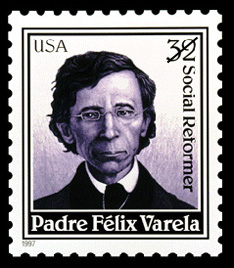
515 years after the introduction of Catholism in Cuba, there is still no Cuban saint, or, rather, the Catholic Church has yet to conclude officially that a single Cuban has met all requisites of sainthood. Since the pope recently eliminated purgatory (or limbo) that leaves only one other place for departed Cubans to moor. Of course, the Church herself admits that she does not know the identity of all her saints nor could canonize all if she did. So it is conceivable, indeed, even probable, that there might be a Cuban or two in the heavenly legions whose recognition has escaped the Church.
The most famous Cuban postulant for sainthood is the Venerable Father Félix Varela, who deserves to be not only a saint but a doctor of the Church. On his visit to Cuba in 1998 Pope John Paul II prayed before the urn containing Varela's ashes in the Great Hall of Havana University but did not canonize him. This was highly unusual because the culmination of papal visits to foreign countries was always the canonization of a native son. Cuba, which had no native saint and could have used one after decades of official atheism, was denied its most fervent wish to embrace Varela as that saint. John Paul II sprinkled the world liberally with saints, creating more in his pontificate than all previous popes in the 2000-year history of the Church. Most of the new saints were Italian (as usual), followed closely by Poles (a coincidence, no doubt) and Spaniards. John Paul II even managed to elevate 300 Japanese martyrs to sainthood, which was probably every Japanese Catholic who ever lived (we exaggerate to make a point).
But no Cuban was judged worthy of saintly investiture, not even Varela, especially not Varela, because he thought too much and wrote too much. His ashes, remember, are at the University of Havana, not the Cathedral of Havana. The Catholic Church prefers saints that don't leave a paper trail. Fray José López Pitiera, who will become the first Cuban to be beatified tomorrow in St. Peter's Square, was martyred at 25 and left behind not a single letter or note and scarcely a signature; everything was consumed in the Spanish Civil War with his life. Such a candidate is the ideal candidate for sainthood, literally heaven sent. Blind faith always trumps informed faith. That is one of the lessons of the New Testament which the Church takes most to heart.
Varela's faith and pity are beyond question, as is the heroic virtue he displayed throughtout his life. His writings have been picked apart for decades by theologians who have never been able to find even one line that deviated from Catholic dogma. He may have been canonical but he was also a humanist, and, dare I say, a freethinker. Varela was as much a child of the Enlightenment as he was a Scholastic, a patriot the same as a churchman, a Cuban no less than a Catholic. And there, as they say, is the rub. The patriot cancels out the priest. He must have been a very great patriot indeed to cancel out the exemplary priest.
Exiled from Cuba and sentenced to death by Spain for having voted at the Cortes (Spanish parlement) to depose the pig-king Ferdinand VII, Varela fled to New York, the first Cuban exile. There he eventually became Vicar General of the New York Diocese. His special apostolate was to New York's recently arrived Irish immigrants, who were as detested and persecuted in the 19th century as Hispanics are today in this country. Varela built the first Catholic schools for them (open to both sexes, for the first time); the first mutual aid society; the first orphanages; and the first parish to cater to their spiritual and material needs, in the notorious Five Corners section were most of them lived. The Irish clamored for Varela to be their bishop, but Spain vetoed his selection because Varela continued to agitate for Cuba's independence from New York, creating, through his patriotic writings, a distinctive Cuban consciousness and nationality. Martí himself journeyed to Varela's grave, then in St. Augustine, FL, to pay homage to "the man who taught us to think" and consecrate his work of liberation to him.
Some believe that it is the Spanish hierarchy which is now blocking Varela's elevation to sainthood as it once vetoed him as bishop of New York. The former home of the Inquisition could not forgive the Cuban priest who thundered against it in parlement until it was abolished; nor the relentless champion of emancipation, which would have threatened the interests of the Church in Cuba, where it was the largest private landholder. Varela wanted to purify Spain, its politics and its religion. Only if he had attacked bullfighting would he have made himself more odious to Spaniards. All these bones of contention have long been buried and forgotten. But not the animus which they provoked in reactionary elements in the Church.
So it appears that whether it is because he is too wise, too liberal, too unlike those who opposed him in life and now oppose him in death, Félix Varela will never be canonized. In short, he is too great to be a saint. Perhaps it is just as well. His country and his church must be worthy of him before they can claim him.
POSTSCRIPT:
Mi Tres Cubano said...
The most famous Cuban postulant for sainthood is the Venerable Father Félix Varela, who deserves to be not only a saint but a doctor of the Church. On his visit to Cuba in 1998 Pope John Paul II prayed before the urn containing Varela's ashes in the Great Hall of Havana University but did not canonize him. This was highly unusual because the culmination of papal visits to foreign countries was always the canonization of a native son. Cuba, which had no native saint and could have used one after decades of official atheism, was denied its most fervent wish to embrace Varela as that saint. John Paul II sprinkled the world liberally with saints, creating more in his pontificate than all previous popes in the 2000-year history of the Church. Most of the new saints were Italian (as usual), followed closely by Poles (a coincidence, no doubt) and Spaniards. John Paul II even managed to elevate 300 Japanese martyrs to sainthood, which was probably every Japanese Catholic who ever lived (we exaggerate to make a point).
But no Cuban was judged worthy of saintly investiture, not even Varela, especially not Varela, because he thought too much and wrote too much. His ashes, remember, are at the University of Havana, not the Cathedral of Havana. The Catholic Church prefers saints that don't leave a paper trail. Fray José López Pitiera, who will become the first Cuban to be beatified tomorrow in St. Peter's Square, was martyred at 25 and left behind not a single letter or note and scarcely a signature; everything was consumed in the Spanish Civil War with his life. Such a candidate is the ideal candidate for sainthood, literally heaven sent. Blind faith always trumps informed faith. That is one of the lessons of the New Testament which the Church takes most to heart.
Varela's faith and pity are beyond question, as is the heroic virtue he displayed throughtout his life. His writings have been picked apart for decades by theologians who have never been able to find even one line that deviated from Catholic dogma. He may have been canonical but he was also a humanist, and, dare I say, a freethinker. Varela was as much a child of the Enlightenment as he was a Scholastic, a patriot the same as a churchman, a Cuban no less than a Catholic. And there, as they say, is the rub. The patriot cancels out the priest. He must have been a very great patriot indeed to cancel out the exemplary priest.
Exiled from Cuba and sentenced to death by Spain for having voted at the Cortes (Spanish parlement) to depose the pig-king Ferdinand VII, Varela fled to New York, the first Cuban exile. There he eventually became Vicar General of the New York Diocese. His special apostolate was to New York's recently arrived Irish immigrants, who were as detested and persecuted in the 19th century as Hispanics are today in this country. Varela built the first Catholic schools for them (open to both sexes, for the first time); the first mutual aid society; the first orphanages; and the first parish to cater to their spiritual and material needs, in the notorious Five Corners section were most of them lived. The Irish clamored for Varela to be their bishop, but Spain vetoed his selection because Varela continued to agitate for Cuba's independence from New York, creating, through his patriotic writings, a distinctive Cuban consciousness and nationality. Martí himself journeyed to Varela's grave, then in St. Augustine, FL, to pay homage to "the man who taught us to think" and consecrate his work of liberation to him.
Some believe that it is the Spanish hierarchy which is now blocking Varela's elevation to sainthood as it once vetoed him as bishop of New York. The former home of the Inquisition could not forgive the Cuban priest who thundered against it in parlement until it was abolished; nor the relentless champion of emancipation, which would have threatened the interests of the Church in Cuba, where it was the largest private landholder. Varela wanted to purify Spain, its politics and its religion. Only if he had attacked bullfighting would he have made himself more odious to Spaniards. All these bones of contention have long been buried and forgotten. But not the animus which they provoked in reactionary elements in the Church.
So it appears that whether it is because he is too wise, too liberal, too unlike those who opposed him in life and now oppose him in death, Félix Varela will never be canonized. In short, he is too great to be a saint. Perhaps it is just as well. His country and his church must be worthy of him before they can claim him.
POSTSCRIPT:
Mi Tres Cubano said...
Well, it is not so much that he had a paper trail, but his paper trail was highly politicized and applicable for today. Whereas San Antonio María Claret, who was the Archbishop of Santiago de Cuba, left a tremendous paper trail but was careful about leaving too much of his political thoughts around.
A canonization of Varela is possible. And I pray his novena when I can, as well as pray for his beatification. The problem is that so long as Varela is used as a political weapon (particularly against castro) the Vatican will use caution in pushing his cause. Not so much because they are for or against castro, but rather, it is done to keep the focus and motive for the canonization clear. Chances are, we may see a San [Félix] Varela only after a Cuba Libre.
It is this same political weight that I bet is slowing the process for JPII down as well.
10/29/2007 2:11 AM
Manuel A.Tellechea said...
A canonization of Varela is possible. And I pray his novena when I can, as well as pray for his beatification. The problem is that so long as Varela is used as a political weapon (particularly against castro) the Vatican will use caution in pushing his cause. Not so much because they are for or against castro, but rather, it is done to keep the focus and motive for the canonization clear. Chances are, we may see a San [Félix] Varela only after a Cuba Libre.
It is this same political weight that I bet is slowing the process for JPII down as well.
10/29/2007 2:11 AM
Manuel A.Tellechea said...
mi tres cubano:
So what you are saying, in effect, is that the Vatican does not want Varela to be used as a "weapon" to win Cuba's freedom. In that case, nothing has changed in 175 years. Claret had a great advantage over Varela: he was Queen Isabel's II confessor. He was also a Spaniard. His ministry in Cuba was heroic and beneficial to the Cuban people, but he was not born in Cuba and was never really embraced by Cubans as a native saint. The same may happen with Blessed Fray José López Pitiera, who although born in Cuba returned to Spain with his parents at age 5 and never saw Cuba again. Of course, if he had returned to Cuba or availed himself of his Cuban citizenship, he would not be a martyr.
I disagree with you in respect to John Paul II's canonization. He is definitely on the "fast track." In his case, the Church does want to use his popularity on her own behalf. If Princess Diana had been a Catholic (which, of course, was legally impossible as the wife of the heir apparent to the British throne), she may just have beaten the late pope to sainthood. After all, there are now more Catholics in England and Scotland than Anglicans for the first time since Henry VIII split the Church.
As for John Paul II, I hope the Vatican will consider his praise of "Che" Guevara when debating his cause. Of course, they never took into consideration Mother Teresa's praise of Castro.
While declining to beatify Varela, John Paul II did beatify Pope Pius IX, who blessed the Spanish troops that fought against the mambises and called theirs (the Spaniards') a "holy cause."
John Paul gave a "push" to practically all his immediate papal predecessors on the road to sainthood except the one who was unquestionably a saint and wellspring of miracles — Pope Pope Pius XII. Although John Paul II believed in Pius XII's cause above all others, he did not have the moral courage to advance it and confront so such calumny and vilification. The sun left its orbit in Pius XII's presence but that was not enough to overcome the world's obliquity.
Sainthood today has become a funtion (or weapon) of Vatican politics. Maybe it always was.
So what you are saying, in effect, is that the Vatican does not want Varela to be used as a "weapon" to win Cuba's freedom. In that case, nothing has changed in 175 years. Claret had a great advantage over Varela: he was Queen Isabel's II confessor. He was also a Spaniard. His ministry in Cuba was heroic and beneficial to the Cuban people, but he was not born in Cuba and was never really embraced by Cubans as a native saint. The same may happen with Blessed Fray José López Pitiera, who although born in Cuba returned to Spain with his parents at age 5 and never saw Cuba again. Of course, if he had returned to Cuba or availed himself of his Cuban citizenship, he would not be a martyr.
I disagree with you in respect to John Paul II's canonization. He is definitely on the "fast track." In his case, the Church does want to use his popularity on her own behalf. If Princess Diana had been a Catholic (which, of course, was legally impossible as the wife of the heir apparent to the British throne), she may just have beaten the late pope to sainthood. After all, there are now more Catholics in England and Scotland than Anglicans for the first time since Henry VIII split the Church.
As for John Paul II, I hope the Vatican will consider his praise of "Che" Guevara when debating his cause. Of course, they never took into consideration Mother Teresa's praise of Castro.
While declining to beatify Varela, John Paul II did beatify Pope Pius IX, who blessed the Spanish troops that fought against the mambises and called theirs (the Spaniards') a "holy cause."
John Paul gave a "push" to practically all his immediate papal predecessors on the road to sainthood except the one who was unquestionably a saint and wellspring of miracles — Pope Pope Pius XII. Although John Paul II believed in Pius XII's cause above all others, he did not have the moral courage to advance it and confront so such calumny and vilification. The sun left its orbit in Pius XII's presence but that was not enough to overcome the world's obliquity.
Sainthood today has become a funtion (or weapon) of Vatican politics. Maybe it always was.
Anyone Leary of Jimmy Carter's "Leary UFO?"

President Jimmy Carter reported that he saw a UFO above Leary, Ga., in 1969. He filed a report about the sighting to the International UFO Bureau and the National Investigations Committee on Aerial Phenomena in 1973 [click on picture to view actual report].
If this had been known in 1976, Jimmy Carter would not have been elected president.
Today, it helps to explain everything.
If this had been known in 1976, Jimmy Carter would not have been elected president.
Today, it helps to explain everything.
This is one of our Jimmy Carter filler posts, which we insert when we are going to proceed from a light to a serious subject. Expect a very serious post forthcoming.
Friday, October 26, 2007
Of "Che" Guevara's Hair and Napoleon's Penis

Gustavo Villoldo has had his payday at long last and I couldn't be happier for him. If everything else has been commercialized about "Che" Guevara, why not his goldilocks? The old freedom fighter will receive $100,000 (minus commission) for a tress of "Che" Guevara's hair which Villoldo snipped 40 years ago before burying the serial killer. The hair was offered by Heritage Auctions of Dallas, TX, which said there had been only one bidder for "Che's" hair, who won it at the reserve price. It's good to know that there is only one person in this world fool enough to bid for it. "Che's" greatest dupe is a Dallas bookseller named Bill Butler (there goes your 15 seconds). There's a sucker born every minute and since 1963 spawning suckers has been Dallas' major industry. Well, enjoy the hair, Bill. Villoldo will enjoy the 100,000 bills. He can also tell you, for a price, where the head to which the hair was once attached is buried, and it isn't in "Che" Guevara's mausoleum in Santa Clara, Cuba. If you are interested, Bill. Personally, I wouldn't mind having "Che's" skull on my desk. Although I don't smoke, I would take up the habit in his honor. I can also think of other uses less decorous than an ashtray. The people who would call me a monster — but would never call "Che" one — don't read this blog.
Pity Villoldo wasn't more creative. He might be taking home a million dollar check rather than $100,000. There was so much more that he could have snipped from the corpse of "Che" Guevara, who, contrary to his statement upon being apprehended, was worth more to his captors dead than alive.
The priest who administered last rites to Napoleon, Abbé Vignoli, snipped (or purloined) the "Little Corporal's" penis (that's all I'll say on the subject) in the course of the autopsy practiced on him by his personal physician, Dr. Francesco Antomarcchi. Napoleon's manservant, Ali, admitted in his Memoirs, published in the Revue de mondes, in 1852, that Vignoli and him had removed "bits of Napoleon" during his autopsy as "souvenirs." What a souvenir! "Look, do you see that in my curio cabinet, it's Napoleon's penis, really!" The appendage was been compared to a maltreated piece of leather shoelace or a shrivelled eel (defenders of the Imperial honor contend that only a part of it was removed).
Napoleon's dessicated penis was sold by Vignoli's heirs for $2000 in 1916 to a Philadelphia bibliophile, A.S.W. Rosenbach, who displayed it for years at the Museum of French Art, in New York. It was last put under the gavel (so to speak) at a Paris auction house in 1977. The winning bidder was John Kingsley Lattimer, professor emeritus and former chairman of the department of urology at the Columbia University College of Physicians and Surgeons. He paid $38,000 for Napoleon's pride.
Professor Lattimer had an interesting history himself. He was the attending physician to the defendents at the Nuremberg War Crimes Trials. He also owned Lincoln's bloodstained collar and the glass ampoule that contained the dose of cyanide used by Hermann Goring to cheat the hangman (if Goring's penis is missing, they know where to look). He authored books on Lincoln's assassination and JFK's. His interest in Napoleon's penis was not merely professional; he believed that Napoleon, too, had been assassinated, poisoned by his personal physician at the orders of his British jailers (I wonder if they used cyanide too; no, probably arsenic).
The distinguished Dr. Lattimer, who discovered a cure for renal tuberculosis and is the father of pediatric urology, died earlier this year at the age of 92. Napoleon's penis is now owned by the doctor's daughter. It is the first time since Napoleon's death that a woman has owned Napoleon's penis. This unique item of napoleona now resides with its owner in Englewood, N.J.
The largest collection of Napoleon artifacts, sans the imperial penis, was assembled by the Cuban sugar magnate Julio Lobo, a Jewish-Cuban who admired the French emperor because he had enfranchised the Jews. His collection was confiscated by Fidel Castro at the triumph of the Revolution. It now is exhibited (what's left of it) at Havana's Napoleonic Museum. Napoleon's personal pistols, perhaps the most valuable item in the collection, were presented by Fidel Castro to Leonid Brezhnev.
Pity Villoldo wasn't more creative. He might be taking home a million dollar check rather than $100,000. There was so much more that he could have snipped from the corpse of "Che" Guevara, who, contrary to his statement upon being apprehended, was worth more to his captors dead than alive.
The priest who administered last rites to Napoleon, Abbé Vignoli, snipped (or purloined) the "Little Corporal's" penis (that's all I'll say on the subject) in the course of the autopsy practiced on him by his personal physician, Dr. Francesco Antomarcchi. Napoleon's manservant, Ali, admitted in his Memoirs, published in the Revue de mondes, in 1852, that Vignoli and him had removed "bits of Napoleon" during his autopsy as "souvenirs." What a souvenir! "Look, do you see that in my curio cabinet, it's Napoleon's penis, really!" The appendage was been compared to a maltreated piece of leather shoelace or a shrivelled eel (defenders of the Imperial honor contend that only a part of it was removed).
Napoleon's dessicated penis was sold by Vignoli's heirs for $2000 in 1916 to a Philadelphia bibliophile, A.S.W. Rosenbach, who displayed it for years at the Museum of French Art, in New York. It was last put under the gavel (so to speak) at a Paris auction house in 1977. The winning bidder was John Kingsley Lattimer, professor emeritus and former chairman of the department of urology at the Columbia University College of Physicians and Surgeons. He paid $38,000 for Napoleon's pride.
Professor Lattimer had an interesting history himself. He was the attending physician to the defendents at the Nuremberg War Crimes Trials. He also owned Lincoln's bloodstained collar and the glass ampoule that contained the dose of cyanide used by Hermann Goring to cheat the hangman (if Goring's penis is missing, they know where to look). He authored books on Lincoln's assassination and JFK's. His interest in Napoleon's penis was not merely professional; he believed that Napoleon, too, had been assassinated, poisoned by his personal physician at the orders of his British jailers (I wonder if they used cyanide too; no, probably arsenic).
The distinguished Dr. Lattimer, who discovered a cure for renal tuberculosis and is the father of pediatric urology, died earlier this year at the age of 92. Napoleon's penis is now owned by the doctor's daughter. It is the first time since Napoleon's death that a woman has owned Napoleon's penis. This unique item of napoleona now resides with its owner in Englewood, N.J.
The largest collection of Napoleon artifacts, sans the imperial penis, was assembled by the Cuban sugar magnate Julio Lobo, a Jewish-Cuban who admired the French emperor because he had enfranchised the Jews. His collection was confiscated by Fidel Castro at the triumph of the Revolution. It now is exhibited (what's left of it) at Havana's Napoleonic Museum. Napoleon's personal pistols, perhaps the most valuable item in the collection, were presented by Fidel Castro to Leonid Brezhnev.
Picture: not Napoleon's penis, but claimed as Rasputin's.
Fierce and Fiery Me
From The Not Silent blog:
Belated thanks to Manuel Tellechea
Manuel is a fierce and fiery Cuban-American blogger who isn't afraid to tell it like he sees it, no matter who he's talking about. His blog has alienated some elements of we the exile community, but I as a Libertarian truly appreciate his concern first and foremost with the will of the Cuban people still stranded on the island.
It was with surprise that I realized that he wrote up my post on Joe Cubas from a few weeks ago and gave me some nice props. That was cool, especially since I mostly blog to get my music to people. But I had to rant about that one issue.
Gracias, Mr. T.
Posted by Julio Rey at 12:55 PM, October 25, 2007
Thank-you, Julio. "Honrar, honra," as Baltasar Gracián said (Martí was quoting him).
I am "fierce and fiery" with the enemies of our country and those who serve their interests, knowingly or not; but kind and gentle with Castro's victims, especially the youngest among them. Yes, that is me. And, although, as Julio Rey correctly says in his thank-you note, my "blog has alienated some elements of the exile community," I don't aim to be everybody's darling: the fact that they are wrong and I am right is enough for me.
I invite you visit Julio Rey's blog, especially if music is any part of your life. Julio is one of the few Cuban bloggers to have defended Elenita and deserves everybody's thanks for it.
http://juliorey.blogspot.com/
Belated thanks to Manuel Tellechea
Manuel is a fierce and fiery Cuban-American blogger who isn't afraid to tell it like he sees it, no matter who he's talking about. His blog has alienated some elements of we the exile community, but I as a Libertarian truly appreciate his concern first and foremost with the will of the Cuban people still stranded on the island.
It was with surprise that I realized that he wrote up my post on Joe Cubas from a few weeks ago and gave me some nice props. That was cool, especially since I mostly blog to get my music to people. But I had to rant about that one issue.
Gracias, Mr. T.
Posted by Julio Rey at 12:55 PM, October 25, 2007
Thank-you, Julio. "Honrar, honra," as Baltasar Gracián said (Martí was quoting him).
I am "fierce and fiery" with the enemies of our country and those who serve their interests, knowingly or not; but kind and gentle with Castro's victims, especially the youngest among them. Yes, that is me. And, although, as Julio Rey correctly says in his thank-you note, my "blog has alienated some elements of the exile community," I don't aim to be everybody's darling: the fact that they are wrong and I am right is enough for me.
I invite you visit Julio Rey's blog, especially if music is any part of your life. Julio is one of the few Cuban bloggers to have defended Elenita and deserves everybody's thanks for it.
http://juliorey.blogspot.com/
Notable & Stupid: Did You Know "Granma" Ignores the Opposition?

"On TV, 15 minutes worth of the speech were aired followed by 45 minutes of criticism of it. In print, all of the coverage is of course negative toward the president's remarks. Notice that they don't quote Guillermo Fariñas or Martha Beatriz Roque in Granma." — Henry Gómez, commenting on the state media's coverage of President Bush's speech on Cuba, Babalú blog, October 26, 2007
You don't say! They don't quote Fariñas or Roque in Granma? Who would have thought it!
You don't say! They don't quote Fariñas or Roque in Granma? Who would have thought it!
Notable & More Delusional Still: "Patrick Henry" Prieto Rides Again

"Freedom isn't going to knock on [the Cubans'] doors and ask to come in. It isn't going to arrive in a package from Hialeah or in the suitcase of a family member coming from abroad. Freedom is going to hide behind hunger. It's going to hide behind pain, it's going to hide behind sacrifice. It's going to hide behind bruises and in a pool of blood. And it's only going to be found when it is painstaking[ly] sought after, sought after with extreme hunger and empty bellies, with broken bones and bloody hands and with sheer desperation. There are 11 million people in Cuba, yet you see merely a handful standing firm in their convictions and against their government. Until that handful exponentially increases, not a damned thing will change." — Val Prieto, judging the Cuban people and passing sentence on them, Babalu blog, October 25, 2007
The rhetoric is worthy of Patrick Henry; the sentiments are not. Patrick Henry said: "Give me liberty or give me death." Val Prieto says: "Give me liberty or give them death." The "them" are the Cuban people.
While starving Cubans "with broken bones and bloody hands" are heroically confronting an enemy with its guns, tanks and bomber planes, Val Prieto will, no doubt, be blogging about it with bloody stumps for fingers. He may even decline an extra beer (although that may be taking patriotism too far).
Meanwhile, the Cuban people are a perpetual source of disappointment to Val. He believes himself to be deserving of another people, a braver people, a better people; one willing to throw themselves into the void in order that he may cross it.
I, on the other hand, am of the opposite opinion. I believe the Cuban people are deserving of a better Val. This Val has no right to judge them.
POSTSCRIPT:
Response to an Anonymous Commenter
I always try to fit what I write to the occasion. I did so when I wrote this post. The presumptiousness and arrogance of Val's comments on the courage (or, rather, the lack of courage) of the Cuban people deserved and received the response it got. 4000 Americans died in the American Revolution. More than a half-million Cubans died in Cuba's 19th-century wars of independence. To suggest that the descendents of the mambises lack courage is a canard. What they lack is opportunity. Two superpowers connived to enslave them for 30 years, and now a lunatic vent on succeeding Castro underwrites his machinery of repression. A people cannot rise in arms that has no arms; nor can they oppose tanks with fists. It was tried in Budapest in 1956; in Prague in 1968; and Tiananmen Square in 1989. It didn't work. In the past, Communism has been defeated in only 4 ways: a military mutiny as in the case of Spain (1936-39) and Chile (1973); direct U.S. intervention as in Greece (1948) and the Dominican Republic (1965); indirect U.S. intervention as in Central America and Afghanistan (1980s); or the internal implosion of the Communist system.
No mass uprising against a Communist regime has ever succeeded in a vacuum. It was the collapse of the Soviet Union that allowed the Eastern bloc countries to challenge their satraps and recover their long-lost freedom and independence. Without the collapse of the Soviet Union, Solidarity and Pope John Paul II would have been as helpless in the face of a Soviet invasion as their ancestors were in 1939 when the Polish cavalry gallantly (and hopelessly) charged Stalin's and Hitler's tanks.
This is what makes the present situation so difficult for Cubans to overcome. The regional hagemon (the U.S.) is perfectly content with Communism in Cuba; it reached an accomodation with Castro a long time ago and fears a post-Castro Cuba more than it does the Castro regime. Any regime, Communist or not, that can contain its citizens within its own borders has the nominal support of the U.S., and it appears that for now and the foreseeable future, only Castro will be able to be America's policeman in Cuba as the U.S. is his policeman on the high seas. The repatriation at gunpoint of fleeing refugees under the "Wet Foot/Dry Foot" policy has literally brought that fact home to all Cubans.
The Cuban people, who are given too little credit by Val & Co., know their neighbor well and will not so much as throw a stone until they are sure that the U.S. is no longer the guarantor of Communism in Cuba as it has been since the days of the Kennedy-Khrushchev Pact (1962). It was not the Soviet Union that was an obstacle to freedom in Cuba. That is obvious now. It could not have saved its backwater client-state at such a remove from it, or under the nose of the U.S. were the U.S. disinclined to allow it. The real obstacle to Cuban freedom is and has always been the United States.
If the U.S. ever decides to stop propping up Castro, dispenses with the empty rhetoric and confronts the enemy within its doors — the long-announced and now consummated spread of Castroism to South America — then and only then will the Cuban people be prepared to sacrifice as their forebears sacrificed to obtain the freedom of which they were robbed in 1959 and not just by Castro.
The rhetoric is worthy of Patrick Henry; the sentiments are not. Patrick Henry said: "Give me liberty or give me death." Val Prieto says: "Give me liberty or give them death." The "them" are the Cuban people.
While starving Cubans "with broken bones and bloody hands" are heroically confronting an enemy with its guns, tanks and bomber planes, Val Prieto will, no doubt, be blogging about it with bloody stumps for fingers. He may even decline an extra beer (although that may be taking patriotism too far).
Meanwhile, the Cuban people are a perpetual source of disappointment to Val. He believes himself to be deserving of another people, a braver people, a better people; one willing to throw themselves into the void in order that he may cross it.
I, on the other hand, am of the opposite opinion. I believe the Cuban people are deserving of a better Val. This Val has no right to judge them.
POSTSCRIPT:
I always try to fit what I write to the occasion. I did so when I wrote this post. The presumptiousness and arrogance of Val's comments on the courage (or, rather, the lack of courage) of the Cuban people deserved and received the response it got. 4000 Americans died in the American Revolution. More than a half-million Cubans died in Cuba's 19th-century wars of independence. To suggest that the descendents of the mambises lack courage is a canard. What they lack is opportunity. Two superpowers connived to enslave them for 30 years, and now a lunatic vent on succeeding Castro underwrites his machinery of repression. A people cannot rise in arms that has no arms; nor can they oppose tanks with fists. It was tried in Budapest in 1956; in Prague in 1968; and Tiananmen Square in 1989. It didn't work. In the past, Communism has been defeated in only 4 ways: a military mutiny as in the case of Spain (1936-39) and Chile (1973); direct U.S. intervention as in Greece (1948) and the Dominican Republic (1965); indirect U.S. intervention as in Central America and Afghanistan (1980s); or the internal implosion of the Communist system.
No mass uprising against a Communist regime has ever succeeded in a vacuum. It was the collapse of the Soviet Union that allowed the Eastern bloc countries to challenge their satraps and recover their long-lost freedom and independence. Without the collapse of the Soviet Union, Solidarity and Pope John Paul II would have been as helpless in the face of a Soviet invasion as their ancestors were in 1939 when the Polish cavalry gallantly (and hopelessly) charged Stalin's and Hitler's tanks.
This is what makes the present situation so difficult for Cubans to overcome. The regional hagemon (the U.S.) is perfectly content with Communism in Cuba; it reached an accomodation with Castro a long time ago and fears a post-Castro Cuba more than it does the Castro regime. Any regime, Communist or not, that can contain its citizens within its own borders has the nominal support of the U.S., and it appears that for now and the foreseeable future, only Castro will be able to be America's policeman in Cuba as the U.S. is his policeman on the high seas. The repatriation at gunpoint of fleeing refugees under the "Wet Foot/Dry Foot" policy has literally brought that fact home to all Cubans.
The Cuban people, who are given too little credit by Val & Co., know their neighbor well and will not so much as throw a stone until they are sure that the U.S. is no longer the guarantor of Communism in Cuba as it has been since the days of the Kennedy-Khrushchev Pact (1962). It was not the Soviet Union that was an obstacle to freedom in Cuba. That is obvious now. It could not have saved its backwater client-state at such a remove from it, or under the nose of the U.S. were the U.S. disinclined to allow it. The real obstacle to Cuban freedom is and has always been the United States.
If the U.S. ever decides to stop propping up Castro, dispenses with the empty rhetoric and confronts the enemy within its doors — the long-announced and now consummated spread of Castroism to South America — then and only then will the Cuban people be prepared to sacrifice as their forebears sacrificed to obtain the freedom of which they were robbed in 1959 and not just by Castro.
Thursday, October 25, 2007
Notable & More Delusional: George Bush Is the Greatest "Cuban" Patriot

"So, you can criticize the President of the United States for dedicating a 40-minute speech to Cuba and not mentioning certain things, but, if you're going to do that, you better start at home first, brother. Because from where I stand, President Bush has done more up to right now for the freedom of the Cuban people than most of the Cuban people have done themselves." — Val Prieto, Babalú blog, October 25, 2007
Oh, my god, GW has replaced Gloria Estefan as the greatest Cuban patriot. You will all remember that Val Prieto said 7 months ago that the Estefans have done more for Cuban freedom than any of us ever has or will. That, of course, was before Val allowed them to be called "traitors" on Babalú blog because Emilio had not followed up on an invitation to "do lunch." Well, now Val has another candidate for super Cuban patriot uber alles, and he isn't even Cuban except in his mighty Cuban-loving heart — President George Bush II, who, in Val's estimation, "has done more up to right now for the freedom of the Cuban people than most of the [11 million] Cuban people have done themselves." Wow. Perhaps we should all fall at his feet as the Aztecs fell at Cortez's. Wait, Val already has.
Oh, my god, GW has replaced Gloria Estefan as the greatest Cuban patriot. You will all remember that Val Prieto said 7 months ago that the Estefans have done more for Cuban freedom than any of us ever has or will. That, of course, was before Val allowed them to be called "traitors" on Babalú blog because Emilio had not followed up on an invitation to "do lunch." Well, now Val has another candidate for super Cuban patriot uber alles, and he isn't even Cuban except in his mighty Cuban-loving heart — President George Bush II, who, in Val's estimation, "has done more up to right now for the freedom of the Cuban people than most of the [11 million] Cuban people have done themselves." Wow. Perhaps we should all fall at his feet as the Aztecs fell at Cortez's. Wait, Val already has.
Notable & Delusional: "How Rare Was Your Presidency, George Bush II"

"Yes, he [Bush II] spent too much in his first term; yes, he had steel tariffs in place for about two seconds; yes, the prescription-drug benefit is sketchy; yes, there have been mistakes on the war; yes, Harriet Miers — etc., etc. But do you realize how rare this president is? If you don’t now — I have a feeling you will later." — Val Prieto, reacting to President Bush's speech on Cuba, Babalú blog, October 25, 2000
Yes, yes, yes, Bush has been a rare president from Day 1, America's first illiterate president (despite a Yale education or maybe because of it). But he sure can give a mean speech about Cuba on the eve of another election if the hard words are spelt phonetically. But words are meaningless (even when pronounced correctly) if they are not backed by the right actions. And, in respect to Cuba, Bush's actions have all been detrimental to Cuban freedom, from enforcing Clinton's "Wet Foot/ Dry Foot" policy (which he could have rescinded by presidential fiat) to gutting the embargo on the Cuban regime while instituting a new embargo against the Cuban people, denying them the assistance of their relatives and seeking further to separate the Cuban family. These are things that only Castro did in the past.
Val, of course, has always worshipped at the burning Bush. Yes, he has strayed on a few occasions lately, but it takes very little to bring him back to the fold: an invitation to a conference call from the White House, or a few honeyed words and empty symbolism are enough to convince him that no American president ever understood the Cuban people better or cared more about them. The same was once said about Ronald Reagan. And then we found out that he sent General Vernon Waters on a secret mission to Cuba to promote détente with the Castro regime while (successfully) repudiating détente with the Soviet Union. Maybe that's the reason that Russia is free today and Cuba is not. I wonder how many special missions Bush II has sent to Cuba with the same directive. We will find out shortly. When he leaves office.
Yes, yes, yes, Bush has been a rare president from Day 1, America's first illiterate president (despite a Yale education or maybe because of it). But he sure can give a mean speech about Cuba on the eve of another election if the hard words are spelt phonetically. But words are meaningless (even when pronounced correctly) if they are not backed by the right actions. And, in respect to Cuba, Bush's actions have all been detrimental to Cuban freedom, from enforcing Clinton's "Wet Foot/ Dry Foot" policy (which he could have rescinded by presidential fiat) to gutting the embargo on the Cuban regime while instituting a new embargo against the Cuban people, denying them the assistance of their relatives and seeking further to separate the Cuban family. These are things that only Castro did in the past.
Val, of course, has always worshipped at the burning Bush. Yes, he has strayed on a few occasions lately, but it takes very little to bring him back to the fold: an invitation to a conference call from the White House, or a few honeyed words and empty symbolism are enough to convince him that no American president ever understood the Cuban people better or cared more about them. The same was once said about Ronald Reagan. And then we found out that he sent General Vernon Waters on a secret mission to Cuba to promote détente with the Castro regime while (successfully) repudiating détente with the Soviet Union. Maybe that's the reason that Russia is free today and Cuba is not. I wonder how many special missions Bush II has sent to Cuba with the same directive. We will find out shortly. When he leaves office.
Notable & Quotable: When Popularity Supplants Humanity
"There have always been people willing to trade their best level as performers for their lowest level as human beings." — Alex of Stuck on the Palmetto, from "A Bigot Finds her Ratings," October 25, 2007.
I wonder if Alex was thinking of Rick.
Rick is no different from Fort Lauderdale radio show host Joyce Kaufman, the real subject of Alex's post. Both are after the ratings. An increase in listeners translates into more dollars for Kaufman. An increase in visitors to his blog translates into a bigger ego for Rick. At least Kaufman gets something tangible for selling her soul to the xenophobes. Rick is satisfied with a vigorous rubbing to his ego.
Alex forgets to mention that the bigotted Kaufman is herself Hispanic. Her mother is Puerto Rican. At least Rick hates outside of his ethnic group.
I wonder if Alex was thinking of Rick.
Rick is no different from Fort Lauderdale radio show host Joyce Kaufman, the real subject of Alex's post. Both are after the ratings. An increase in listeners translates into more dollars for Kaufman. An increase in visitors to his blog translates into a bigger ego for Rick. At least Kaufman gets something tangible for selling her soul to the xenophobes. Rick is satisfied with a vigorous rubbing to his ego.
Alex forgets to mention that the bigotted Kaufman is herself Hispanic. Her mother is Puerto Rican. At least Rick hates outside of his ethnic group.
The Last Quackeries of a Lame Duck President
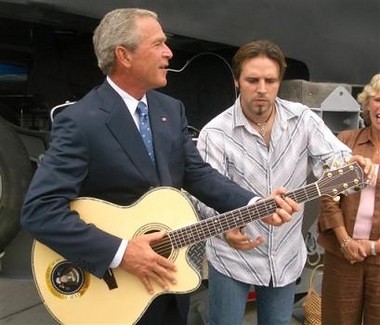
If you are interested in a dissection of Bush's speech yesterday on Cuba, Charlie Bravo has provided an excellent one at Killcastro and Henry Gómez an absolutely appalling one at Babalú. Take your pick.
As for me, I refuse to comment on the last quackeries of a lame duck president who has done nothing in the course of 7 years to advance the cause of Cuban freedom, and, by enforcing the "Wet Foot/Dry Foot" policy longer even than Clinton, turned back the clock on the Civil War and turned this country again into a slaver and scourge of men.
Let him be forgotten; or, rather, remembered as the worst president in this country's history, excepting JFK and Carter.
As for me, I refuse to comment on the last quackeries of a lame duck president who has done nothing in the course of 7 years to advance the cause of Cuban freedom, and, by enforcing the "Wet Foot/Dry Foot" policy longer even than Clinton, turned back the clock on the Civil War and turned this country again into a slaver and scourge of men.
Let him be forgotten; or, rather, remembered as the worst president in this country's history, excepting JFK and Carter.
Wednesday, October 24, 2007
Notable & Stupefying: Antonio Maceo Demoted to Colonel by Congresswoman Ros-Lehtinen

"Just as Colonel Antonio Maceo battled tirelessly for Cuba’s independence against the Spaniards, Dr. Biscet is the “Titan de Bronze” of our generation of freedom fighters against the Castro regime. No longer wielding the machetes of Colonel Maceo’s time, Dr. Biscet has replaced physical force with peaceful strength, yet the battle remains the same." — Congresswoman Iliana Ros-Lehtinen (R-FL), petition nominating Cuban human rghts activist Dr. Oscar Elias Biscet for the Presidential Medal of Freedom, National Review Online, October 24, 2007
Credit goes to our friend Charlie Bravo of Killcastro blog for discovering this gem. There are moments in life when heaven sends down a lightning bolt that illuminates everything for us. This is such a moment. If we fail to see what Charlie is pointing out to us we shall deserve whatever fate befalls us in the future:
Yes, Antonio Maceo was once a Colonel. He rose through the ranks quickly, with heroism and gallantry, with the chilvalry of men of honor in arms. Antonio Maceo earned his General's stars during the first independence war exactly in 1873, before he was knicknamed "El Titán de Bronce" [the Colossus of Bronze] by the Cubans and "El León Mayor" [the Lion of the Pride] by the Spaniards. Comparing Dr. Biscet to Antonio Maceo could seem like a great idea. But though both men are examples of bravery and dedication to the freedom of Cuba, the comparison is simply not just for either of them. There was only one Antonio Maceo y Grajales and there is only one Dr. Oscar Elias Biscet. Each one is unique, each one is a unique a representative of two different struggles, with the common objective of the liberation of Cuba [...]. I hope she reads a Cuban history book, and I hope she calls President Bush to reject and eliminate the unjust "Dry Foot/ Wet Foot" policy, and to order the Coast Guard to assist and rescue the Cuban refugees on the high seas, instead of becoming an extension of the Cuban Coast Guard and be the ones used by Castro for offshoring and outsourcing his repressive ways."
Bravo, Charlie!
Is there any other Cuban above the age of 5 who doesn't know that Maceo was a general? And the woman is hardly a child.
Why does she compare Maceo to Biscet? Why not to Martí? Biscet is not a warrior. Neither was Martí. No doubt Biscet would become a soldier, as Martí did, to defend his country in the hour of her redemption. But Biscet is not in any way a military man, much less the military genius that Maceo was. And, honestly, much as we admire and support Dr. Biscet, he is not and should never be expected to be another Maceo. Such a comparison is not a compliment; no man, not even Biscet, can withstand it, and I am sure that Biscet himself would be the first to reject it. Such a man as Maceo is sui generis; beyond comparison, and, indeed, had he not actually lived, beyond imagining.
The only reason Ros-Lehtinen compared the two is because they are both men of color, the worst reason to compare them. What does that have to do with anything? What an embarrassment, ignoring the essential and focusing on the superficial, and, in the process, disrespecting both men.
Really, words fail before such an enormity.
But words must be found.
No one with such an abysmal ignorance of our history should be allowed to represent our interests in Washington, or anywhere else; much less have any imput in deciding the future of our country (I mean Cuba), which as a U.S. congressman she should not presume to do in any case. There will be men and woman enough to be the future leaders of our country who know whom Antonio Maceo was and what he represents to our people, alongside Martí, the highest peaks of our nationality, a natural phenomenon that cannot be repeated in our country or any country: el lugarteniente.
Blessed Fray José López Piteira, Catholic Martyr and Cuban

On Sunday, October 28, 2007, in Vatican Square, the first native born Cuban will be beatified by Pope Benedict XVI, the last step on the road to sainthood and the fartherest that any Cuban has ever gotten on that road. His name is José López Piteira, born on February 2, 1912, in the town of Jatibonico, Camaguey Province. He was ordained a deacon on September 8, 1935, the feast of Our Lady of Charity, patroness of Cuba. He died a martyr for the faith at the hands of the Communists, killed not in Cuba but in Spain, during its Civil War (1936-39). He was 24 years old, the youngest of 50 Augustinian monks from the El Escorial Monastery to be executed at the orders of Santiago Carrillo, the political commissar of Madrid personally responsible for the murder of 3000 priests, nuns and other religious. They were variously crucified, burnt at the stake, or, as in the case of Fray José and his companions, shot by firing squad, at Paracuellos de Jarama, November 30, 1936. Yes, in the 20th century; within living memory; only 70 years ago. He did not have to die. He was a Cuban citizen and could have saved himself by invoking his nationality, but he refused to abandon his brothers in Christ and insisted on sharing their fate.
His last words, all too familiar to another generation of Cubans, were ¡Viva Cristo Rey!
His last words, all too familiar to another generation of Cubans, were ¡Viva Cristo Rey!
Fray José will be beatified along with 495 other martyrs of the Spanish Civil War. This will be the largest beatification in the 2000-year history of the Church. Although the pope does not personally officiate at beatifications anymore, he will do so this time to punctuate the importance of this occasion and the Church's displeasure with the historical revisionism of Spain's governing Socialist Party, political allies and heirs to the killers of Blessed Fray José López Piteira and the other martyrs for the faith.
The declaration by the pope as head of the Church that one of its communicants has lived a saintly life as a believer or died a heroic death as a martyr and is dwelling in the happiness of heaven. (Yes, there is now a Cuban in heaven!). Those who have been declared Blessed are entitled to veneration by the faithful. Prayers may be raised to them; their images may be placed in churches and their feast days celebrated, especially in localities and orders associated with their lives. The difference between saints and the blessed is that saints are not merely entitled to local veneration, but must be venerated by the Universal Church. For one who is Blessed to be canonized (declared a saint) two miracles must be attributed to his intercession. God willing, perhaps the first miracle that Blessed Fray José will perform will be the liberation of Cuba from Communism.

Tuesday, October 23, 2007
The Voyage of the "St. Louis" (1939): FDR's "Hour of Infamy" (Among Many)

[If you are wondering what I've been doing today, I have been fighting demons at Klotz As In Blood, where a discussion on the "Wet Foot/Dry Foot" policy and whether Mexicans can pass as Cubans (watch Cane for the answer) suddenly metamorphosed into a "serves them right" argument against Cuban refugees because 68 years ago their Jewish counterparts on the "St. Louis" were denied entry to Cuba. Very few nations in the 1930s welcomed refugees. It was a time of worldwide depression and immigrants were regarded as just more mouths at a barren table. Imagine, if you will, the rabid xenophobia which Mexicans endure in this country today at a time of relative prosperity and multiply that one-hundred fold and you will get some faint idea of the hostility with which most immigrants were met in the pre-war period. One group of refugeees, the Jews, were literally escaping for their lives. The U.S. government and the media, however, did not acknowledge that fact. The New York Times, for example, did not report on the Holocaust until the first concentration camp was liberated. Even then it never apologized for failing to report the plight of the Jews when it was still possible to save their lives. And The Times' owners, the Ochs-Sulzbergers, of course, were Jews. The plight of the Jews, in fact, was not appreciated in its true dimensions by anyone. They were regarded as indescript immigrants requiring no special dispensation, or, indeed, consideration.
One of the few nations to open its doors to Jewish refugees in the pre-war period was Cuba. Most came to Cuba because it was easier to be admitted to Cuba than to the United States, and also because there was no better conduit to the United States than Cuba. Thousands arrived on the island before 1939. It was with that expectation that the beleaguered passengers of the "St. Louis" sailed to Cuba in 1939. Their journey, however, was to be like no other before or since ...]
Dave Says:
October 18th, 2007 at 6:41 am
... In the 1940s [1939] a whole shipload of Jews were sent back by Havana to Germany [to Europe, not Germany] to their most certain death [more than two-thirds survived World War II]. Every country on this planet has sent back refugees to horrific situations without any remorse. Why is anyone surprised?
Manuel A. Tellechea Says:
October 22nd, 2007 at 12:27 pm
Dave:
It wasn’t the Cubans who sent the Jewish refugees on the St. Louis back to Europe and an uncertain future in countries soon to be overrun by Hitler. It was FDR. He refused to allow the ship to dock in the U.S.; in fact, he turned it away when it tried. Knowing that its Jewish passengers would use Cuba as a conduit to enter the U.S., FDR ordered the Cuban government not to accept them either. FDR was then running for his 3rd term and he did not want to antagonize the xenophobes and Jew-haters which at that time constituted a sizable percentage (perhaps a majority) of both parties.
Prior to the St. Louis, Cuba had admitted more refugees from Fascism than had any other country in the Western Hemisphere, a total of more than 300,000. CUBA WITH A POPULATION OF LESS THAN 5 MILLION ADMITTED IN RAW NUMBERS MORE REFUGEES DURING THE 1930s THAN DID THE U.S. WITH A POPULATION OF 170 MILLION. Most of these refugees were Spaniards fleeing Fascism or Communism during the Spanish Civil War, but the total also included 8000 Jewish refugees from Naziism.
Bang Bang Lulu Says:
October 22nd, 2007 at 3:35 pm
There goes Tellechea rewriting history to soothe his fascist soul. FDR had nothing to do with what happened to the St. Louis in Cuba. There was a scam run by the immigration czar, Manuel Benitez, that cleaned out whatever little resources the desperate refugees had. After they stole what they could, they sent the ship to hell.
FDR, caving in to isolationists and anti-immigration forces in the US, didn’t intervene even when the St Louis approached Florida. He came up small.
If Tellechea can point me to evidence that FDR was behind the atrocious Cuban conduct in this international scandal, I’ll read it. Otherwise it’s just some little apologist ducking responsibility for unforgivable and in this case racist behavior, which the Cubans are pretty good at.
Wire Pallladin Says:
October 22nd, 2007 at 8:24 pm
I thought the St. Louis set out for Cuba as its original destination, not the US. It was only after Cuba refused to let it land that it headed for Florida, where it was also refused. That story in #6 is just wrong. Typical Castro-type distortion.
Manuel A. Tellechea Says:
October 23rd, 2007 at 10:14 am
Bang-Bang:
Your stupidity, Bang-Bang, is a shining beacon to Wire Paladin (the 2 extra “Ls” which you use in your moniker are unnecessary).
I don’t think that anyone with any knowledge of Cuban history would dispute the fact that FDR had the final say in this matter, not the Cubans. If he had told President Laredo Bru or Colonel Batista to let the Jews in, they would have done that. If he had told them not to let them, they would have done that.
He certainly could have taken the humanitarian course by ordering the Cubans to admit the Jews, which would have opened the door of the U.S. to them without offending too much the xenophobes, Jew-haters and isolationists. But he did not. Not only that he actually turned the Jews away himself when the St. Louis moored off the coast of Florida. Yeah, Bang Bang, FDR “came up small.” He did nada to aid the Jews either before Kristallnacht or afterwards.
What strikes me as funny is that Bang-Bang and his ilk will be the first to say that before the Revolution Cuban presidents were puppets of the U.S. who did its bidding. In the case of the St. Louis, however, they contend that Cuba was a superpower and the Cuban president not only independent of the U.S. but the equal of the U.S. president.
Finally, why did the Jews sail to Cuba in the first place?
Because no European country would admit them. This was before they had been invaded by Germany.
If you are going to blame Cuba (the most innocent party in this affaire), spread the blame around.
Blame Canada, for example, which also refused the Jews, and, after the outbreak of war, confined all Germans (including Jews!) in internment camps for the duration.
And while you are passing out the blame, don’t forget the Jewish owners of The New York Times, which didn’t even report on the Holocaust until the concentration camps were liberated.
And don’t forget Fidel Castro.
Before 1959, there were 30,000 Cuban Jews in Cuba. Castro did to them exactly what Hitler had done to them: he stripped them of their rights and their property (as he did to all other Cubans). For Cuban Jews, however, it was the second such displacement in 20 years. Today there are less than 100 Jews in Cuba. Even Hitler did not make Germany a “Jewish-free territory” to the extent that Castro has Cuba.
Does anybody care to condemn Castro for it? Or for sponsoring the “Zionism Is Racism” Resolution at the United Nations in 1975? Or for allowing the PLO to have training camps in Cuba? Or for lending military assistance to the Arab states in the Yom Kippur War?
Wire Palladin Says:
October 23rd, 2007 at 10:38 am
Only one extra l, Manuel. Bad typist.
Look — the fact that the Cubans piled on to screw the Jews doesn’t excuse them or anybody else. Those Jews and the captain of the St. Louis anticipated a safe haven when they arrived, but got fucked over instead. (Just as later on the Cubans expected air cover from JFK, and got fucked over, too. People get fucked over all the time. It’s how the world runs.) Stop making excuses for inexcusable behavior. In the incident we’re talking about, the Cubans fucked a boatload of Jews. Period.
Bang Bang Lulu Says:
October 23rd, 2007 at 10:52 am
If you are going to blame Cuba (the most innocent party in this affaire), spread the blame around. — Tellechea
That’s the first sensible thing you ever said, Tellechea. There’s plenty to spread around, and a whole lot for Cuba. You mean the president of the United States ordered the Cuban immigrant director to cook up a scam to cheat the St. Louis’s passengers before the they were cut adrift?
Find me evidence that FDR ordered them out of port and I’ll believe you. Otherwise, I consider this just another apologist’s lies from the losers corner trying to make his side look a little worse.
My people — not Jews — have been fucked over and over, even by themselves. Nobody ever stands up and takes responsiblity, let alone apologizes. Cubans like you are just as bad.
Manuel A. Tellechea Says:
October 23rd, 2007 at 11:49 am
Bang-Bang:
Yes, there are Cubans like you who enjoy fucking their people “over and over again” as you are doing right now.
Ok, you don’t believe that Roosevelt ordered the St. Louis out of a Cuban port. Do you believe that he did not allow them into an American port?
In fact, while the St. Louis was circling Cuba, Roosevelt ordered the U.S. Coast Guard to trail it lest it try to make for land in the U.S.
The Jews on the St. Louis were not interested in settling in Cuba. They just wanted to stay their till their U.S. immigration quota numbers came up. Their admission posed no kind of problem for Cuba. Thousands of other Jews had used Cuba as a conduit to the U.S. before and after them. The reason that these particular Jews were not able to do so was because of the upcoming U.S. presidential elections. Roosevelt and Morgenthau, the Jewish Secretary of the Treasury, both agreed that it was more important for Roosevelt to win a third term than it was to save a boatload of Jews. The American Jewish Relief Committee even offered President Laredo Bru a $125,000 "bribe" (later hiked to $500,000) to let the Jewish refugees land in Cuba. He refused. The Cuban president had his orders from Roosevelt and had to obey.
Manuel A. Tellechea Says:
October 23rd, 2007 at 12:02 pm
Wire Paladin:
Actually, paladin has only one “L” not 2.
Cuba saved more Jews from the Holocaust than any nation in the Western Hemisphere.
My country has every reason to feel proud of its generosity to these immigrants, especially when you consider that Cubans (and Americans, for that matter) did not know the full extent of the persecution of the Jews in Germany because the U.S. government and (media) purposefully concealed it so that it would have to do nothing about it.
I am sure that if Laredo Bru had known what Roosevelt knew, he would have disobeyed Roosevelt’s orders and admitted the Jews even if that meant another landing of the Marines in Cuba.
Bang Bang Lulu Says:
October 23rd, 2007 at 2:16 pm
I’m not a Cuban, Tellechea, and I’m not fucking over any either. No, I don’t believe that Roosevelt intervened the way you say he did. I believe the corrupt Cuban government wanted to extort more money to line its own pockets that the passengers and their friends in the States could produce. That simple, and that’s what the research states… [do] you have something else besides your own bed time stories? Show me. Your account is a typical sneaky self-serving revision practiced by apologists for tyranny the world over from time immemorial.
Save it for the kids and the true believers, Tellechea. I’m not buying.
Wire Palladin Says:
October 23rd, 2007 at 2:52 pm
Palladin is my name, dickwad. Don’t tell me how to spell it.
Here’s your statement: “Cuba saved more Jews from the Holocaust than any nation in the Western Hemisphere.”
I think maybe there were 25,000 Jews, tops, in Cuba at any one time; 15,000 in the early 50s. More than that passed through New York every year leading up to WWII, despite the quotas. This is from the Holocaust Museum:
By September 1939, approximately 282,000 Jews had left Germany and 117,000 from annexed Austria. Of these, some 95,000 emigrated to the United States, 60,000 to Palestine, 40,000 to Great Britain, and about 75,000 to Central and South America, with the largest numbers entering Argentina, Brazil, Chile, and Bolivia. More than 18,000 Jews from the German Reich were also able to find refuge in Shanghai, in Japanese-occupied China.
I don’t know what joy you derive from making up self-aggrandizing facts and figures, but to those of us who know something about this, it smacks of anti-Semitism or just plain ignorance. Next will you deny the holocaust?
Hose B Says:
October 23rd, 2007 at 3:07 pm
Hey! What about the Jewbans?
Manuel A. Tellechea Says:
October 23rd, 2007 at 3:43 pm
Palladin (or whatever):
If “Palladin” is your real name, you come from a long line of misspellers. In English, at least, it’s paladin. But so be it. You can call yourself whatever you want so long as it’s not fair.
I see that the only way you have of winning an argument is with non-sequiturs such as “next you will deny the Holocaust.” Idiot.
Let’s see: Cuba in 1939 had a population of not quite 5,000,000. If it saved a total of 25,000 (or 15,000 or 8,000) Jews then it saved more Jews proportionally than you claim were saved by the United States with a population of 170,000,000. Cuba admitted one Jew per 200 of its inhabitants. For the U.S. to have done as much as Cuba did, it would have to have admitted 850,000 Jews. In fact, it admitted only 95,000.
In addition to the Jews, Cuba admitted 300,000 refugees from Spain’s Civil War between 1931-1940 These refugees, of course, were escaping from both Communism and Fascism.
In fact, on second consideration, I should have said that Cuba was the world’s most generous haven for refugees in the pre-war years.
Manuel A. Tellechea Says:
October 23rd, 2007 at 3:50 pm
Bang-Bang:
I have given you the facts. Now you can believe whatever you want. The fate of the Jews is of no interest to you. All that matters to you is bashing Cubans. Ditto for Pal[l]idin.
Wire Palladin Says:
October 23rd, 2007 at 4:04 pm
That’s what you mean when you write “Cuba saved more Jews from the Holocaust than any nation in the Western Hemisphere.” More Jews proportionately? So the 4 Latin American nations named that actually sheltered more (many remain) count for less?
That’s hilariously moronic. I rest my case. Go away.
Manuel A. Tellechea Says:
October 23rd, 2007 at 4:18 pm
Pal[l]adin:
In raw numbers, Cuba sheltered more refugees than the 4 cited South American nations put together. Cuba is not mentioned on that list because bigots like yourself, by continually harping on the tragedy of the St. Louis, have obscured Cuba’s role in saving Jewish lives. The man most American Jews regarded as their idol [FDR] was personally responsible for the fate of the passengers of the St. Louis.
Here’s what the U.S. Jewish Holocaust Museum has to say on the subject:
Sailing so close to Florida that they could see the lights of Miami, passengers on the St. Louis cabled President Franklin D. Roosevelt asking for refuge. Roosevelt never answered the cable. The State Department and the White House had already decided not to let them enter the United States. A State Department telegram sent to a passenger stated that the passengers must “await their turns on the waiting list and then qualify for and obtain immigration visas before they may be admissible into the United States.” Quotas set out in the 1924 Immigration Act strictly limited the number of immigrants who could be admitted to the United States each year. In 1939, the annual combined German-Austrian immigration quota was 27,370 and was quickly filled. In fact, there was a waiting list of at least several years. Visas could have been granted to the passengers only by denying them to the thousands of German Jews who had already applied for them. President Roosevelt could have issued an executive order to admit additional refugees, but chose not to do so for a variety of political reasons.
Bang Bang Lulu Says:
October 23rd, 2007 at 5:01 pm
Oh, look, Palladin’s a bigot, too. He doesn’t agree with Blowhard Tellechea. That’s why Cuba isn’t on the list. Bigots. Like Palladin. That proves it.
Look how Tellechea can go find some research about FDR refusing to intervene in one matter, but he can’t find anything about FDR intervening in Cuban affairs. He just won’t accept the obvious: that Cuba’s filthy government extorted Jewish money from desperate refugees and sent them back to Europe for extermination.
There’s no heroes in this story Tellechea. By twisting the facts and telling bedtime stores you just make it worse.
I’m done this with til you produce some proof.
Manuel A. Tellechea Says:
October 23rd, 2007 at 5:30 pm
Bang-Bang:
No one “extorted Jewish money” from the refugees. President Laredo Bru in fact refused $500,000 from the U.S. Jewish Relief Commitee to admit the Jews. Why? Because Roosevelt would not allow him to admit them. Perhaps if their American sponsors had agreed to donate that half-million to FDR’s electoral campaign, FDR might have relented.
Is the Holocaust Museum telling a “bedtime story” also? Their “story” certainly makes Roosevelt look a lot worse than mine does.
Stop using euphemisms. Roosevelt didn’t just “refuse to intervene.” It was he who sent the St. Louis passengers back to Europe.
Bang Bang Lulu Says:
October 23rd, 2007 at 5:55 pm
You can keep saying “Roosevelt would not allow him" all you please, Tellechea, but you can’t cite an authority to prove it. You’re full of shit. You’re telling tales.
As for nobody extorting money from refugees, here’s a cut from the same source you cited about FDR refusing to take the cable:
In Cuba in early 1939, Decree 55 had passed which drew a distinction between refugees and tourists. The Decree stated that each refugee needed a visa and was required to pay a $500 bond to guarantee that they would not become wards of Cuba. But the Decree also said that tourists were still welcome and did not need visas. The director of immigration in Cuba, Manuel Benitez, realized that Decree 55 did not define a tourist nor a refugee. He decided that he would take advantage of this loophole and make money my selling landing permits which would allow refugees to land in Cuba by calling them tourists. He sold these permits to anyone who would pay $150. Though only allowing someone to land as a tourist, these permits looked authentic, even were individually signed by Benitez, and generally were made to look like visas. Some people bought a large group of these for $150 each and then resold them to desperate refugees for much more. Benitez himself had made a small fortune in selling these permits as well as receiving money from the cruise line. Hapag had realized the advantage of being able to offer a package deal to their passengers, a permit and passage on their ship.
The President of Cuba, Frederico Laredo Bru, and his cabinet did not like Benitez making a great deal of money - that he was unwilling to share - on the loophole in Decree 55. Also, Cuba’s economy had begun to stagnate and many blamed the incoming refugees for taking jobs that otherwise would have been held by Cubans.
On May 5, Decree 937 was passed which closed the loophole. Without knowing it, almost every passenger on the S.S. St. Louis had purchased a landing permit for an inflated rate but by the time of sailing, had already been nullified by Decree 937.
There’s your god damn cursed extortion Tellechea, right where you got the other quote. You’re a fraud and a liar and a sneak.
Steve Says:
October 23rd, 2007 at 8:11 pm
All done guys? Safe to come out?
Manuel A. Tellechea Says:
October 23rd, 2007 at 8:32 pm
Bang-Bang:
Months before the St. Louis sailed for Cuba, President Laredo Bru signed a decree requiring every immigrant to post a $500 bond to guarantee that they would not become wards of the state during a time of depression. Perfectly reasonable. The U.S. required immigrants to have sponsors who agreed to assume financial responsibility for them for 7 years before it would allow them into the country. Since few Jews had relatives in Cuba, the (refundable) bond was the only means to accommodate them.
Most of the passengers on the St. Louis chose, instead, to attempt to enter the country as tourists for a fee of $150. Thousands of Jews had done so before them. Benítez had actually saved refugees millions by passing them through immigration as tourists. Clearly, however, they were not tourists and this ruse would eventually be discovered.
Decree 937 closed that loophole. Still, all the passengers on the St. Louis would have been admitted on posting bond. The Jewish Relief Committee offered to do so for the 1000 who could not (26 individuals who posted bond themselves were admitted immediately).
The total bond for the 1000 immigrants was $500,000. American Jews offered $125,000 instead. Eventually, though, they agreed to the stipulated sum, but by then it was too late. Roosevelt had already decided that the passengers should not be admitted to Cuba and had communicated that fact to President Laredo Bru, who consequently declined the $500,000. If this had been a “bribe,” it would not have been declined. But Laredo Bru could not accept it even if it had been a bribe because Roosevelt forbid him to (accept the Jews, that is).
The Jewish passengers of the St. Louis then cabled Roosevelt begging him to intercede on their behalf and he didn’t even answer them. He wanted nothing to do with these Jews whose admission could have cost him his re-election in the isolationist xenophobic climate of the times.
Benítez, incidentally, should be declared a “Righteous Gentile” because he saved the lives of thousands of Jews and tried his best to have the St. Louis passengers admitted as tourists to Cuba. Did he personally profit from his exertions as his detractors claim? Well, so did Oskar Schindler.
Your “god damn cursed extortion” is a fiction and the only “fraud, liar and sneak” here is you.
Steve Says:
October 23rd, 2007 at 9:41 pm
Still going, I see.
Manny: I checked Lulu’s source (Holocaust Museum) and that account differs from yours. Both Wire Palladin and Lulu asked for some kind of source to compare your account with the ones they cite on-line. I’m open — what can you share with us? Where’s the authority, the 3rd party confirmation, for your account of what the Holocaust Museum clearly presents as extortion and exploitation, particularly by Benitez?
I agree with you that the one who comes out looking worst in this is FDR, but frankly, I always thought that, and this sordid little tale, no matter whose version is accurate, doesn’t change my opinion.
Rick Says:
October 24th, 2007 at 6:08 am
Wow. That request for proof sort of stopped things dead in its tracks, didn’t it, Steve?
This whole thread is vintage Tellechea. Make up “facts,” wrap them in articulate language, and throw them out there for people to disprove. Hell, the guy went around masquerading as a 90-year-old Cuban immigrant for years until someone finally produced a late ’90’s newspaper interview of Manny by Liz Balmeseda who said he was in his late 30’s at the time of the interview.
And people fall for it every time. Which really doesn’t surprise me as much as the fact that he is provided a forum for his crap here on this blog. Your BS Meter is usually a lot better, Steve.
BTW, George Bush is a drug addict and is cheating on Laura. Don’t believe me?
Prove it.
Steve Says:
October 24th, 2007 at 9:18 am
Now, now Rick — Manny is at the very least entertaining, and while his take on certain topics differs diametrically from mine (and plenty of others), I enjoy his presentation. Almost as much as I enjoy the head-butting with (e.g.) Lulu, Palladin, Pierre, and others whose buttons he pushes.
Right, guys?
Besides, when it comes to pure BS around here, nobody tops Rufus Leeking M.D. Except Rollo Nickels. Or maybe even me.
Manuel A. Tellechea Says:
October 24th, 2007 at 10:08 am
Rick:
Ah, still the spurned blogger! Remember when I was, to quote your words, “the beloved Manuel A. Tellechea, Stuck on the Palmetto’s favorite?” Now that I’ve turned my back on SotP you just can’t stand it. Yes, Rick, you will never see Sitemeter numbers like those again. Get over it, buddy. Move on (no pun intended).
For the millionth time: As to the telephone interview to which you refer, I never said that I was in my 30s to Liz Balmeseda or anybody else. She assumed that I was 38 because I state in the prologue to my translation of José Martí’s Versos sencillos/Simple Verses, which she was reviewing, that I was 38 at the time the translation was completed. Of course, there is no reason to assume that the translation was published immediately upon my completing it. I could just as well have finished the translation in Cuba 50 years ago and published it here in 1997.
It doesn’t matter whether I’m 50 or 100. What matters, at least to you, is that you will never be the writer I am at 50 or 100.
But why pick on me? There are millions of better writers than you. Steve, for one.
Manuel A. Tellechea Says:
October 24th, 2007 at 10:11 am
Steve:
Thank God that you will never bite the goose that lays the golden eggs, or something to that effect.
Manuel A. Tellechea Says:
October 24th, 2007 at 10:14 am
“George Bush is a drug addict and is cheating on Laura. Don’t believe me? Prove it.” — Rick
I thought all that had already been proved.
Rollo Nickels Says:
October 24th, 2007 at 10:51 am
I resemble that remark. I call Bullshit, remember? You’re the asshole who shovels it out. I love ya anyway.
Kent Standit Says:
October 24th, 2007 at 2:22 pm
I didn’t learn anything from this exchange, but the insults were amusing. Happens quite a but around here.
Manuel A.T.: Klotz is more likely to lay the goose that bites the golden eggs that the other way ’round.
Rick Says:
October 24th, 2007 at 9:51 pm
Manny Tellechea:It doesn’t matter whether I’m 50 or 100.
It does when you tell everyone you’re the latter. It’s called being a liar. Look it up, T.
Manuel A. Tellechea Says:
October 24th, 2007 at 10:53 pm
Rick:
It should not matter to you. But you are obsessed about my age. It’s called being an ass.
Manuel A. Tellechea Says:
October 24th, 2007 at 10:56 pm
P.S.: And, no, you don’t have to look that up.
Steve Says:
October 25th, 2007 at 6:45 am
Sorry Rollo…..I think I mixed you up with B.F.D. Hard to tell the inmates apart without reading the wrist bracelets.
Manuel A. Tellechea Says:
October 25th, 2007 at 7:09 am
Is anybody here too stupid to realize that in 1939 Cuba could have made no decision in respect to the St. Louis without consulting the U.S., and that if the U.S. objected to any decision the Cubans made, the U.S. position would have prevailed in the end? Well, Roosevelt did object. He didn’t want the refugees in the U.S. and admitting them to Cuba would have amounted to the same thing. Shall I also prove to you that the earth is not flat or that Rick is a narcissist? Some things should be obvious.
Manuel A. Tellechea Says:
October 25th, 2007 at 7:22 am
The Roosevelt administration even chastised the St. Louis passengers for using a circuitous route to get around the U.S. quota system and “elbow their way” to the front of the immigrant line! To Roosevelt they were “cheaters” who were unwilling to wait for their number to come up in Europe as their world crashed around them and they were led like sheep to slaughter by the Nazis.
Wire Palladin Says:
October 25th, 2007 at 11:23 am
Can’t say if “anybody here is too stupid” to accept Castro Tellechea’s account. I do see that 3 of us, me included, keep asking C.T. to prove it, not keep saying it over and over. I see the horseshit. Where’s the beef?
For what it’s worth, here’s an account by a scholar who says the exact opposite.
http://www.savingthejews.com/html/carterlibraryspeech.htm
Manuel A. Tellechea Says:
October 25th, 2007 at 11:50 am
Wire Pal[l]adin:
Very poor show.
You are citing the Carter Institute as a source? As a source for what? Jimmy Carter’s anti-Semitism?
The author of the article on the Saint Louis concludes:
“The Roosevelt Administration had done all it could.”
Really?
How about admitting the passengers of the St. Louis to the United States?
It could have done that.
Wire Palladin Says:
October 25th, 2007 at 12:15 pm
Disparage the scholarship all you please, Castro Tellechea. Where’s YOURS to back up YOUR position?
Like I said before, this whole issue is news to me. That chapter gave me some background, presented an argument, and offered evidence. You show me how it’s wrong other than by belittling Carter (who had nothing to do with it, I’ll believe it. But you don’t.
Who’s your buddy “Rick”? Maybe he’s right about you, C.T.
Manuel A. Tellechea Says:
October 25th, 2007 at 3:52 pm
Wire Pal[l]adin:
My scholarship, Pal[l]adin, obviously flies above your limited radar.
Jimmy Carter is now the world’s preeminent anti-Semite. Ask the Jews (if you know any). Nothing that his Carter Center disseminates about Israel or the Jews can be believed.
Rosen’s book seeks to exculpate FDR of all blame for the Holocaust. Of course he blames the Cubans; he blames everybody except Roosevelt, then as now the idol of liberal Jews.
You and Rick could be great friend; you both hate Cubans and don’t know a whit about us.
Payot Says:
October 25th, 2007 at 4:39 pm
Mr Tallechea:
As a Jew I’m upset about some of Jimmy Carter’s recent remarks, written and printed, about Israel and the Palestinians, but calling him the ‘world’s preeminent anti-Semite’ is just ignorant. The scholarship in the book referenced is quite good. As a student of Jewish history, I’m satisfied as to its overall accuracy, as are most others of my acquaintance.
He doesn’t ‘blame the Cubans,’ he locates responsibility on the president and a handful of corrupt officials. There is a big difference, just as there is today.
As for FDR and the St Louis, he erred, and certainly realized it soon afterwards. Cuba’s conduct in the affair was only marginally worse, in my judgment, although one must remember how widespread anti-Jewish sentiment was at the time. Too, clearly the Nazis had a hand in stirring the pot of hatred.
The details of the St Louis incident can be found in many accounts, including on the site of the Holocaust Museum: http://www.ushmm.org. There is plenty of blame to go around.
Manuel A. Tellechea Says:
October 25th, 2007 at 8:38 pm
Mr. Payot:
Well-known and credible Jews have called Jimmy Carter much worse than “the world’s preeminent anti-Semite.” You know that.
As a student of Jewish history, you must also know that prior to World War II Cuba saved the lives of thousands of Jews by granting them asylum when the U.S. would not because of its quota system.
Yet the only time that Cuba is referenced in respect to the Jews fleeing Hitler’s persecution is when the “St. Louis” incident is held against my country.
Well, my country happens to be blameless in this matter. The regional hagemon called the shots and Cuba obeyed. It would no doubt have been more noble to disobey Roosevelt’s orders. Unfortunately, Cuba was not in a position to do that in 1939.
I’m glad that you realize that FDR “erred” in respect to the St. Louis. That’s more than Rosen does. His book is an apologia for Roosevelt. Or didn’t you notice?
Rick Says:
October 25th, 2007 at 9:10 pm
Heh. You got nuthin’, Manny.
Nada.
Manuel A. Tellechea Says:
October 25th, 2007 at 10:01 pm
Rick:
If this were a battlefield, I would be standing alone. The powerful and irrefutable evidence I have presented is of no use to you because you lack the logic to process it and the historical background to understand it. These I cannot supply, nor if I could would they suffice to overcome your ingrained animus towards Cubans which makes it impossible for you to judge us fairly.
Bang Bang Lulu Says:
October 26th, 2007 at 8:41 am
Still going on, Tellechea? Other than your own hot air, what ‘irrefutable evidence’ have you shown us? I see whole bunches from other people — some of them actually know what they’re talking about. You should try that yourself. Maybe you wouldn’t look so goddam stupid.
Manuel A. Tellechea Says:
October 26th, 2007 at 9:46 am
Bang Bang:
The only facts in this entire debate have been supplied by me. Sadly, Bang Bang, my presence anywhere, although I don’t intend it, does tend to make other people look stupid. You, of course, don’t need my help.
Wire Palladin Says:
October 26th, 2007 at 11:22 am
“The only facts in this entire debate have been supplied by me.” Castro Tellechea
Had I been aware that CT was as delusional and, well, stuffed with shit as he obviously is, I wouldn’t have bothered to enter the discussion. However,in fairness, by following through to some of the research cited (none of it, not a scrap, provided by Castro T) I do come away with some insights about this SS St Louis affair I didn’t have before.
Also, as Payot points out, singling out Cuba for bad behavior doesn’t make a whole lot of sense because the whole world was acting crazy at the time. Castro Tellechea doesn’t seem to appreciate Peyot’s point, all he wants to do is whine about how Cuba never gets credited for the good it does, just blamed for bad.
Manuel A. Tellechea Says:
October 26th, 2007 at 4:07 pm
Wire Pa[l]adin:
The problem is that you keep quitting this discussion in a huff and then, after you have managed to convince yourself yet again that all is not lost, you return to bury yourself even deeper in syllogisms and non sequiturs.
I will accept no blame whatever for my country in this matter, and the more it is unfairly blamed, the more strenuously will I argue its innocence.
Manuel A. Tellechea Says:
October 27th, 2007 at 12:33 pm
An article in Time Magazine dated June 12, 1939 states that on May 5 Cuban President Fedérico Laredo Bru sighed a decree “requir[ing] specific permission of the [U.S.] Departments of State, Labor and the Treasury” for the St. Louis passengers (or any others) to land in Cuba whose ultimate destination was the United States. No such permission having been granted to the passengers of the St. Louis, the ship was turned away turned away as per Roosevelt’s orders.
Time Magazine fails to mention that the passengers of the St. Louis had cabled President Roosevelt begging for asylum and that he refused even to answer their cable. No such cable was ever sent to President Laredo Bru because the St. Louis passengers knew, even if all of you don’t, that Roosevelt would determine their fate, not a Cuban president.
The Time article also mentions that Cuba had received 5000 Jewish refugee in Havana over the last year and that there were a total of 25,000 Jews there already.
It also reports that “in a half-dozen harbors in the Western Hemisphere … the St. Louis drama was being repeated.” At Veracruz, Mexico, German Jews on the Ondre were turned back, and at Buenos Aires, Argentina the Jewish refugeees on the Caporte, the Monte Olivia and the Mendoza were sent back to Germany.
Of course, none of these ships is a byword for indifference to the plight of Jews escaping the Holocaust. Just the St. Louis. And it is the innocent Cuban people who are blamed, not Roosevelt or the leaders of any country.
And as a final insult to the Cuban people when lists are compiled of countries that helped to rescue Jews, Cuba is always left out (see above) though proportionally it it did more than any other country on earth to save them.
Manuel A. Tellechea Says:
October 27th, 2007 at 9:21 pm
What about the U.S. Congress? What did it do to save the passengers on the St. Louis?
Congress, controlled in both chambers by the Democrats, killed in committee the Wagner-Rogers Bill (1939) which would have saved the St. Louis passengers and an additional 20,000 Jewish orphans from extermination. This was the same Congress that repeatedly refused to pass an Anti-Lynching law.
Know your own country’s history before you presume to criticize mine.
Payot Says:
October 28th, 2007 at 4:51 pm
The Time Magazine article referred to is here: http://www.time.com/time/magazine/article/0,9171,762382-1,00.html
I encourage everybody interested in this exchange to read it, not only for its specific content, but also to appreciate exactly how Mr. Tallechea has distorted its contents through omissions, selective quotes, and, perhaps most disturbingly, fabrication.
Mr Tallechea writes “An article in Time Magazine dated June 12, 1939 states that on May 5 Cuban President Fed‚rico Laredo Bru sighed a decree ‘requir[ing] specific permission of the [U.S.] Departments of State, Labor and the Treasury’ for the St. Louis passengers (or any others) to land in Cuba whose ultimate destination was the United States.”
Note that he places brackets around “U.S.” This is because the Time article makes no mention whatsoever of the US in this context. The exact unedited quote: “…and on May 5, nine days before the St. Louis sailed, hard-faced President Federico Laredo Bru had decreed that Cuba required specific permission of the Departments of State, Labor and the Treasury.” Given the context, why would those be American rather than components of the Cuban government?
Mr Tallechea writes “The Time article also mentions that Cuba had received 5000 Jewish refugee in Havana over the last year and that there were a total of 25,000 Jews there already.” In fact, the article makes no mention of the 25,000 number at all. It is a highly inflated estimate: most research points to a maximum of 15,000 Jews living in Cuba at any one time.
In his comment, Mr Tellechea does NOT include this passage from the same article:
“The rumors whispered of a longstanding dispute between the Hamburg-American Line and the Cuban Government, of a growth of Cuban anti-Semitism due to the landing of 5,000 refugees in Havana during the past year.”
I find these kinds of distortions quite disturbing on several levels. As a Jew and a student of Jewish history, I am familiar with many incidents where tyrants, racists, and their apologists in the media and academia distort the facts of science and history to serve their purpose and gain favor with the population. Jews are one of the persecuted groups that have been victims of this behavior for centuries.
I do not fault today’s Cubans (or Cuban Americans) for the conduct of a handful of their government officials almost 70 years ago, any more than I fault today’s Germans for their Nazi past. But I do fault those who would today deny the repugnant actions of those who came before us, and seek to whitewash their morally deficient conduct to suit their own ends, whatever they are.
I also note that throughout this sometimes heated exchange, which clearly involves parties who have locked horns previously, Mr Tellechea has steadfastly refused to provide sources for his statements, preferring instead to simply repeat himself. (Perhaps his abuse of this Time article explains why.) This is a well-known technique by tyrants the world over. While most of the world has seen the damage such conduct creates, I fear Mr. Tellechea has been left behind.
On final note: as Mr. Tellechea properly points out, Roosevelt and the US government behaved very badly in this affair, as did most other nations at the time. There are many reasons offered, none morally acceptable in my opinion. Still, poor conduct by one entity or government does nothing to justify another’s. That lesson remains true today.
Wire Palladin Says:
October 28th, 2007 at 8:03 pm
Peyot: you have this exactly right. Thank you. Castro Tellechia cherry-picks what he likes, ignores what he doesn’t, and makes up the rest. Then he bangs on his chest about what a hero he is. It is intellectually dishonest and morally despicable.
And for what? To make the actions of a 70 year old long-gone corrupt government look better than those of the United States? Everybody reviewing this matter can agree that the whole world acted terribly, singly and jointly.
Tellechia: you’re a fraud, exposed for all to see.
Thank you, Peyot.
Manuel A. Tellechea Says:
October 28th, 2007 at 11:52 pm
Mr. Payot:
It is you who have distorted and maliciously misrepresented the content of the Time article in order to calumniate me personally and the Cuban people in general, which you may deny is your intent but which the thrust of your argument clearly betrays as your sole objective.
“Omissions” and “selective” quotations” because I did not quote the entire article or those passages that you wished me quote? As for “fabrications,” it is you who have misconstrued by the muted light of your ignorance or malice every quoted passage in the Time article, to wit:
“President Fedérico Laredo Bru had decreed that Cuba required specific permission of the Departments of State, Labor and the Treasury” to admit the refugees.
Why would President Laredo Bru require the “specific permission” of his own Departments of State, Labor and Treasury to admit the refugees? He is, after all, the president of Cuba, and, as in the U.S. and every other country, it is the cabinet secretaries who must obtain the president’s permission before acting in his name, not the other way around. Clearly, Laredo Bru’s Decree requires that Cuba obtain the “specific permission” of the U.S. Departments of State, Labor and Treasury before admitting the St. Louis refugees whose ultimate destination is the United States. That permission, given the outcome, was obviously not granted.
“The Time article also mentions that Cuba had received 5000 Jewish refugee in Havana over the last year and that there were a total of 25,000 Jews there already.”
This is exactly true. The Time article does in fact mention the 25,000 figure as the total number of Jews in Cuba in 1939. Read it again. And why, Payot, are you so personally invested in the “15,000″ figure? Why does it seem to upset you that Cubans saved 10,000 more Jews than you had creditted them with? Here your animus against Cubans is most transparent.
“The rumors [are] whispered of a longstanding dispute between the Hamburg-American Line and the Cuban Government, of a growth of Cuban anti-Semitism due to the landing of 5,000 refugees in Havana during the past year.”
I do not credit unsubstantiated “rumors” (”whispered” or not) or conclusions which are not based on evidence. On what basis does Time conclude that there has been a “growth of anti-Semitism in Cuba?” It does not say. For a country with a population of less than 5 million to have accepted 25,000 Jewish refugees would indicate that Cuba was in fact remarkably free of anti-Semitism and generous beyond its means.
Manuel A. Tellechea Says:
October 28th, 2007 at 11:57 pm
Wire Pal[l]idin:
Your champion, Payot, is a paper tiger. You had better look for another as you seem unable to defend your own positions.
One of the few nations to open its doors to Jewish refugees in the pre-war period was Cuba. Most came to Cuba because it was easier to be admitted to Cuba than to the United States, and also because there was no better conduit to the United States than Cuba. Thousands arrived on the island before 1939. It was with that expectation that the beleaguered passengers of the "St. Louis" sailed to Cuba in 1939. Their journey, however, was to be like no other before or since ...]
Dave Says:
October 18th, 2007 at 6:41 am
... In the 1940s [1939] a whole shipload of Jews were sent back by Havana to Germany [to Europe, not Germany] to their most certain death [more than two-thirds survived World War II]. Every country on this planet has sent back refugees to horrific situations without any remorse. Why is anyone surprised?
Manuel A. Tellechea Says:
October 22nd, 2007 at 12:27 pm
Dave:
It wasn’t the Cubans who sent the Jewish refugees on the St. Louis back to Europe and an uncertain future in countries soon to be overrun by Hitler. It was FDR. He refused to allow the ship to dock in the U.S.; in fact, he turned it away when it tried. Knowing that its Jewish passengers would use Cuba as a conduit to enter the U.S., FDR ordered the Cuban government not to accept them either. FDR was then running for his 3rd term and he did not want to antagonize the xenophobes and Jew-haters which at that time constituted a sizable percentage (perhaps a majority) of both parties.
Prior to the St. Louis, Cuba had admitted more refugees from Fascism than had any other country in the Western Hemisphere, a total of more than 300,000. CUBA WITH A POPULATION OF LESS THAN 5 MILLION ADMITTED IN RAW NUMBERS MORE REFUGEES DURING THE 1930s THAN DID THE U.S. WITH A POPULATION OF 170 MILLION. Most of these refugees were Spaniards fleeing Fascism or Communism during the Spanish Civil War, but the total also included 8000 Jewish refugees from Naziism.
Bang Bang Lulu Says:
October 22nd, 2007 at 3:35 pm
There goes Tellechea rewriting history to soothe his fascist soul. FDR had nothing to do with what happened to the St. Louis in Cuba. There was a scam run by the immigration czar, Manuel Benitez, that cleaned out whatever little resources the desperate refugees had. After they stole what they could, they sent the ship to hell.
FDR, caving in to isolationists and anti-immigration forces in the US, didn’t intervene even when the St Louis approached Florida. He came up small.
If Tellechea can point me to evidence that FDR was behind the atrocious Cuban conduct in this international scandal, I’ll read it. Otherwise it’s just some little apologist ducking responsibility for unforgivable and in this case racist behavior, which the Cubans are pretty good at.
Wire Pallladin Says:
October 22nd, 2007 at 8:24 pm
I thought the St. Louis set out for Cuba as its original destination, not the US. It was only after Cuba refused to let it land that it headed for Florida, where it was also refused. That story in #6 is just wrong. Typical Castro-type distortion.
Manuel A. Tellechea Says:
October 23rd, 2007 at 10:14 am
Bang-Bang:
Your stupidity, Bang-Bang, is a shining beacon to Wire Paladin (the 2 extra “Ls” which you use in your moniker are unnecessary).
I don’t think that anyone with any knowledge of Cuban history would dispute the fact that FDR had the final say in this matter, not the Cubans. If he had told President Laredo Bru or Colonel Batista to let the Jews in, they would have done that. If he had told them not to let them, they would have done that.
He certainly could have taken the humanitarian course by ordering the Cubans to admit the Jews, which would have opened the door of the U.S. to them without offending too much the xenophobes, Jew-haters and isolationists. But he did not. Not only that he actually turned the Jews away himself when the St. Louis moored off the coast of Florida. Yeah, Bang Bang, FDR “came up small.” He did nada to aid the Jews either before Kristallnacht or afterwards.
What strikes me as funny is that Bang-Bang and his ilk will be the first to say that before the Revolution Cuban presidents were puppets of the U.S. who did its bidding. In the case of the St. Louis, however, they contend that Cuba was a superpower and the Cuban president not only independent of the U.S. but the equal of the U.S. president.
Finally, why did the Jews sail to Cuba in the first place?
Because no European country would admit them. This was before they had been invaded by Germany.
If you are going to blame Cuba (the most innocent party in this affaire), spread the blame around.
Blame Canada, for example, which also refused the Jews, and, after the outbreak of war, confined all Germans (including Jews!) in internment camps for the duration.
And while you are passing out the blame, don’t forget the Jewish owners of The New York Times, which didn’t even report on the Holocaust until the concentration camps were liberated.
And don’t forget Fidel Castro.
Before 1959, there were 30,000 Cuban Jews in Cuba. Castro did to them exactly what Hitler had done to them: he stripped them of their rights and their property (as he did to all other Cubans). For Cuban Jews, however, it was the second such displacement in 20 years. Today there are less than 100 Jews in Cuba. Even Hitler did not make Germany a “Jewish-free territory” to the extent that Castro has Cuba.
Does anybody care to condemn Castro for it? Or for sponsoring the “Zionism Is Racism” Resolution at the United Nations in 1975? Or for allowing the PLO to have training camps in Cuba? Or for lending military assistance to the Arab states in the Yom Kippur War?
Wire Palladin Says:
October 23rd, 2007 at 10:38 am
Only one extra l, Manuel. Bad typist.
Look — the fact that the Cubans piled on to screw the Jews doesn’t excuse them or anybody else. Those Jews and the captain of the St. Louis anticipated a safe haven when they arrived, but got fucked over instead. (Just as later on the Cubans expected air cover from JFK, and got fucked over, too. People get fucked over all the time. It’s how the world runs.) Stop making excuses for inexcusable behavior. In the incident we’re talking about, the Cubans fucked a boatload of Jews. Period.
Bang Bang Lulu Says:
October 23rd, 2007 at 10:52 am
If you are going to blame Cuba (the most innocent party in this affaire), spread the blame around. — Tellechea
That’s the first sensible thing you ever said, Tellechea. There’s plenty to spread around, and a whole lot for Cuba. You mean the president of the United States ordered the Cuban immigrant director to cook up a scam to cheat the St. Louis’s passengers before the they were cut adrift?
Find me evidence that FDR ordered them out of port and I’ll believe you. Otherwise, I consider this just another apologist’s lies from the losers corner trying to make his side look a little worse.
My people — not Jews — have been fucked over and over, even by themselves. Nobody ever stands up and takes responsiblity, let alone apologizes. Cubans like you are just as bad.
Manuel A. Tellechea Says:
October 23rd, 2007 at 11:49 am
Bang-Bang:
Yes, there are Cubans like you who enjoy fucking their people “over and over again” as you are doing right now.
Ok, you don’t believe that Roosevelt ordered the St. Louis out of a Cuban port. Do you believe that he did not allow them into an American port?
In fact, while the St. Louis was circling Cuba, Roosevelt ordered the U.S. Coast Guard to trail it lest it try to make for land in the U.S.
The Jews on the St. Louis were not interested in settling in Cuba. They just wanted to stay their till their U.S. immigration quota numbers came up. Their admission posed no kind of problem for Cuba. Thousands of other Jews had used Cuba as a conduit to the U.S. before and after them. The reason that these particular Jews were not able to do so was because of the upcoming U.S. presidential elections. Roosevelt and Morgenthau, the Jewish Secretary of the Treasury, both agreed that it was more important for Roosevelt to win a third term than it was to save a boatload of Jews. The American Jewish Relief Committee even offered President Laredo Bru a $125,000 "bribe" (later hiked to $500,000) to let the Jewish refugees land in Cuba. He refused. The Cuban president had his orders from Roosevelt and had to obey.
Manuel A. Tellechea Says:
October 23rd, 2007 at 12:02 pm
Wire Paladin:
Actually, paladin has only one “L” not 2.
Cuba saved more Jews from the Holocaust than any nation in the Western Hemisphere.
My country has every reason to feel proud of its generosity to these immigrants, especially when you consider that Cubans (and Americans, for that matter) did not know the full extent of the persecution of the Jews in Germany because the U.S. government and (media) purposefully concealed it so that it would have to do nothing about it.
I am sure that if Laredo Bru had known what Roosevelt knew, he would have disobeyed Roosevelt’s orders and admitted the Jews even if that meant another landing of the Marines in Cuba.
Bang Bang Lulu Says:
October 23rd, 2007 at 2:16 pm
I’m not a Cuban, Tellechea, and I’m not fucking over any either. No, I don’t believe that Roosevelt intervened the way you say he did. I believe the corrupt Cuban government wanted to extort more money to line its own pockets that the passengers and their friends in the States could produce. That simple, and that’s what the research states… [do] you have something else besides your own bed time stories? Show me. Your account is a typical sneaky self-serving revision practiced by apologists for tyranny the world over from time immemorial.
Save it for the kids and the true believers, Tellechea. I’m not buying.
Wire Palladin Says:
October 23rd, 2007 at 2:52 pm
Palladin is my name, dickwad. Don’t tell me how to spell it.
Here’s your statement: “Cuba saved more Jews from the Holocaust than any nation in the Western Hemisphere.”
I think maybe there were 25,000 Jews, tops, in Cuba at any one time; 15,000 in the early 50s. More than that passed through New York every year leading up to WWII, despite the quotas. This is from the Holocaust Museum:
By September 1939, approximately 282,000 Jews had left Germany and 117,000 from annexed Austria. Of these, some 95,000 emigrated to the United States, 60,000 to Palestine, 40,000 to Great Britain, and about 75,000 to Central and South America, with the largest numbers entering Argentina, Brazil, Chile, and Bolivia. More than 18,000 Jews from the German Reich were also able to find refuge in Shanghai, in Japanese-occupied China.
I don’t know what joy you derive from making up self-aggrandizing facts and figures, but to those of us who know something about this, it smacks of anti-Semitism or just plain ignorance. Next will you deny the holocaust?
Hose B Says:
October 23rd, 2007 at 3:07 pm
Hey! What about the Jewbans?
Manuel A. Tellechea Says:
October 23rd, 2007 at 3:43 pm
Palladin (or whatever):
If “Palladin” is your real name, you come from a long line of misspellers. In English, at least, it’s paladin. But so be it. You can call yourself whatever you want so long as it’s not fair.
I see that the only way you have of winning an argument is with non-sequiturs such as “next you will deny the Holocaust.” Idiot.
Let’s see: Cuba in 1939 had a population of not quite 5,000,000. If it saved a total of 25,000 (or 15,000 or 8,000) Jews then it saved more Jews proportionally than you claim were saved by the United States with a population of 170,000,000. Cuba admitted one Jew per 200 of its inhabitants. For the U.S. to have done as much as Cuba did, it would have to have admitted 850,000 Jews. In fact, it admitted only 95,000.
In addition to the Jews, Cuba admitted 300,000 refugees from Spain’s Civil War between 1931-1940 These refugees, of course, were escaping from both Communism and Fascism.
In fact, on second consideration, I should have said that Cuba was the world’s most generous haven for refugees in the pre-war years.
Manuel A. Tellechea Says:
October 23rd, 2007 at 3:50 pm
Bang-Bang:
I have given you the facts. Now you can believe whatever you want. The fate of the Jews is of no interest to you. All that matters to you is bashing Cubans. Ditto for Pal[l]idin.
Wire Palladin Says:
October 23rd, 2007 at 4:04 pm
That’s what you mean when you write “Cuba saved more Jews from the Holocaust than any nation in the Western Hemisphere.” More Jews proportionately? So the 4 Latin American nations named that actually sheltered more (many remain) count for less?
That’s hilariously moronic. I rest my case. Go away.
Manuel A. Tellechea Says:
October 23rd, 2007 at 4:18 pm
Pal[l]adin:
In raw numbers, Cuba sheltered more refugees than the 4 cited South American nations put together. Cuba is not mentioned on that list because bigots like yourself, by continually harping on the tragedy of the St. Louis, have obscured Cuba’s role in saving Jewish lives. The man most American Jews regarded as their idol [FDR] was personally responsible for the fate of the passengers of the St. Louis.
Here’s what the U.S. Jewish Holocaust Museum has to say on the subject:
Sailing so close to Florida that they could see the lights of Miami, passengers on the St. Louis cabled President Franklin D. Roosevelt asking for refuge. Roosevelt never answered the cable. The State Department and the White House had already decided not to let them enter the United States. A State Department telegram sent to a passenger stated that the passengers must “await their turns on the waiting list and then qualify for and obtain immigration visas before they may be admissible into the United States.” Quotas set out in the 1924 Immigration Act strictly limited the number of immigrants who could be admitted to the United States each year. In 1939, the annual combined German-Austrian immigration quota was 27,370 and was quickly filled. In fact, there was a waiting list of at least several years. Visas could have been granted to the passengers only by denying them to the thousands of German Jews who had already applied for them. President Roosevelt could have issued an executive order to admit additional refugees, but chose not to do so for a variety of political reasons.
Bang Bang Lulu Says:
October 23rd, 2007 at 5:01 pm
Oh, look, Palladin’s a bigot, too. He doesn’t agree with Blowhard Tellechea. That’s why Cuba isn’t on the list. Bigots. Like Palladin. That proves it.
Look how Tellechea can go find some research about FDR refusing to intervene in one matter, but he can’t find anything about FDR intervening in Cuban affairs. He just won’t accept the obvious: that Cuba’s filthy government extorted Jewish money from desperate refugees and sent them back to Europe for extermination.
There’s no heroes in this story Tellechea. By twisting the facts and telling bedtime stores you just make it worse.
I’m done this with til you produce some proof.
Manuel A. Tellechea Says:
October 23rd, 2007 at 5:30 pm
Bang-Bang:
No one “extorted Jewish money” from the refugees. President Laredo Bru in fact refused $500,000 from the U.S. Jewish Relief Commitee to admit the Jews. Why? Because Roosevelt would not allow him to admit them. Perhaps if their American sponsors had agreed to donate that half-million to FDR’s electoral campaign, FDR might have relented.
Is the Holocaust Museum telling a “bedtime story” also? Their “story” certainly makes Roosevelt look a lot worse than mine does.
Stop using euphemisms. Roosevelt didn’t just “refuse to intervene.” It was he who sent the St. Louis passengers back to Europe.
Bang Bang Lulu Says:
October 23rd, 2007 at 5:55 pm
You can keep saying “Roosevelt would not allow him" all you please, Tellechea, but you can’t cite an authority to prove it. You’re full of shit. You’re telling tales.
As for nobody extorting money from refugees, here’s a cut from the same source you cited about FDR refusing to take the cable:
In Cuba in early 1939, Decree 55 had passed which drew a distinction between refugees and tourists. The Decree stated that each refugee needed a visa and was required to pay a $500 bond to guarantee that they would not become wards of Cuba. But the Decree also said that tourists were still welcome and did not need visas. The director of immigration in Cuba, Manuel Benitez, realized that Decree 55 did not define a tourist nor a refugee. He decided that he would take advantage of this loophole and make money my selling landing permits which would allow refugees to land in Cuba by calling them tourists. He sold these permits to anyone who would pay $150. Though only allowing someone to land as a tourist, these permits looked authentic, even were individually signed by Benitez, and generally were made to look like visas. Some people bought a large group of these for $150 each and then resold them to desperate refugees for much more. Benitez himself had made a small fortune in selling these permits as well as receiving money from the cruise line. Hapag had realized the advantage of being able to offer a package deal to their passengers, a permit and passage on their ship.
The President of Cuba, Frederico Laredo Bru, and his cabinet did not like Benitez making a great deal of money - that he was unwilling to share - on the loophole in Decree 55. Also, Cuba’s economy had begun to stagnate and many blamed the incoming refugees for taking jobs that otherwise would have been held by Cubans.
On May 5, Decree 937 was passed which closed the loophole. Without knowing it, almost every passenger on the S.S. St. Louis had purchased a landing permit for an inflated rate but by the time of sailing, had already been nullified by Decree 937.
There’s your god damn cursed extortion Tellechea, right where you got the other quote. You’re a fraud and a liar and a sneak.
Steve Says:
October 23rd, 2007 at 8:11 pm
All done guys? Safe to come out?
Manuel A. Tellechea Says:
October 23rd, 2007 at 8:32 pm
Bang-Bang:
Months before the St. Louis sailed for Cuba, President Laredo Bru signed a decree requiring every immigrant to post a $500 bond to guarantee that they would not become wards of the state during a time of depression. Perfectly reasonable. The U.S. required immigrants to have sponsors who agreed to assume financial responsibility for them for 7 years before it would allow them into the country. Since few Jews had relatives in Cuba, the (refundable) bond was the only means to accommodate them.
Most of the passengers on the St. Louis chose, instead, to attempt to enter the country as tourists for a fee of $150. Thousands of Jews had done so before them. Benítez had actually saved refugees millions by passing them through immigration as tourists. Clearly, however, they were not tourists and this ruse would eventually be discovered.
Decree 937 closed that loophole. Still, all the passengers on the St. Louis would have been admitted on posting bond. The Jewish Relief Committee offered to do so for the 1000 who could not (26 individuals who posted bond themselves were admitted immediately).
The total bond for the 1000 immigrants was $500,000. American Jews offered $125,000 instead. Eventually, though, they agreed to the stipulated sum, but by then it was too late. Roosevelt had already decided that the passengers should not be admitted to Cuba and had communicated that fact to President Laredo Bru, who consequently declined the $500,000. If this had been a “bribe,” it would not have been declined. But Laredo Bru could not accept it even if it had been a bribe because Roosevelt forbid him to (accept the Jews, that is).
The Jewish passengers of the St. Louis then cabled Roosevelt begging him to intercede on their behalf and he didn’t even answer them. He wanted nothing to do with these Jews whose admission could have cost him his re-election in the isolationist xenophobic climate of the times.
Benítez, incidentally, should be declared a “Righteous Gentile” because he saved the lives of thousands of Jews and tried his best to have the St. Louis passengers admitted as tourists to Cuba. Did he personally profit from his exertions as his detractors claim? Well, so did Oskar Schindler.
Your “god damn cursed extortion” is a fiction and the only “fraud, liar and sneak” here is you.
Steve Says:
October 23rd, 2007 at 9:41 pm
Still going, I see.
Manny: I checked Lulu’s source (Holocaust Museum) and that account differs from yours. Both Wire Palladin and Lulu asked for some kind of source to compare your account with the ones they cite on-line. I’m open — what can you share with us? Where’s the authority, the 3rd party confirmation, for your account of what the Holocaust Museum clearly presents as extortion and exploitation, particularly by Benitez?
I agree with you that the one who comes out looking worst in this is FDR, but frankly, I always thought that, and this sordid little tale, no matter whose version is accurate, doesn’t change my opinion.
Rick Says:
October 24th, 2007 at 6:08 am
Wow. That request for proof sort of stopped things dead in its tracks, didn’t it, Steve?
This whole thread is vintage Tellechea. Make up “facts,” wrap them in articulate language, and throw them out there for people to disprove. Hell, the guy went around masquerading as a 90-year-old Cuban immigrant for years until someone finally produced a late ’90’s newspaper interview of Manny by Liz Balmeseda who said he was in his late 30’s at the time of the interview.
And people fall for it every time. Which really doesn’t surprise me as much as the fact that he is provided a forum for his crap here on this blog. Your BS Meter is usually a lot better, Steve.
BTW, George Bush is a drug addict and is cheating on Laura. Don’t believe me?
Prove it.
Steve Says:
October 24th, 2007 at 9:18 am
Now, now Rick — Manny is at the very least entertaining, and while his take on certain topics differs diametrically from mine (and plenty of others), I enjoy his presentation. Almost as much as I enjoy the head-butting with (e.g.) Lulu, Palladin, Pierre, and others whose buttons he pushes.
Right, guys?
Besides, when it comes to pure BS around here, nobody tops Rufus Leeking M.D. Except Rollo Nickels. Or maybe even me.
Manuel A. Tellechea Says:
October 24th, 2007 at 10:08 am
Rick:
Ah, still the spurned blogger! Remember when I was, to quote your words, “the beloved Manuel A. Tellechea, Stuck on the Palmetto’s favorite?” Now that I’ve turned my back on SotP you just can’t stand it. Yes, Rick, you will never see Sitemeter numbers like those again. Get over it, buddy. Move on (no pun intended).
For the millionth time: As to the telephone interview to which you refer, I never said that I was in my 30s to Liz Balmeseda or anybody else. She assumed that I was 38 because I state in the prologue to my translation of José Martí’s Versos sencillos/Simple Verses, which she was reviewing, that I was 38 at the time the translation was completed. Of course, there is no reason to assume that the translation was published immediately upon my completing it. I could just as well have finished the translation in Cuba 50 years ago and published it here in 1997.
It doesn’t matter whether I’m 50 or 100. What matters, at least to you, is that you will never be the writer I am at 50 or 100.
But why pick on me? There are millions of better writers than you. Steve, for one.
Manuel A. Tellechea Says:
October 24th, 2007 at 10:11 am
Steve:
Thank God that you will never bite the goose that lays the golden eggs, or something to that effect.
Manuel A. Tellechea Says:
October 24th, 2007 at 10:14 am
“George Bush is a drug addict and is cheating on Laura. Don’t believe me? Prove it.” — Rick
I thought all that had already been proved.
Rollo Nickels Says:
October 24th, 2007 at 10:51 am
I resemble that remark. I call Bullshit, remember? You’re the asshole who shovels it out. I love ya anyway.
Kent Standit Says:
October 24th, 2007 at 2:22 pm
I didn’t learn anything from this exchange, but the insults were amusing. Happens quite a but around here.
Manuel A.T.: Klotz is more likely to lay the goose that bites the golden eggs that the other way ’round.
Rick Says:
October 24th, 2007 at 9:51 pm
Manny Tellechea:It doesn’t matter whether I’m 50 or 100.
It does when you tell everyone you’re the latter. It’s called being a liar. Look it up, T.
Manuel A. Tellechea Says:
October 24th, 2007 at 10:53 pm
Rick:
It should not matter to you. But you are obsessed about my age. It’s called being an ass.
Manuel A. Tellechea Says:
October 24th, 2007 at 10:56 pm
P.S.: And, no, you don’t have to look that up.
Steve Says:
October 25th, 2007 at 6:45 am
Sorry Rollo…..I think I mixed you up with B.F.D. Hard to tell the inmates apart without reading the wrist bracelets.
Manuel A. Tellechea Says:
October 25th, 2007 at 7:09 am
Is anybody here too stupid to realize that in 1939 Cuba could have made no decision in respect to the St. Louis without consulting the U.S., and that if the U.S. objected to any decision the Cubans made, the U.S. position would have prevailed in the end? Well, Roosevelt did object. He didn’t want the refugees in the U.S. and admitting them to Cuba would have amounted to the same thing. Shall I also prove to you that the earth is not flat or that Rick is a narcissist? Some things should be obvious.
Manuel A. Tellechea Says:
October 25th, 2007 at 7:22 am
The Roosevelt administration even chastised the St. Louis passengers for using a circuitous route to get around the U.S. quota system and “elbow their way” to the front of the immigrant line! To Roosevelt they were “cheaters” who were unwilling to wait for their number to come up in Europe as their world crashed around them and they were led like sheep to slaughter by the Nazis.
Wire Palladin Says:
October 25th, 2007 at 11:23 am
Can’t say if “anybody here is too stupid” to accept Castro Tellechea’s account. I do see that 3 of us, me included, keep asking C.T. to prove it, not keep saying it over and over. I see the horseshit. Where’s the beef?
For what it’s worth, here’s an account by a scholar who says the exact opposite.
http://www.savingthejews.com/html/carterlibraryspeech.htm
Manuel A. Tellechea Says:
October 25th, 2007 at 11:50 am
Wire Pal[l]adin:
Very poor show.
You are citing the Carter Institute as a source? As a source for what? Jimmy Carter’s anti-Semitism?
The author of the article on the Saint Louis concludes:
“The Roosevelt Administration had done all it could.”
Really?
How about admitting the passengers of the St. Louis to the United States?
It could have done that.
Wire Palladin Says:
October 25th, 2007 at 12:15 pm
Disparage the scholarship all you please, Castro Tellechea. Where’s YOURS to back up YOUR position?
Like I said before, this whole issue is news to me. That chapter gave me some background, presented an argument, and offered evidence. You show me how it’s wrong other than by belittling Carter (who had nothing to do with it, I’ll believe it. But you don’t.
Who’s your buddy “Rick”? Maybe he’s right about you, C.T.
Manuel A. Tellechea Says:
October 25th, 2007 at 3:52 pm
Wire Pal[l]adin:
My scholarship, Pal[l]adin, obviously flies above your limited radar.
Jimmy Carter is now the world’s preeminent anti-Semite. Ask the Jews (if you know any). Nothing that his Carter Center disseminates about Israel or the Jews can be believed.
Rosen’s book seeks to exculpate FDR of all blame for the Holocaust. Of course he blames the Cubans; he blames everybody except Roosevelt, then as now the idol of liberal Jews.
You and Rick could be great friend; you both hate Cubans and don’t know a whit about us.
Payot Says:
October 25th, 2007 at 4:39 pm
Mr Tallechea:
As a Jew I’m upset about some of Jimmy Carter’s recent remarks, written and printed, about Israel and the Palestinians, but calling him the ‘world’s preeminent anti-Semite’ is just ignorant. The scholarship in the book referenced is quite good. As a student of Jewish history, I’m satisfied as to its overall accuracy, as are most others of my acquaintance.
He doesn’t ‘blame the Cubans,’ he locates responsibility on the president and a handful of corrupt officials. There is a big difference, just as there is today.
As for FDR and the St Louis, he erred, and certainly realized it soon afterwards. Cuba’s conduct in the affair was only marginally worse, in my judgment, although one must remember how widespread anti-Jewish sentiment was at the time. Too, clearly the Nazis had a hand in stirring the pot of hatred.
The details of the St Louis incident can be found in many accounts, including on the site of the Holocaust Museum: http://www.ushmm.org. There is plenty of blame to go around.
Manuel A. Tellechea Says:
October 25th, 2007 at 8:38 pm
Mr. Payot:
Well-known and credible Jews have called Jimmy Carter much worse than “the world’s preeminent anti-Semite.” You know that.
As a student of Jewish history, you must also know that prior to World War II Cuba saved the lives of thousands of Jews by granting them asylum when the U.S. would not because of its quota system.
Yet the only time that Cuba is referenced in respect to the Jews fleeing Hitler’s persecution is when the “St. Louis” incident is held against my country.
Well, my country happens to be blameless in this matter. The regional hagemon called the shots and Cuba obeyed. It would no doubt have been more noble to disobey Roosevelt’s orders. Unfortunately, Cuba was not in a position to do that in 1939.
I’m glad that you realize that FDR “erred” in respect to the St. Louis. That’s more than Rosen does. His book is an apologia for Roosevelt. Or didn’t you notice?
Rick Says:
October 25th, 2007 at 9:10 pm
Heh. You got nuthin’, Manny.
Nada.
Manuel A. Tellechea Says:
October 25th, 2007 at 10:01 pm
Rick:
If this were a battlefield, I would be standing alone. The powerful and irrefutable evidence I have presented is of no use to you because you lack the logic to process it and the historical background to understand it. These I cannot supply, nor if I could would they suffice to overcome your ingrained animus towards Cubans which makes it impossible for you to judge us fairly.
Bang Bang Lulu Says:
October 26th, 2007 at 8:41 am
Still going on, Tellechea? Other than your own hot air, what ‘irrefutable evidence’ have you shown us? I see whole bunches from other people — some of them actually know what they’re talking about. You should try that yourself. Maybe you wouldn’t look so goddam stupid.
Manuel A. Tellechea Says:
October 26th, 2007 at 9:46 am
Bang Bang:
The only facts in this entire debate have been supplied by me. Sadly, Bang Bang, my presence anywhere, although I don’t intend it, does tend to make other people look stupid. You, of course, don’t need my help.
Wire Palladin Says:
October 26th, 2007 at 11:22 am
“The only facts in this entire debate have been supplied by me.” Castro Tellechea
Had I been aware that CT was as delusional and, well, stuffed with shit as he obviously is, I wouldn’t have bothered to enter the discussion. However,in fairness, by following through to some of the research cited (none of it, not a scrap, provided by Castro T) I do come away with some insights about this SS St Louis affair I didn’t have before.
Also, as Payot points out, singling out Cuba for bad behavior doesn’t make a whole lot of sense because the whole world was acting crazy at the time. Castro Tellechea doesn’t seem to appreciate Peyot’s point, all he wants to do is whine about how Cuba never gets credited for the good it does, just blamed for bad.
Manuel A. Tellechea Says:
October 26th, 2007 at 4:07 pm
Wire Pa[l]adin:
The problem is that you keep quitting this discussion in a huff and then, after you have managed to convince yourself yet again that all is not lost, you return to bury yourself even deeper in syllogisms and non sequiturs.
I will accept no blame whatever for my country in this matter, and the more it is unfairly blamed, the more strenuously will I argue its innocence.
Manuel A. Tellechea Says:
October 27th, 2007 at 12:33 pm
An article in Time Magazine dated June 12, 1939 states that on May 5 Cuban President Fedérico Laredo Bru sighed a decree “requir[ing] specific permission of the [U.S.] Departments of State, Labor and the Treasury” for the St. Louis passengers (or any others) to land in Cuba whose ultimate destination was the United States. No such permission having been granted to the passengers of the St. Louis, the ship was turned away turned away as per Roosevelt’s orders.
Time Magazine fails to mention that the passengers of the St. Louis had cabled President Roosevelt begging for asylum and that he refused even to answer their cable. No such cable was ever sent to President Laredo Bru because the St. Louis passengers knew, even if all of you don’t, that Roosevelt would determine their fate, not a Cuban president.
The Time article also mentions that Cuba had received 5000 Jewish refugee in Havana over the last year and that there were a total of 25,000 Jews there already.
It also reports that “in a half-dozen harbors in the Western Hemisphere … the St. Louis drama was being repeated.” At Veracruz, Mexico, German Jews on the Ondre were turned back, and at Buenos Aires, Argentina the Jewish refugeees on the Caporte, the Monte Olivia and the Mendoza were sent back to Germany.
Of course, none of these ships is a byword for indifference to the plight of Jews escaping the Holocaust. Just the St. Louis. And it is the innocent Cuban people who are blamed, not Roosevelt or the leaders of any country.
And as a final insult to the Cuban people when lists are compiled of countries that helped to rescue Jews, Cuba is always left out (see above) though proportionally it it did more than any other country on earth to save them.
Manuel A. Tellechea Says:
October 27th, 2007 at 9:21 pm
What about the U.S. Congress? What did it do to save the passengers on the St. Louis?
Congress, controlled in both chambers by the Democrats, killed in committee the Wagner-Rogers Bill (1939) which would have saved the St. Louis passengers and an additional 20,000 Jewish orphans from extermination. This was the same Congress that repeatedly refused to pass an Anti-Lynching law.
Know your own country’s history before you presume to criticize mine.
Payot Says:
October 28th, 2007 at 4:51 pm
The Time Magazine article referred to is here: http://www.time.com/time/magazine/article/0,9171,762382-1,00.html
I encourage everybody interested in this exchange to read it, not only for its specific content, but also to appreciate exactly how Mr. Tallechea has distorted its contents through omissions, selective quotes, and, perhaps most disturbingly, fabrication.
Mr Tallechea writes “An article in Time Magazine dated June 12, 1939 states that on May 5 Cuban President Fed‚rico Laredo Bru sighed a decree ‘requir[ing] specific permission of the [U.S.] Departments of State, Labor and the Treasury’ for the St. Louis passengers (or any others) to land in Cuba whose ultimate destination was the United States.”
Note that he places brackets around “U.S.” This is because the Time article makes no mention whatsoever of the US in this context. The exact unedited quote: “…and on May 5, nine days before the St. Louis sailed, hard-faced President Federico Laredo Bru had decreed that Cuba required specific permission of the Departments of State, Labor and the Treasury.” Given the context, why would those be American rather than components of the Cuban government?
Mr Tallechea writes “The Time article also mentions that Cuba had received 5000 Jewish refugee in Havana over the last year and that there were a total of 25,000 Jews there already.” In fact, the article makes no mention of the 25,000 number at all. It is a highly inflated estimate: most research points to a maximum of 15,000 Jews living in Cuba at any one time.
In his comment, Mr Tellechea does NOT include this passage from the same article:
“The rumors whispered of a longstanding dispute between the Hamburg-American Line and the Cuban Government, of a growth of Cuban anti-Semitism due to the landing of 5,000 refugees in Havana during the past year.”
I find these kinds of distortions quite disturbing on several levels. As a Jew and a student of Jewish history, I am familiar with many incidents where tyrants, racists, and their apologists in the media and academia distort the facts of science and history to serve their purpose and gain favor with the population. Jews are one of the persecuted groups that have been victims of this behavior for centuries.
I do not fault today’s Cubans (or Cuban Americans) for the conduct of a handful of their government officials almost 70 years ago, any more than I fault today’s Germans for their Nazi past. But I do fault those who would today deny the repugnant actions of those who came before us, and seek to whitewash their morally deficient conduct to suit their own ends, whatever they are.
I also note that throughout this sometimes heated exchange, which clearly involves parties who have locked horns previously, Mr Tellechea has steadfastly refused to provide sources for his statements, preferring instead to simply repeat himself. (Perhaps his abuse of this Time article explains why.) This is a well-known technique by tyrants the world over. While most of the world has seen the damage such conduct creates, I fear Mr. Tellechea has been left behind.
On final note: as Mr. Tellechea properly points out, Roosevelt and the US government behaved very badly in this affair, as did most other nations at the time. There are many reasons offered, none morally acceptable in my opinion. Still, poor conduct by one entity or government does nothing to justify another’s. That lesson remains true today.
Wire Palladin Says:
October 28th, 2007 at 8:03 pm
Peyot: you have this exactly right. Thank you. Castro Tellechia cherry-picks what he likes, ignores what he doesn’t, and makes up the rest. Then he bangs on his chest about what a hero he is. It is intellectually dishonest and morally despicable.
And for what? To make the actions of a 70 year old long-gone corrupt government look better than those of the United States? Everybody reviewing this matter can agree that the whole world acted terribly, singly and jointly.
Tellechia: you’re a fraud, exposed for all to see.
Thank you, Peyot.
Manuel A. Tellechea Says:
October 28th, 2007 at 11:52 pm
Mr. Payot:
It is you who have distorted and maliciously misrepresented the content of the Time article in order to calumniate me personally and the Cuban people in general, which you may deny is your intent but which the thrust of your argument clearly betrays as your sole objective.
“Omissions” and “selective” quotations” because I did not quote the entire article or those passages that you wished me quote? As for “fabrications,” it is you who have misconstrued by the muted light of your ignorance or malice every quoted passage in the Time article, to wit:
“President Fedérico Laredo Bru had decreed that Cuba required specific permission of the Departments of State, Labor and the Treasury” to admit the refugees.
Why would President Laredo Bru require the “specific permission” of his own Departments of State, Labor and Treasury to admit the refugees? He is, after all, the president of Cuba, and, as in the U.S. and every other country, it is the cabinet secretaries who must obtain the president’s permission before acting in his name, not the other way around. Clearly, Laredo Bru’s Decree requires that Cuba obtain the “specific permission” of the U.S. Departments of State, Labor and Treasury before admitting the St. Louis refugees whose ultimate destination is the United States. That permission, given the outcome, was obviously not granted.
“The Time article also mentions that Cuba had received 5000 Jewish refugee in Havana over the last year and that there were a total of 25,000 Jews there already.”
This is exactly true. The Time article does in fact mention the 25,000 figure as the total number of Jews in Cuba in 1939. Read it again. And why, Payot, are you so personally invested in the “15,000″ figure? Why does it seem to upset you that Cubans saved 10,000 more Jews than you had creditted them with? Here your animus against Cubans is most transparent.
“The rumors [are] whispered of a longstanding dispute between the Hamburg-American Line and the Cuban Government, of a growth of Cuban anti-Semitism due to the landing of 5,000 refugees in Havana during the past year.”
I do not credit unsubstantiated “rumors” (”whispered” or not) or conclusions which are not based on evidence. On what basis does Time conclude that there has been a “growth of anti-Semitism in Cuba?” It does not say. For a country with a population of less than 5 million to have accepted 25,000 Jewish refugees would indicate that Cuba was in fact remarkably free of anti-Semitism and generous beyond its means.
Manuel A. Tellechea Says:
October 28th, 2007 at 11:57 pm
Wire Pal[l]idin:
Your champion, Payot, is a paper tiger. You had better look for another as you seem unable to defend your own positions.
Continue the debate at:
Subscribe to:
Posts (Atom)


