Tuesday, November 20, 2007

"Am I Not a Man and a Brother?"


http://killkasstro.blogspot.com/2007/11/oro-negro.html

http://penultimosdias.com/2007/11/19/la-foto-del-dia-un-negro-en-cueros-en-linea-y-2/

Díaz-Balart vs. McGovern: The Lincoln-Douglas Debate It Wasn't

Henry Gómez's critique of the C-Span debate on the trade embargo is actually rather good. The Lincoln-Douglas debate it certainly wasn't. Díaz-Balart was an ineffectual advocate for the trade embargo and Cuban freedom. Not exactly outfranked by his dim partner, Díaz-Balart did not manage to do what McGovern did — get his talking points across. Lincoln Diaz-Balart simply cannot think on his feet. I don't know whether this is because of a paucity of brain matter, tired feet, or both. Henry's riposte was 100 percent on target. If Henry had debated McGovern and limited himself to this statement, he would have won easily. Henry, who suffers from a painful lack of gravitas and decomposes when exasperated, would not have done better on stage than did Díaz-Balart. But it is a fact and I will not deny it that not in a million years, working like the proverbial monkey at the typewriter, could Díaz-Balart produce Henry's eloquent and reasoned brief for the trade embargo.


Postscript:

Leftist bloggers are not satisfied with Congressman McGovern's performance either. Left I On the News (how cute!) had this to say about it:

"McGovern, the liberal? Not one word of rebuttal! All he had to say was, the blockade (they called it an "embargo" of course) is a "failed policy" ("failed" because it hasn't overthrown the government), and if we really want to "change things" in Cuba, the best way to do that is to drop the blockade and let American college students on spring break "invade" Cuba. [L]iberals like McGovern are so frightened about being "tarred" by association with Cuba that the thought of saying one word in Cuba's defense is simply too much for them to deal with, even on a subject like the end of apartheid. Instead, he retreats to the "safer" area of "Americans' Constitutional right to travel" and the "best way to change things in Cuba. Feh."

Monday, November 19, 2007

A New Poll of Cubans Shows Their Rejection of the Castro Regime

In what has been described rightly or wrongly as "the first authoritative poll of the aspirations and attitudes of the Cuban people," it was found that the overwhelming majority of the Cuban people (75 percent) want to be given the opportunity to elect Fidel Castro's successor. At least that's how the pollsters from the non-partisan International Republican Institute (IRI) have presented the data. It would have been simpler and truer to say that Cubans want a return to democracy, which necessarily entails dismantling the present system. Nor is the implication correct that they are content to see Fidel Castro become the first Cuban dictator to die in his own bed. That may be inevitable by now, but it is not so by the will of the Cuban people. The poll also found that a corresponding number (79 percent) believe that the present regime is incapable of solving the country's problems and that only a market-based economy could improve their daily lives (83 percent). Since it created the problems and declined to solve them by the only expedient that could — namely, disappearing from the national life — it is certainly no stretch of the imagination to suppose even in the absence of a poll that Cubans are fed up with 48 years of unrelieved economic failure supported by an unprecedented apparatus of repression, whose maintanance aggravates that failure. At best, this poll confirms what should be taken for granted by everyone since surely no people on earth wear chains as a talisman for one much less 48 years. That even the presumption should exist that this is still an open question shows the extent of the world's delusion about Communist Cuba.

600 Cubans in "14 of the 15 provinces" were polled by IRI, which I interpret to mean (since for me there are only six provinces) that 94% of the national territory was covered. What is different about this poll from, say, the recent Gallup poll which also claimed to be the most extensive and authoritative to date, is that the pollsters were in cognito when they sounded out their subjects on these various questions. There are both advantages and disadvantages to this modality. For one thing, as an official pollster — or an official anything — you are unlikely to elicit honest answers, since most Cubans would assume that you were either working on behalf of the regime or that it was monitoring your activities and would somehow gain access to your data. Gallup pointed out that engaging subjects in exploratory conversations might skew the results because the questioner must also reveal to some extent his own opinions in order to expect equal frankness from those he engages in conversation. If the pollster were to present a series of questions, one after the other, without commentary or feedback, his subject would presume, at the very least, that he was a pollster. And that would certainly never do. Just how must better are IRI's protocals than Gallup's may be be judged from the response which each received to the question, "Do you disapprove of Cuba's leadership?" 39% of those polled by Gallup answered in the affirmative. 79% of those surveyed by IRI did.

Cubanologists on the left, who are mostly concerned with justifying the Castro regime, do not believe the findings of the IRI poll to be any kind of indicator of Cubans' real feelings about the regime or Cuba's future. Phillip Peters, of the Lexington Institute and Cuban Triangle, regards the poll as a godsend — for Raúl. All he has to do now, according to Peters, is fix Cuba's economy to earn the support of the Cuban masses. This presupposes that Raúl cares about the support of the Cuban people. Having ruled 48 years without it, why should he be concerned about it now? It also assumes without any basis that if Raúl Castro were able to raise the living standard by implementing some reforms (such as allowing Cubans to own airplanes?) they wouldn't care about human rights or anything else. In this Peters is echoing Booker T. Washington's Atlanta Compromise, which deferred civil rights for a place at the common table (or, rather, under it).

Vicki Huddleston, a fellow at the Brookings Institute and former chief of the American Interests Section in Havana, following in Wayne Smith's footsteps, as have most of his successors regardless of party, opined that the poll shows that Cubans want to reform the system in order to "preserve some things, such as free education and health care." There is more to life than going to school or getting sick. Very little of life, in fact, is spent at school or in hospital. But even if that were all there was to life the Cuban people would not be any less miserable for it, because Cuban schools are anything but free and Cuban health care both inadequate and dangerous. Still, Ms. Huddleston believes that Cubans "do like some of the things they've been given [by the Revolution] and might not be willing to give up stability for democracy." So the present situation, the greatest convulsion in Cuba's history, represents "stability" to Ms. Huddleston, while democracy, which would certainly disrupt the status quo, conduces to disorder and chaos. And what about the things that Cubans have not been "given" by the Revolution? Such as democracy, the Rule of Law, economic, civil and human rights? No, those are of no importance to the Cuban people; there both Peters and Huddleston agree. What they fear and reject — the restoration of democracy in Cuba — even the Cuban people, locked in a box for nearly 50 years, recognize intuitively as the only hope for their country. Why must Cubans choose between "stability" and democracy? Why can't they have both? Or, more to the point, why can't they be presumed to want both?


POSTSCRIPT:

Phil Peters said...

Mr. Tellechea, I think you got a little carried away with a single sentence where I was quoted in the USA Today article.

Regarding the poll, it seems to me to be a good effort in an environment where accurate polling, as we understand it, is not really feasible.

This is certainly not the “first authoritative poll” done in Cuba. It bears noting that the poll itself has not been released. A link to the selected results that IRI released is on my blog, here.

I believe the poll is probably accurate in its finding that when Cubans are asked to identify the biggest problem they face, they predominantly cite economic issues. That doesn’t mean that they don’t want political freedom too, and it certainly doesn’t mean that I don’t think they deserve it.

But if the poll is accurate, and if Raul Castro delivers effective economic reforms – two significant “ifs” – then he stands to benefit politically. That seems obvious, doesn’t it?
11/19/2007 10:06 PM

Manuel A.Tellechea said...

Mr. Peters:

You do seem rather fixated on the idea of Raúl as an agent of change. This he never has been. What change could he possibly implement that would place him in a better position than he is right now? The only positive change that can be expected of Raúl is for him to die. If he should do so before his brother, it would be the best thing that could happen to Cuba.

Sunday, November 18, 2007

For the First Time, Hispanic Surnames Among the Top Ten in the U.S.

Well, we have arrived; or, rather, the consequences of our arrival are becoming patent. As The New York Times reported today, the "Garcias Are Catching Up to The Joneses." Of course, the Cuban Garcías surpassed the Joneses, white or black, many decades ago. However, The Times does not mean economically but demographically. For the first time ever, two Hispanic surnames are now among the 10 most common in the nation. García is now the 8th most common last name and Rodríguez is 9th. Martínez almost made it to the Top Ten, but was edged out by Wilson. The rankings are based on the 2000 census. It is remarkable that it was taken the Census Bureau nearly eight years to make these calculations. By now, it is likely that Martínez is already among the Top Ten and possibly one or more Spanish surnames have cracked the name parade. As of 2000, 6 Hispanic names were among the top 25. One-fourth of the total, though Hispanics account for just 13 percent of the population (that figure is also grossly underestimated).

Well, the United States would certainly be an adornment to the other Hispanic nations. Since 1990, the U.S. Hispanic population has grown by 58 percent. A few more decades like that, while non-Hispanic whites obligingly plan, control and abort themselves into demographic extinction, and America will revert to its original inhabitants and colonists.

I see it. And so do all the Anglo bigots in this country who, if being themselves is not bad enough, must now contend with the additional humiliation that they are being unmanned in their own corral, to use a delicate phrase. They had better take a lesson from the mules or the inhabitants of Utah and stop this foolishness about building a Great Wall on the Mexican border when the Trojan horse is already intra muros.

If you know a García or a Rodríguez (and we all do), congratulate them.

Look for your surname:

http://www.census.gov/genealogy/www/freqnames2k.html

Should We Cheer for Cuban Athletes At International Competitions? Only If We Revel in their Degradation


An actual discussion, sans obcenities, threats or anathemas (so far), is taking place at Babalu blog in response to Alberto de la Cruz's observation that "they must be eating out their livers in Havana right now" because the Americans beat the Cubans to win the Baseball World Cup in Taiwan. A commenter, Espirituano, observed correctly that Cubans on the island do root for their players (we might add, whether playing in Cuba or the U.S.). Cruz, and, especially, abajofidel (fantomas), forcefully brought home the point that a victory for Fidel Castro is a victory for no one except Castro, certainly not for the Cuban people or even the Cuban athletes themselves.

Do Cuban athletes represent the Cuban people? The Cuban people believe they do and they are closer to them than Americans are to their athletes. For one thing, though they receive perks which ordinary Cubans do not, these afford Cuban athletes, even at the highest levels, a lifestyle which is far, far closer to that of ordinary Cubans than the salaries of their American counterparts place them in relation to their own countrymen. A professional athlete in the U.S. can aspire to earn as much or more than a CEO of a Fortune 500 company; no athlete in Cuba earns more than a major in the army. Cuban players are obviously exploited by the regime and denied the opportunity to employ their talents to their fullest potential. All Cubans can empathize with their plight because all Cubans share it. Excluding the parasites of the regime, all other Cubans would be doing better today, whatever their positions, if the state released them from the yoke which it imposes on all Cuban workers, that is, if serfdom were abolished in Cuba. Of course, athletes are the most exploited of all Cubans; their real value, as confirmed by those who have escaped their involuntary indenture, is sometimes in the hundreds of millions of dollars; yet they are forced to squander their talents and their futures in the stables of their decrepit master at whose pleasure and for whose glory they compete — or not; for, in many cases, they are denied the opportunity even to exhibit their talents because they are deemed unworthy of the privilege of serving him.

Of course, it would be unjust to ask these young men and women to renounce their dreams of athletic glory, circumscribed as those dreams are. The ultimate dream — that of escaping and realizing their potential elsewhere — is contingent on their participation in Cuba's sports programme. No one would want them otherwise because they would be unknown quantities. That is the one advantage which accrues to them from being showcased by the regime: they get noticed. To go beyond that they must risk their lives on the high seas just as all Cuban refugees must do who want to realize their potential, or attempt the even riskier feat of defecting abroad and running the same fate as the Cuban boxers who were deported by Castro's slave catchers in Brazil.

It is correct to see Cuban athletes as victims of the regime, because they are; it is quite another thing to root for them at international competitions because that is just to applaud their status and prolong their servitude. Applause in their ears rings as hollow as that bestowed on gladiators by spectators to, and participants in, their degradation. It is well to remember that almost all Roman gladiators weren't Roman. Foreigners were sacrificed in the arena while Romans cheered. If freemen cheer the exploits of Cuban athletes they are in fact condoning their exploitation.

Saturday, November 17, 2007

In Happier Times the Seeds of Discord Were Sown

Hugo Chávez amuses Chilean president Bachelet to no end; but observe the exquisite smirk on the King's face. His eyes appear to be closed; it is not as easy to turn off the audio. The King's entire demeanor seems to be saying: "Why don't you just shut up!" Hours later he would say precisely that.

Notable & Ominous: "I Don't Want the King to Kneel Before Me"

"If the Spaniards don't want this incident to become a problem for them, they have to rectify their conduct. I am not going to ask the King to get on his knees before me, but to recognize in some way that he exceeded his limits, that he did something that was improper because he's not the king of Latin American presidents. Speaking for myself, I did nothing 'improper,' as Zapatero has suggested. I simply made an historical observation. Moratinos, for his part, has sent conciliatory messages while throwing oil on the fire by asserting that we precipitated this incident. I don't understand Moratinos. He claims that they don't want this situation to escalate but declares in Chile that Daniel [Ortega] and I crashed with Zapatero because we were defending our Old Left, which means that the Spanish government does not understand that there have been great changes in Latin America." — Hugo Chávez, speaking on Venezuelan television, November 15, 2007

Oh, I think the Spanish government understands it a lot better now.

When Chávez attacks Moratinos, who is the very personification of the left-wing fellow traveller and has always been a cheerleader for both Castro and Chávez, there is more at play than a bruised ego. What Chávez sees is an opportunity to embark on the final phase of Venezuela's transformation into a Communist state by promoting a second "Bolivarian War of Independence" against Spain.

On the positive side, we may be witnessing the implosion of Spain's Socialist Party courtesy of their fraternal ally in the Socialist International.

Friday, November 16, 2007

Notable & Inevitable: Fidel Calls Zapatero a "Coward"

"All hell broke loose at the Ibero-American Summit. Zapatero’s cowardly and untimely remarks, his defense of Aznar, the King of Spain's abrupt interjection, and the dignified response of the President of Venezuela who, because of technical problems, was unable to hear precisely what the King had said, were an unambiguous display of the genocidal ways and methods of the empire and its accomplices exercised over the anesthetized victims of the Third World." — Fidel Castro Ruz, Granma, November 15, 2007.

Zapatero has now been labelled a coward by Castro, who is, undoubtedly, the greatest coward in Cuban history and should know whereof he speaks in this area, at least. Whatever the benefits that might accrue to the Cuban regime from maintaining cordial relations with a spineless Spanish ally adept at softening the hard stances of other European nations is nothing compared to the material assistance which it receives on a daily basis from Castro's chief idolator and heir presumptive. Zapatero is expendable; Chávez is indispensable. A sucker like that is not born every minute. If panegyrics are the currency in which Communist Cuba repays its debts to Venezuela, then Castro's wagging tongue is a printing press that will never stop spewing the specie of the realm.

In his last days Fidel Castro reminds me more of Hitler than at any other time of his life. In this latest "reflection" he is mimicking the Hitler of the bunker days, fulminating about the German people having let him down and proving unworthy of the great mission which history had entrusted to them. Fidel Castro also feels that "the anesthetized victims of the Third World" have fallen short of the grace of Marx and he cannot but be perturbed to see that the lessons of the fall of Communism in Eastern Europe did not entirely escape them as they did him.

Barry Bonds: Reviving the Salem Witch Trials or Castro's Purges

Anabolic steroids were criminalized in the U.S. in 1990. The American Medical Association (AMA), the Drug Enforcement Agency (DEA), the Food and Drug Administration (FDA) as well as the National Institute on Drug Abuse (NIDA) all opposed the classification of anabolic steroids as controlled subtances at the time because "use of these hormones does not lead to the physical or psychological dependence required for such scheduling under the Controlled Substance Act." Nevertheless, Congress ignored all scientific evidence in favor of a bizarre kind of morality which proscribes certain natural or synthesized substances as avatars of evil. Alcohol was such a subtance once. In 1919, its manufacture and consumption was outlawed by Constitutional amendment, which was subsequently repealed in 1933 when it was realized that it would take a great deal of alcohol to get through the Depression and the government could use all tax revenue that its sale would generate. Still, alcohol, unlike anabolic steroids, is certainly physically and psychologically addictive and could be listed as a controlled substance tomorrow if the government so decreed it.

When alcohol was an illegal subtance in the U.S., the government did not go after athletes who used it. The period of its proscription coincided almost exactly with Babe Ruth's baseball career. Was the country's most famous alcoholic ever indicted for consuming alcohol or denying that he consumed alcohol? Were his records challenged because he was almost always drunk or nearly-drunk when he came to bat, or indeed, drunk or nearly-drunk all the time? Alcohol, of course, can be a performance enhancer or not, depending on the individual. Clearly, it worked wonders for the Bambino. (General Grant is another example).

If Barry Bonds or any baseball player used anabolic steroids before 1990, they were guilty of no crime. After anabolic steroids were made illegal in 1990, athletes were tested periodically for the use of performance-enhancement drugs. Bonds never failed any drug test administered by Major League Baseball. Yet he has just been indicted on a spate of felony charges which could send him away for 30 years for allegedly lying to a grand jury about his alleged use of anabolic steroids, ten times as long as if he had been convicted of actually using them. This tactic, incidentally, was used to convict mobsters and traitors like Alger Hiss when the statute of limitations had expired or other recourses failed. For the offense of perjury Hiss received 3 years. Obviously, it's not as great a crime to betray your country — that is, to endanger the lives of millions — as it is to endanger one's own life (allegedly). Not only does the punishment not fit the "crime" but it is tantamount to what the Victorians used to do to failed suicides — hang them.

Does anyone besides me see a grievous miscarriage of justice here? Is this not an attempt to destroy the life and reputation of a man that many see as "unworthy" to wear Hank Aaron's mantle or Babe Ruth's? This kind of historical revisionism goes far beyond attaching an "*" to his records. It is the recourse of a judiciary turned star chamber, which is not enforcing the laws but creating new "moralities" to persecute. This is always the recourse of tyranny. If there is no evidence to convict someone of a crime (even one which was invented ex post facto to entrap him), then simply declare the defendant's refusal to admit to the crime as evidence of his guilt. It worked at the Salem witch trials. It's also what enabled Fidel Castro to murder 15,000 Cubans in the first year of the Revolution. In another parallel to Castro's Cuba, a judge in California has imprisoned Bond's personal trainer, Greg Anderson, for nearly a year for refusing to testify against Bonds. Since when is testimony compulsory in this country? That's another resourse of tyranny.

Well, let Americans take care of their own house (or not). A country that implements the "Wet Foot/Dry Foot" policy is not beyond sending Barry Bonds to jail for 30 years for denying he used steroids. Para Cuba que llora, la primera palabra.

Thursday, November 15, 2007

"Dignidad Ante Dinero": 82% of Spaniards In Favor of Severing Relations with Chávez's Venezuela

In a poll conducted by the Spanish newspaper El Mundo, 82 percent of Spaniards were in favor of severing diplomatic relations with Venezuela over Chávez's continued insults and threats to their country.

This is the real Spain, not the caricature advanced by her enemies, whether the Castro clique or the BUCLers of unpleasant memory. The people of Spain feel no love or loyalty to Spanish conglomerates or political parties and appear to have no difficulty repudiating them. Spaniards do care about their Cuban cousins and all Spanish families are related in some degree or other to the children of the emigrantes, whose descendents constitute the majority population of the island.


POSTSCRIPT:

Anonymous said...

Yes, Manuel, Spaniards love Cubans — especially las mulaticas. Millions of them vote with their ... every year.

Problem is that 83% vote is not in support of the Venezuelan people, it's nothing more than a predictable nationalist reaction.

No brownie points from me today.
11/16/2007 1:40 AM


Manuel A.Tellechea said...

Anonymous:

Millions of Spaniards do not visit Cuba every year. The millions stay home; the thousands visit Cuba. And who are these Spanish tourists? Fellow travellers and admirers of the gallego's son, loathesome fidelini without an island of their own to ravish. These pathetic degenerates should be attacked as I have always attacked them; but they no more represent the Spanish people than do the Spanish conglomerates.

The Spaniards' opposition to this tyrant — whether as a nationalist reaction or any other kind of reaction — will rebound to the benefit of both the Venezuelan and Cuban people. It certainly rebounds to the credit of Spaniards.

Notable & Risible: Castro Excoriates Spanish Colonialism and Warns Chávez to Beware the Ides of November

"Time, distance and space were reduced to zero. It seemed unreal. There has never been a dialogue like that between heads of state and government, representing, almost in their totality, countries sacked for centuries by colonialism and imperialism. No other incident could have been more enlightning. Saturday, November 12, 2007 will go down in the history of Our America as the day of truth. This ideological Waterloo occurred when the King of Spain asked Chávez abruptly, "Why don't you shut up?" In that instant the hearts of all Latin Americans quivered. The Venezuelan people, who on December 2 will answer "yes" or "no" [to Chávez's constitutional reforms that would allow him to remain in power indefinitely], was profoundly moved to realize that they were living anew the glorious days of Bolívar. The betrayals and low blows which our bosom friend receives on a daily basis will not change the feelings of his Bolivarian people towards him.

On his return to the airport in Caracas, from Chile, having been told from his very lips of his plans to mix freely with his people, as he has done so many times before, I understood with absolute clarity that, given the present circumstances and the far-reaching ideological victory obtained by him [at the Ibero-American Summit], a paid assassin of the Empire, a debased oligarch influenced by the Empire's propaganda machinery, or a mentally disturbed person, might try to put an end to Chavez's life. It is impossible to dismiss the impression that the Empire and the oligarchy have led Chávez up a blind alley putting him well within the reach of a bullet.

In Venezuela's case, victory will not be turned into a terrible setback but into an even greater victory, in order to prevent imperialism from leading us to the suicide of our species. We must continue fighting and running risks but not playing Russian roulette every day nor heads or tails. No one can escape mathematical calculations [of probability].

Under such circumstances it would have been preferable to use modern means of communications to transmit to the world live and direct the debates of the Summit."
— Fidel Castro Ruz, "Reflections" of the Comandante," November 12, 2007

I am willing to bet my last dime that Fidel Castro actually wrote this "reflection." Either that or they have finally found a ghostwriter who can mimic him to perfection. What is more remarkable, however, is that this imitation, if in fact it is one, is not of the addled Fidel, which would be easy enough to parody, but of Fidel at the height of his powers of deception, bombast and Machiavellianism. There are so many concealed barbs in these few paragraphs, the points of which are barely visible to the eye, so much concentrated hypocrisy and dissimulation, that never was the maxim "the style is the man" more applicable.

Castro is concerned, foremost, in turning his ally's monumental embarrassment at the Ibero-American Summit into a victory. But, of course, that is not enough for Fidel. It must be a transcendental victory of the most transcendental kind; one that, literally, causes the world to pause in its revolutions, or, as Castro puts it, "reduces time, distance and space to zero." It is, moreover, the most instructive political exchange in history; an ideological Waterloo or ultimate defeat for the forces of imperialism; and it revives the glorious days of Bolivar's triumphs against colonialism. And here we thought that all that had happened of note at the Ibero-America Summit was the well-deserved desplante which the impolitic and impolite Chávez received from King Juan Carlos. It is obvious that Chávez was profoundly humiliated at the summit and he has gone from trying to dismiss the incident as irrelevant, to making fun of it, to exploiting it for political gain, to fuming at the arrogance of kings, to demanding an apology from Spain, and, finally, to threatening to nationalize Spanish banks in Venezuela. Fidel assures Chavez, however, that this was his finest hour and "the hour of truth" for all Latin America. More interesting still, Castro predicts that this may possibly be Chávez's final hour. This epoch-making victory has made him the Empire's "Public Enemy #1." Yes, he has displaced Castro himself as a target for assassination. That mantle, too, Castro is graciously ceding to his Venezuelan counterpart even before the first bullet has been fired.

Here is where the concealed barbs to which I previously alluded become more conspicuous to the trained eye. Fidel's praise is mockery. He knows his subject well enough to assume that the last person in the world who could ever see through his cynicism would be Chávez himself. And not only mockery, but payback.

Since Castro fell ill and even before, the heir presumptive has been predicting Castro's imminent demise. First, it was in the form of funereal praise: Castro could never die, Chávez said, because he is part of the earth, the air, the water, in short, elemental and eternal. To many that sounded like a eulogy in the absence of a corpse: Castro will live forever but only allegorically. Lately, Chávez has become less poetical. While transmitting his tv program "Alo Presidente" from Santa Clara, Cuba for the 40th anniversary of "Che" Guevara's death, Chávez spoke of his lastest meeting with Castro as possibly his last. The Cuban ministers of state in attendance at the live show turned redder than the red tee-shirts they were all wearing in homage to Chávez. Castro himself called the show to castigate his overeager disciple for his pessimism (optimism?). Still, one can't blame Chávez for being a little impatient. He's been paying the bills for a long time and expects some kind of return for his investment. Fidel's mantle is not good enough anymore. Hugo wants him in a shroud and soon. He certainly doesn't have the patience of Prince Charles, nor is Fidel his mother.

In these few paragraphs Castro warns Chávez against unduly exposing his life by mixing freely with the populace, which he compares to playing Russian roulette. The odds, he says, are definitely against Chávez and one can beat anything except the odds. Implicit in this is the admonition that one has to be Fidel Castro to beat the odds as he did, and that Hugo Chávez is no Fidel Castro. In fact, it is certainly possible that Fidel could outlive his replacement if that "imperialist bullet" finds Hugo Chávez and this "reflection" is Castro's way of reminding him.

Castro may be dying and senile. But his personality, at least, is unaffected.

Wednesday, November 14, 2007

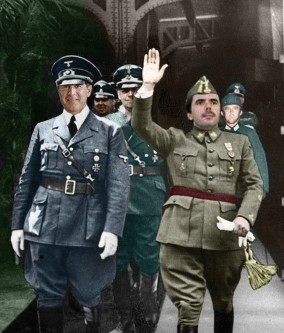
Aznar as Chávez Sees Him (Can You See This Picture Now?)

Chávez Threatens to Nationalize Spanish Banks In Venezuela: Sounds Familiar?

Hugo Chávez is threatening to nationalize Spanish holdings in Venezuela in retaliation for King Juan Carlos' verbal rebuke at the Ibero-American Summit. Zapatero and Moratinos are ready to do any penance themselves to satisfy him, afraid that they will be blamed, as already they are being blamed, for cultivating such "friends" for Spain and endangering national interests for the sake of international grandstanding. The summit was a much-needed wake-up all for the Spanish Socialists. It was not just Hugo Chávez who was castigating Spain for the very "abuses" which are always charged against the U.S. at international forums. Since this was a meeting of the leaders of "La Raza," it was the original hagemon which was the target of their resentments and envy. The most adamant denouncer among them, Nicaraguan president Daniel Ortega, railed for an hour about his country's Spanish-owned electric company. Public utilities were always a popular target in Latin America. In pre-Castro Cuba, the U.S.-owned Cuban Telephone Company was perhaps the only foreign monopoly which everybody hated. When Cuba was Cuba, Spain was poorer than Cuba so there were no great Spanish-owned conglomerates in Cuba other than those which belonged to Spanish emigrants whose roots were no longer in the motherland. By contrast, in Venezuela today, Spanish investments are held by Spanish capitalists who have no roots in their host country. It is even easier, then, to foment popular resentment again them and use that as a pretext to tighten the government's stranglehold on the economy.

All foreigners must be evicted in order for Venezuela to become the Socialist (read robber) state which Hugo Chávez says he wants it to be. The first page in the manual of economic ruin, which Castro graciously lent his Venezuelan protege and benefactor, is to privatize, nationalize, and, preferably, confiscate without compensation, all foreign capital. This is always the preclude to the theft of all national wealth regardless of whether it is in foreign or native hands.
After Chávez has confiscated Spanish investments in Venezuela — say a decade or two later — he will offer to settle all Spanish claims, now deemed irrecuperable and already written off, for a fraction of a cent on the dollar. The duped will rejoice that they were able to recover even that much, and calculating that bigger investments will offset past losses, grandiose plans will again be drawn for Spanish capitalization. Now, of course, it will be a different kind of investment. The state (Chávez) will be a majority holder in all new enterprises and the salaries of Venezuelan nationals will be paid directly to him, who in turn will allocate some pittance to his hapless subjects, negligible except when compared to the even smaller pittance which the state pays its unindentured servants. Of course, being partners and mindful of each other's interests, Chávez will never again raise the specter of the Black Legend in Venezuela. Once the Spanish firms are in effect working for him there will be no need to decry them as exploiters when it is in his interest to have them refine and expand their exploitation.

In order to reap this double-fortune Chávez must lay the groundwork with a concerted campaign of vilification against Spain and Spaniards. Or perhaps just demand an apology from a Spanish king intent on upholding the honor of his people and his country. All would work as Chávez had hoped and Castro assured him except for his own Socialist allies in Spain who are intent on ruining a good thing for Chávez by kow-towing ten meters into the ground if necessary to placate him and forestall the inevitable piñata until their conservative opponents are in office again, when they will be free to blame the confiscations on their "intransigence" while simultaneously applauding Chávez's "purification of national interests" or "dignification of his people."

Notable & Pedantic: Cubans Are Now "Cubands"

"Cubands is an elastic and all-inclusive term I developed in order to simultaneously take account of the layered presences that constitute Cuban cultural and national identity (such as those of Spain, Africa, Ireland, France, the United States and the former Soviet Union, etc.) as well as allow room for the hybrid identities that are continuously transforming in an ever-changing diasporic context, which is at once global and transnational... Added to the mix are the experiences and expressions of Cubands, either born or raised outside the island, who claim to possess a Cuban consciousness that has been shaped as a result of what I term a second-hand experience of exile... The diversity that exists within the Cuban diasporic population, coupled with the permutations and transformations that have occurred outside the island, thus speaks directly to the need to relinquish and move beyond a monolithic idea of nation or cultural identity, or the misleading binary of island and diaspora, aquí y allí. The emphasis then is not so much on locating 'home,' but on the fluid process of voyaging between identities and worlds; in other words, the journey is 'home.' In this sense we as Cubands — on and off the island — are at once post- and trans-national. " — Andrea O'Reilly Herrera, author of Cuba: Idea of a Nation Displaced, quoted in The Miami Herald, November 14, 2007

Professor O'Reilly is the very proud of herself. Proud of her Irish extraction. Proud of being the chairman of the department of "Ethnic Studies" at Colorado University. Proud of her theory that there is no such thing as a static Cuban nationality. But proud, above all else, of having invented the word cuband. You don't understand this professor's "cutesiness?" Well, let me parse it for you: Cuba + and = nothing. This formula may be too easy for the professor to understand and she would certainly disavow it if she could. But, in a nutshell, that is her philosophy. We are nothing because we are nothing in particular, just hybrids. Second-generation exiles are the biggest nothings of all, because they received their national and cultural consciousness at second hand. In fact, according to Professor O'Reilly, they even experienced exile at second hand. O'Reilly Herrera believes that our "journey" (read exile) is home and that we had better resign ourselves to this fact. On the other hand, "Cubands" are in the vanguard of the post-national world. For her, statelessness is the promised land and perfection of human existence. And we happy, happy Cubans and "Cubands" got there first.

Of course, Professor O'Reilly Herrera is herself a cuband. Which is to say, a specter, an illusion, nothing. Yet this "nothing" is very vocal about her ideas of what constitutes a Cuban nationality and what does not. Shouldn't "nothing" be more circumspect? Shouldn't "nothing" know her place or her "non-place?" Nothing certainly should.

http://www.miamiherald.com/540/story/306917.html

Tuesday, November 13, 2007

Oscar Corral: The Return of The Prodigal


The prodigal has returned but not in triumph. Oscar Corral's byline is again featured in The Miami Herald. The Cuban-American community having closed its doors to him, and the crime beat also being off limits to him, the disgraced reporter has become The Herald's resource of last resort and least importance, doing the kind of "man-on-the-street" interviews and obituaries on which most beginners cut their teeth. He reemerged last week with a brief article on the reaction of Miami's Pakistani community to President Pervez Musharaff's declaration of a state of emergency. He wrote an almost identical "follow-up" this week. Both articles consist chiefly of quotes from various local Pakistani personalities, and both introduce in the first paragraph Farzana Farooq, sister of a former justice on Pakistan's Supreme Court (one of 17). Since Corral's expertise on Pakistani affairs appears to be nil, he cannot do otherwise than relate what others say without attempting to place their comments in a broader context; and having managed to offend no one in the first article, he essentially followed the same formula in the second, producing a nearly identical article. Had he been as circumspect in his coverage of Miami's Cuban-American community — about which he knows just about as much as he does about Miami's Pakistanis — Corral might not have sidetracked his career, at least, though his meretricious proclivities would certainly have derailed it, as eventually they did.

His other story this week was an obituary of George Stead, 52, the Edison High School footbal player who was paralyzed at age 15 when he dove for a tackle in a football game against Norland at the Orange Bowl in 1971. We can't help but wonder whether this obituary was assigned intentionally to Corral to cure him of depression and self-pity, which required a 5-month sabbatical to treat, longer than it did for Stead to return to school after his catastrophic injury. Stead's courage in the face of adversity and refusal to consider himself a victim hold valuable lessons for Corral, though moral greatness usually requires some sense of morality.

Can anything be more humiliating for a seasoned reporter, at one time The Herald's point man on Cuba and improvised "expert" on journalistic ethics, than to return to work in the capacity of an obituary writer and man-on-the-street reporter? Lois Lane, even Jimmy Olsen, got more important stories. What's next for Corral? Quinceañera parties? No, he would be persona non grata there. Too scandalous a figure and not to be trusted around teenagers. Speaking of which, Corral's troubles from soliciting the sexual services of one, continue for the indefinite future, as he has decided not to plead out and will pursue this matter through continuances, motions and appeals for as long as it takes for him to be vindicated or for the principals in the case (the prostitute and pimp) to disappear, which is much the same thing. Then it will be just his word against the arresting policewoman, and if his attorney selects carefully the members of the jury, the erstwhile golden boy turned enfant terrible might walk and be "promoted" to the Broward bureau just in time to do one of those "man-on-the-street" interviews there about Fidel Castro's death.


***

Included here are all the posts, from the newest to the oldest, which we have devoted to Oscar Corral on the RCAB, the most comprehensive archive on the net of the disgraced ace reporter's antics:

Alfonso Chardy is the New Oscar Corral

First Anniversary of Oscar Corral's "Miamí Moonlighters" Story

From the Tellechea Digital Archives: Carl Hiaasen and Jesús Díaz Battle Over Martí Moonlighters Story and Díaz Blinks

From the Tellechea Digital Archives: Oscar Corral's "Martí Moonlighters" Story Revisited

All You Ever Wanted to Know About Oscar Corral But Didn't Know Where To Ask

The Sun-Post's Rebecca Wakefield Polishes Oscar Corral's Apple Again

Deserving of the Pulitzer for Best Cartoonist

The Miami Media's Reaction to the Oscar Corral Affaire

Ah, Poor Henry Misses Me at Herald WatchRCAB News: Cornering the Market on Oscar Corral

El Nuevo Herald Buckles to The Miami Herald While Granma Comes to Oscar Corral's Defense

Discussion of Oscar Corral Affaire Banned at Babalú Blog

Corgiguy Protests RCAB's Treatment of Oscar Corral

Oscar Corral: Rescuer of Lost Souls

Schadenfreude: Oscar Corral Gloats About Arthur Teele Jr.'s Downfall

Yamilet López: The Girl Whom Oscar Corral Propositioned

Oscar Corral's Alleged Homosexuality: Slander or Libel?

Oscar Corral Deletes Comments Critical of Him at "Miami's Cuban Connection"

Re Oscar Corral: Is Prostitution a "Victimless Crime?"

Oscar Corral and the Divine Finger"

"In Miami's Fair City/Where the Girls Are So Pretty..."

New Times Names Oscar Corral "Best Commie Spy" in "Best of 2007" Issue

The Wrong Reporter For the Posada Story

Oscar Corral: The Man Without Principles

Monday, November 12, 2007

Notable & Deranged: Venezuelans, It's Already Too Late for You


"The king got very mad, like a bull. But I'm a great bullfighter - ole!" — Hugo Chávez, quoted by El Mundo, November 10, 2007