Monday, April 23, 2007

Boris Yeltsin (1931-2007)


Shortly before the fall of the Soviet Union, Boris Yeltsin ordered the house razed where Tsar Nicholas II, the tsarina and their children were massacred by the Bolsheviks because it had become a place of pilgrimage for Russians; and a few years later, in the democratic era, Yeltsin attended their reburial and canonization at the resurrected Cathedral of Christ the Redeemer, which had been razed by Stalin and its marble used to build the Moscow Subway. There, in a nutshell, is the career of Boris Yeltsin, and, indeed, the history of the Russian people since 1917.

Yeltsin, an indescript apparatchik for most of his life, became the father and savior of Russian democracy at its most crucial hour, when hardliners conspired, with Castro's connivance, to return Russia to Stalinist times. Yeltsin was a flawed man in many ways (his faults being particularly congenial to his people), but ultimately he was the necessary man to install democracy in Russia and end 75 years of Communist tyranny. He also had the wisdom to leave office when his work was done, a virtue which is not given to all political leaders and is almost always denied to ones reared under dictatorships.

Although it is my sincere hope that Cuba will bypass all the Gorbachevs, Yeltsins and Putins, and proceed from tyranny to democracy without an interregnum of "former Communists," still I am grateful that there was a Yeltsin to release Russia from Communism and Cuba from three decades of thralldom to the Soviet Union.

Rest in peace, great muzhik. History will judge you more kindly than it will your critics.

Sunday, April 22, 2007

The Wrong Reporter For the Posada Story


Oscar Corral's textbook story of 8 September 2006 about the Herald Moonlighters — "textbook" because it has been held up by more than one expert on journalistic ethics as an example of what not to do when writing a so-called investigative report — did not appear first in The Miami Herald, but on Castroite television, where a propagandist on Mesa Redonda announced that The Miami Herald would shortly be publishing a story about Cuban-Americans reporters in the pay of the U.S. government (as if Cuban viewers could go out and buy a copy of the newspaper hot off the presses). This revelation indicates one of two things — either the original story was fed by Castro operatives to Corral, or the Cuban government has one (or many) moles at The Miami Herald who keep it apprised of upcoming stories that could be fodder for their propaganda mill. Indeed, if an Ana Belén Montes or a Juan Pablo Roque can infiltrate the Defense Intelligence Agency (DIA) or FBI are we to presume that The Miami Herald is impenetrable? This is a question that The Herald has never addressed because of the fear that any investigation would become a"witchhunt." It has no scrupples whatever about firing or libelling anti-Communist reporters because they are anti-Communist, but it trembles at the thought of exposing Cuban Communist agents on its staff because that might expose them to the charge of McCarthyism. Maybe the demented cartoonist who recently tried to stage a coup at The Miami Herald was not so "demented," after all. In fact, I am sure that the first sign that Communism is about to fall in Cuba will be the departure en masse of its compromised staff members to redder venues, the San Francisco Chronicle and such. But to return to Corral.

At best, Oscar Corral is a dupe to whom others feed what they want him to regurgitate, and at worst he is a dupe again who spills all he knows to the wrong people at The Herald. I do not, however, believe that Corral is himself a mole: he is simply not intelligent enough and too conspicuously placed to function beyond suspicion, which would make him virtually useless. But whatever kind of dupe he is, having already fallen prey to Castro's agents in the past, Oscar hardly seems the ideal candidate to cover the Posada Carriles story, quite apart from the personal animus that he has already demonstrated towards his subject in his reportage.

Describing him in a April 20 article ["Posada in Miami, But He Can't Leave"] as "a ghost of his former self" — as what man is not at 80? — Corral cannot comprehend, because he does not share it, the spiritual greatness of the man, which has sustained Posada through this ordeal and others like it which would surely have broken lesser men (say Corral). Yes, this old man who has been kept in "preventive detention" for 2 years and shackled in waist and leg irons is none the better for wear, but he still lives despite the best efforts of the Castro agent who shot him in the face or the U.S. government's Bay-of-Pigs-like conduct towards one who fought for this country in 100 covert wars and Vietnam.

Corral is even shameless enough to throw Posada's honorable poverty at his face, as if that were not yet another patent of his greatness. What can it possibly matter to Posada that he must reside in an apartment in "a cookie-cutter development" in Kendall? In his wanderings through the world in the service of his country, and particularly in the last 2 years, Posada has surely endured a lot worse. Such a "punishment" — that is, to live in a "cookie-cutter development" in Kendall — is the worst that can befall any man from Corral's snobbish perspective and he is stupid enough to rub that in Posada's face!

The lowest blow, because low blows are Oscar's specialty, is when he sneers at Posada's reconciliation with a wife he has not seen in 30 years. Posada is a lucky man to have a spouse (or former spouse) who, after 30 years, understands at last his spiritual greatness. Martí himself was not as fortunate. But Corral, rather than be touched by this timeless love story, chooses to scoff at it, as if love were something that Posada could not give or receive.

Did I say the "lowest blow?" Now I am not certain since Corral goes on to question apropos of absolutely nothing Posada's disfiguring facial scars, which are the result of being shot in the face by a Castro agent: "Posada, who says his facial scars are the result of an assassination attempt by Cuban agents..." Oh, he only "says" that Castro's agents did it. Well, then, we must surely doubt it since Posada said it. Who THE HELL would shoot Posada in the face if not a Castro agent? Is Corral really that stupid or does he only challenge the origins of Posada's scars because he fears that these will actually make anyone feel sympathy towards him and understand the nature of the enemy he is fighting — one man against an entire apparatus of repression? (Incidentally, Castro's cartoonists also mock Posada's mutilated face in their portrayals of him).

To create the impression that Posada is isolated and viewed indifferently at best by his fellow Cuban exiles, Corral quotes only Posada's lawyer and former comrades in his defense, including one even older than Posada. Corral could not be more misleading. Posada is a hero to every Cuban exile who still retains a shread of dignity and these are still the majority in Miami.

Quoted against him and more extensively than anyone else is Posada's Judas, Gilberto Abascal, whom the U.S. has identified as a double-agent in the service of Cuban Intelligence, but who, nonetheless, the government is using as its star witness in the prosecution of Posada on immigration charges. Nevertheless, Castro-agent Abascal volunteers that he knows (how?) that Posada is responsible for blowing up the Cubana Airlines plane in Venezuela. Corral also cites two "presidents" who also believe as Abascal believes: Fidel Castro and Hugo Chávez. But Corral is not content with these luminaries of truth. He also quotes Giustino di Celmo, the 87-year-old father of an Italian killed in a hotel bombing in Cuba, who now himself resides in Havana; José Pertierra, a Cuban-American (?) attorney who represents the Chávez regime; and Camilo Rojo (interesting name), the son of a Cubana de Aviación "official" killed in the explosion of the airliner. Rojo gets the all-important last words in the article: "How is it possible that the United States has not charged him with terrorism, but with lying? That's like if they arrest [Osama] bin Laden and charge him with telling lies. [Posada is] a terrorist. He has said so publicly. The United States knows this but allowed a killer free on the streets."

So the "United States knows [that Posada is a terrorist] but allowed a killer out on the street." Isn't this remarkable. The U.S. "knows" that Posada is guilty even though he has never been convicted and has in fact been acquitted by both civil and military courts in Venezuela; it "knows" that Posada is a "killer" but has no evidence to indict him as such and must instead charge him with entering the country illegally, an offense that 70% percent of native-born Mexicans residing in the U.S. could be charged with but are not. Two years in prison (and counting) for that?

The indictment may read "lying to immigration officials about how he entered the country," but, in reality, Posada is being tried for the 1976 bombing of which he has already been acquitted. And Corral, of course, knows this, approves and is doing his upmost to poison all the wells for Posada.

Maybe I am wrong. Maybe Corral is far worse than I suppose.

http://www.miamiherald.com/548/story/80476.html


POSTSCRIPT:

Because Corral can't write English correctly and his editors don't know enough to correct him, he refers to Posada in the first sentence of his article as a "warrior of lore." He means, of course, a "warrior of yore" (time past, especially long past). "Lore" means a lesson or something learned, especially traditional knowledge or belief. Can Corral mean that Posada is a legendary warrior? Although true, I doubt that this is what Corral meant to say or would admit. What he meant to write is obviously a "warrior of yore (of a time long past), which, of course, isn't true, because Posada, despite his age, is still in the trenches fighting the good fight. His heroism does not yet belong to the past although it will always be eternal.

Oscar Corral: The Man Without Principles


Oscar Corral is the most despicable of all Cuban-American bloggers besides whom Val Prieto and Henry Gómez are monuments to disinterested patriotism and good sense. Oscar is the reluctant blogger, forced by The Miami Herald to run its house blog on Cuba, but hating every moment of it and absenting himself as much as possible from the irksome task. For years his blog literally ran itself; his only contribution being to post the occasional newspaper article while letting his blog's habitues go at it with one another in what was once the most entertaining free-for-all in Cuban-American blogdom. Thanks to his indifference and the relative freedom it afforded, it was not unusual to see threads with more than 400 comments, something which few national blogs can boast and no local ones. This, which would have meant everything to other bloggers, meant nothing to Oscar. If anything, it only increased the headache for him.

When things got out of control as inevitably things would, Oscar would let the proceedings continue unchecked as if deriving a smarmish pleasure from the havoc he was wreaking simply by making himself the least conspicuous presence on his blog. But this game could not continue forever and eventually the lunatics did take over the asylum, converting Miami's Cuban Connection into, of all things, a covert for pedophiles to champion their lifestyle, with communiqués from NAMBLA and more such nonsense. Eventually all the regulars quit in disgust, even its most famous commenter, the irreplaceable John Longfellow, who was many things but not a pervert.

Eventually Oscar had no recourse but to institute so-called "moderation," which finally succeeded in bringing all this shenanigans to a stop, even if it all but killed his blog as "moderation" (i.e. preëmptive censorship) always will. It was a kind of poetic justice that his blog finally imploded at precisely the moment when Oscar became victim and facilitator of the biggest journalistic hoax that was ever perpetrated on or by a reporter from The Miami Herald. Having written thousands of words on this subject — more certainly than Oscar wrote — I do not want to re-visit it here but have no choice.

One day, shortly before the implosion, there appeared a note from Oscar on Miami's Cuban Connection announcing that he was going "underground" to cover an important story on Cuba. Most of his readers assumed that he was on a clandestine mission to Cuba, the kind that Herald reporters occasionally undertake because they are not normally granted access to the island. In fact, Oscar's "secret mission" became a kind of joke on his blog — "Waiting for Corral-Godot." After a month or so, Oscar finally resurfaced to break his long-awaited story, which led to the arbitrary discharge of three of his colleagues at The Herald and smeared at least 60 other Cuban-American journalists by the time it had run its course.

Their supposed offense? They had moonlighted for Radio Martí while in the employ of The Herald. It was not reported in the story, however, that The Herald not only knew about it, but had actually reported that fact years before without the least hint of disapproval. Moreover, there was no internal Herald policy prohibiting it, though the editors attempted to improvise one after the fact, which was eventually exposed for the sham it was. None of the Cuban journalists, or, indeed, any reporter at The Herald had signed an exclusive contract at the time of their employment. All, therefore, including the Cubans, were free to proceed as they saw best. Nonetheless the Cubans had obtained the permission of the late El Nuevo Herald editor before appearing on Radio Martí. None of this was reported in The Herald's original story and would only slowly come out under the prodding of others. Foremost in exposing the machinations at The Herald was Henry Gómez's Herald Watch, perhaps the highest public service ever done by a Miami blog.

Oscar's story, which was widely reported by the MSM, as one would expect any story to be that discredits Cuban exiles, began to unravel when it was discovered that thousands of (non-Cuban) journalists had engaged in the same practice over the last 56 years, that is, since the very inception of public broadcasting, including the patron saint of American journalists, Edward R. Murrow, who even headed the government's foreign broadcasting agency in the Kennedy administration.

As a result of these revelations and others no less embarrassing, there developed a schism between The Miami Herald and its sister publication El Nuevo Herald, which, unintentionally and for the first time in decades, transformed Miami into a two-newspaper town, both housed under the same roof and receiving the same pay check.

In the end, the fired reporters were rehired by the McClatchy corporation with half-hearted apologies, and The Herald's publisher Jesús Díaz and its managing editor Tom Fiedler departed the paper (more or less voluntarily). Oscar, however, was unscathed by the scandal, though he was subjected to a great deal of criticism from other quarters, which he received with the same dispassion as had characterized his demeanor at Miami's Cuban Connection.

Only a few people know besides Oscar and his editors that he was the witless agent of a conspiracy hatched up in Havana to discredit Cuban-American journalists and the entire Cuban-American community. His reflexive disdain for anything and everything that his parents' countrymen have done or might do to promote Cuba's freedom made him an easy mark for every slanderer who wished to use him to malign us. He even cultivated such acquaintances in the hope that they would provide him with the materia prima that he needed to advance his career beyond the Miami "ghetto." Oscar Corral has big dreams, ready ears and a none too facile pen and might even have obtained his desire if he had even one ounce of discernment and could tell when he's being used and when he's using others.

The Miami Herald, which can always rely on him to do its dirty work without too many prompts as he is the consummate "company man," has assigned Oscar, of all people, to the Posada Carriles story, as if anyone could possibly believe that he could bring anything to it but a lack of objectivity and malicious intent. In his reportage on Posada's release on bond, Oscar seemed almost giddy with excitement at the 80-year-old's mistreatment at the hands of federal authorities and the ordeals which he has thus far faced and the many more which are still ahead of him for being something that Oscar never was and never will be -- a man of principles. To an opportunist like Oscar Corral principles are something to scoff at; and sacrifice, well, sacrifice is not even in the picture. Never has there been such a disconnect between the subject of a story and the reporter covering it.

This shall be the subject of a future post (most likely to appear tomorrow).

Remembering Elián on the Anniversary of His Abduction


Seven years ago today, the United States committed one of the great historic wrongs in the annals of this republic — the kidnapping at gunpoint of Elián González and his consequent repatriation to Communist Cuba. There are many "days of infamy" in the shared history of our two countries, many even of greater historical transcendence. But those other "days of infamy" are removed in time by 50-150 years, and though their repercussions are still felt today, these events are not part of the living memory of most Americans or Cubans. Elián is. He is the living embodiedment of all the crimes, usurpations and humiliations inflicted by this country upon ours. But for these wrongs we would be virtual strangers. Because of them, we are bound together for all time.

From Narciso López to the Spanish-American War, from the Treaty of Paris to the Platt Amendment, from the rise of Fidel Castro to the Bay of Pigs, from the Missile Crisis to the Kennedy-Khrushchev Pact, from Elián to the "Wet Foot/Dry Foot" policy — and not counting another thousand betrayals — the U.S. has been the greatest obstacle to Cuba's pursuit of happiness and the artifex of the destruction of our country.

On a day like today this needs to be said and it should be remembered all the other 364 days of the year.

As for Bill Clinton and Janet Reno, both in precarious health, may they both live long enough to have Elián spit in their faces.

Katie Couric Wants to be a "Relatively Intelligent Person"


55-year-old Katie Couric, who has referred to Cuban-Americans as petite tyrants who "tolerate no dissent or freedom of political expression" and have transformed Miami into a "banana republic within America," proudly strutted-out her 33-year-old boyfriend to garner publicity for her failed efforts as anchor of the CBS Evening News. The boyfriend, the heir of a wealthy Connecticut family, follows the tennis circuit, and is, according to a friend quoted in People Magazine, best known for "a lot of shirtlessness. He seems to enjoy displaying his bod."

We were not surprised by the fact that Couric's boyfriend is young enough to be her son. We were surprised, rather, that there was a boyfriend, since despite her prissiness she always seemed rather mannish to us, and would, in our opinion, have made an ideal older companion for Rosie.

Couric said that she hopes viewers will be patient with her because she is "still getting her sea legs" after 7 months on the job (and nearly 30 years in broadcast television). She also demurred that she hopes to "establish the broadcast as smart and trustworthy, and [herself] as a relatively intelligent person."

Relative to what? Mark you, she wants to be perceived as "relatively intelligent" and is working to establish that reputation, but she seems to care nothing about actually becoming intelligent (even "relatively"). Yes, Couric described her ultimate goal as establishing a reputation for being "a relatively intelligent person." Well, if a legless man can climb Mount Everest, anything is possible.

Click Here: More About Katie Couric's Peccadillos

http://www.mediaresearch.org/specialreports/2000/elian.asp

Friday, April 20, 2007

William F. Buckley and Me


The recent death of Pat Buckley, William F. Buckley's wife, reminded me of my own association with the father of modern American conservatism, which had ceased to have any meaning for me when Bill came out against the trade embargo on Cuba some 15 years ago. If conservatism is just another word for opportunism, as its critics contend, then Buckley, as usual, was ahead of the pack. But no matter; it was not on the issue of Cuba that our paths diverged in the 1980s, but on the question of what constitutes anti-Semitism.

One of the National Review's own staff writers, Joseph Sobran, had been accused of anti-Semitism because of his defense of John Demjanjuk, an autoworker from Cleveland, OH who was accused of being a notorious concentration camp guard known as "Ivan the Terrible." Sobran believed that this was a case of mistaken identity (as both the Israeli Supreme Court and the U.S. Sixth Court of Appeals would later find). Sobran pointed out that it was the height of hypocrisy to accept Kurt Walheim, an undisputed former Nazi (can one be a former Nazi?) as head of the United Nations and later president of Austria, while the U.S. aimed not its guns but its cannons at a Cleveland autoworker in an almost successful campaign to have him hanged for another man's crimes.

This seemed to me a most reasonable position, but Buckley saw it otherwise. First he came to Sobran's "defense" with this statement: "Sobran is not a naked anti-Semite, nor, in my opinion, a crypto or even a latent anti-Semite." Finally, however, Buckley fulfilled the promise of that initial statement and came out against his friend and protegé whom everyone supposed would some day be his successor at the National Review. Of course, Buckley was entitled to his opinion. What he was not entitled to do, in my opinion, was to fire Sobran because of his. Buckley compounded the offense by agreeing with neoconservatives that Sobran's statements could be interpreted as "anti-Semitism" of a kind, which Buckley defined as any criticism at all of Jews or Israel. Buckley wrote that this prohibition was a "welcome taboo" in order to avoid "another genocidal catastrophe." So poor Sobran, whose only "offense" was Zola's in championing the cause of an innocent man, was indirectly accused of abetting another "genocidal catastrophe."

I wrote an article in the old New York Tribune where I turned my own small polemical skills on Buckley: "The argument ad Holocaust is a wearysome cliché of the liberal-left and of neo-conservatives who have abandoned their old comrades on the left but have not been able to escape the pernicious imprint that four decades of intellectual anemia has left on their minds. The thrust of this argument is always the same — we haven't learned from Nazi Germany's past and are condemned to repeat it in America. Just when, no one knows, but it's always around the corner. It is just this kind of fashionable paranoia thar finds parallels between Auschwitz and Bitburg, Sobran and Rosenberg (the Nazi ideologue), the National Review and Volkischer Beobachter (the Nazi party organ)."

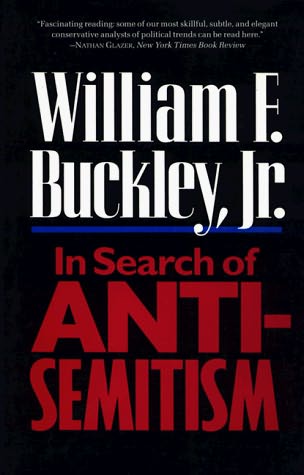
My article did not go unnoticed or unanswered. In fact, Buckley devoted an entire book to answering it entitled In Search of Anti-Semitism. My article is quoted there though not rebutted.

There is a sequel to this story. In 2005, 20 years after the Sobran affaire, the National Archives released a letter written in 1982 by William F. Buckley to Judge (later Supreme Court Justice) John Roberts, Jr. on behalf of a Russian-language lecturer at Yale, Vladimar Sokolov, who was accused of writing anti-Semitic newspaper articles in Nazi-occupied Russia during World War II, and was facing, like Demjanjuk, denaturalization and extradition. In effect, while Buckley was supporting an acknowledged Nazi propagandist from his alma mater, he accused and fired a colleague for doing publicly what he was doing privately. Sokolov eventually admitted the charges against him and fled to Canada ahead of a court order to extradite him to the Soviet Union. The U.S. Sixth Circuit Court eventually ruled that the Justice Department's Office of Special Investigation (OSI) had perpetrated "a fraud on the court" in claiming that Demjanjuk was Treblinka guard "Ivan the Terrible." It might be noted, en passant, that this same Office of Special Investigations is in charge of prosecuting another innocent man, Luís Posada Carriles.

I have just sent a note of condolence to Bill Buckley along with my best wishes for his continued good health. (In truth there is no worse fate that can befall a man than to outlive a wife of more than 50 years). No man fought Communism harder in what José Martí called the "paper trenches" than did WFB and his lapses in judgment should not obscure that fact, not even his longstanding opposition to the Cuban trade embargo.

Thursday, April 19, 2007

Mr. Prim and Mr. Proper


Their self-importance is their most obnoxious quality. It was on exhibit today in Val Prieto's refusal to express even one word of support for Posada Carriles' release or outrage over his treatment, lamenting, instead, the outrage which his excarceration might cause among the media. The media are Val's judges and the prospect of their outrage (at him and other Cubans) shakes every fiber of his sensitive being. He cannot live without their approval, or, failing that, their indifference.

Henry Gómez is not much better but thinks himself immensely better than Val at maneuvering the road that lies between principles and interests. In the Posada case, Henry believes that this path lies in agreeing to have the much-acquitted Posada tried yet again as Castro and Chávez are demanding, just so long as Posada's trial follows Castro's. This is Henry's idea of justice: everybody into the pyre and let God sort the guilty from the just. Worse even than his position on Posada Carriles is Henry's vile refusal to utter even one word in support of the claims to asylum of that 4-year old Cuban refugee girl, Elian's spiritual sister, whose custody the Castro regime is contesting in a Florida Family Court presided over by a judge who is on record as supporting the deportation of all Cubans to Cuba. Henry even accused me on another blog of being the only one who was stirring the pot on this case as if that were some kind of reproach.

Charlie Bravo has likened Val and Henry's condition to that of house slaves in the ante-bellum South, but I think this is a far too generous appraisal. Slaves, whether house or field, lived at the mercy of their masters and were obliged to satisfy their every whim and never to incur their wrath (if possible). If the house slaves were more obsequious than other slaves, it is because they had more to lose. No such justification exists for Val and Henry's cowering before the media, nor their habit of throwing any and all of their compatriots to the wolves to curry the wolf's favor.

Posada Carriles Is Free


Today, Communist Cuba celebrates publicly its "victory" over the freedom fighters at the Bay of Pigs — a "victory" which was a gift from JFK; privately, of course, Cubans old enough to remember the re-birth of hope which the news of the invasion first brought them, will mourn the death of that hope and all the horrors which were unleashed on the Cuban people over the next five decades by Kennedy's failure of will.

The capos of the regime, however, will not be celebrating so exuberantly on this anniversary, because Posada Carriles, their Public Enemy #1, has just been ordered released by a federal judge and is en route to Miami even as I write. I am by no means convinced that the government will allow him to enjoy for long his legal victory. The same Justice Department which kidnapped a 5-year old boy at gunpoint in order to present him as a gift to Castro, or which, for that matter, shackled in waist and leg irons an 80-year old man who stands before the law as innocent of any crime as you or I do, such a rogue agency, led by an unrepentant liar who answers to an even bigger liar, cannot be trusted to abide by court orders but will ride roughshod over the law itself to achieve its nefarious ends.

For now, however, and for as long as Posada's freedom is respected, we may all rejoice that justice has prevailed and that this selfless patriot, a hero of three nations and 1000 battles against Communism, will soon be among his people again.


POSTSCRIPT:

Babalú has posted a communiqué regarding Posada's release, but said nothing about the release itself except to mourn that it will cause a "media outrage barrage" and backlash against Cuban-Americans, implying that perhaps Posada should have remained in jail to spare Val and his ilk more "embarrassment" about being Cuban exiles. Not to be outdone, Henry Gómez wants Posada tried for the crimes which Castro imputes to him, although Posada has already been acquitted in a civil trial and court martial of any part in those crimes. Henry, to be fair, wants Castro and his henchmen tried before Posada. How generous of him! I suppose he would have favored trying the Jews after the Nazis had already been convicted at Nuremberg. If they were not so offensive, these two clowns would be the Abbot and Costello of Cuban-American blogging.


POSTSCRIPT 2:

Babalú has an intriguing new "commenter" named Marifea Perez-Unstable whose position on Posada is not radically different from Val and Henry's: "Luis Posada deserves to be tried before the Queen of Hearts: 'Sentence first, verdict later.'" Still, I fear that Val will soon ban her.

A Chip Off the Old Block


Val Prieto has an interesting item this morning about Desi Arnaz, Jr., scion of Babalú's iconic inspiration. As reported by TV Guide Online, Desi Jr. declined an invitation from Castro to attend the Ernest Hemingway Fishing Tournament 5 years ago.

Although he was not raised in Miami or as a "Cuban," and even though it is unlikely that he even speaks Spanish, Desi Arnaz, Jr, is not as disconnected from our reality as are the Estefans, Val's other icons. Money doesn't blind him because he has more of it than even the Estefans and his Cuban compass is clearly fixed on Cuba, not Los Angeles, New York or Miami.

Kudos to him for honoring his father's memory by not dishonoring his father's country or name.


POSTSCRIPT:

Desi Arnaz Secretly Funded Anti-Castro Groups
Sunday, May 9, 2004

Desi Arnaz of "I Love Lucy" fame and fortune helped finance the freedom of hundreds of Bay of Pigs fighters captured in 1961 by Cuban government forces, veterans say.

A belated thank you to the late entertainer has now happened, 18 years after he died.

This past Friday, according to a Miami Herald report, surviving vets of the Bay of Pigs invasion presented a posthumous award to daughter Lucie Arnaz for her father's "moral support and generosity."

That generosity was legend among Bay of Pigs veterans.

"He always supported the Cuban cause," said Felix Rodriguez Mendigutia, president of Bay of Pigs Veterans Association. "Anything against Fidel Castro, he supported."

In accepting the award, Lucie Arnaz said her father would have felt honored. She revealed that even she was unaware that her famous father had given money to the cause of the imprisoned invaders, but said it would be consistent with his character and his sympathies.

"Knowing my dad and my grandfather, I'm sure they were emotionally very involved in the Bay of Pigs invasion. I'm sure my father would be very proud to be acknowledged," Arnaz added.

Surrounded by admirers of her father at the Miami event, Arnaz said: "I feel like I have a lot of friends and family here. We're all probably related." Desi Arnaz was a native-born Cuban.

Nilo Messer, vice president of the association and one of the invaders who were imprisoned, said: "We would always get news from the common prisoners and the employees. Someone told me that Desi Arnaz was helping with the efforts to get us out. He was one of the people pushing for a commission to negotiate our release."

The veterans say Arnaz donated $50,000 – an amount worth about $300,000 today. Reportedly, Arnaz gave the money to a commission headed by Eleanor Roosevelt that arranged to send $53 million worth of food, medicine and farm equipment to Cuba in exchange for the prisoners' release.

Arnaz also provided seed money for several exile organizations, reported the Herald, and he is said to have provided the contact that led to liberated prisoners appearing on the Ed Sullivan show.

"He cooperated a lot," Rodriguez said. "And he never sought any publicity for helping us or anyone else. Now that he's gone, we want to honor his memory."

http://www.newsmax.com/archives/ic/2004/5/9/115258.shtml

Wednesday, April 18, 2007

No More Babies to be Drawn and Quartered in U.S.


It is no longer permissible in this country to murder babies piecemeal while they are in the process of being born. The Supreme Court has just this moment upheld the constitutionality of the ban on partial birth abortion.

What is partial birth abortion? It is when doctors sever and smash the heads and limbs of babies who have already taken their first breath in the world but whose feet have not yet exited the birth canal. This is akin to a medieval practice known as "drawing and quartering," which was reserved for traitors and heretics and was always considered the most terrible of deaths (among other tortures, your limbs were torn from you by horses pulling in opposite directions). Of course, no man has been drawn and quartered in 200 years. We live in an "enlightened age" that only does that to babies.

There is no medical justification for this abomination, which has nothing to do with medicine and everything to do with murder. The practice matches and even surpasses anything that Dr. Mengele ever did in his gruesome experiments on concentration camp children (most of whom survived, unlike the victims of partial birth abortions).

Today this country's quotient of humanity has increased. Of course, there is more than one way to kill a baby and all ways are objectionable even the most "benign." Just as slavery brought an awful retribution on this country so shall the culture of abortion on demand bring its own terrible price.

In Communist Cuba, which has the world's highest rate of abortion, and, indeed, cultivates abortion as a "cure" for infant mortality, partial birth abortion is the favorite method because it is the cheapest: hacking someone to death usually is very cheap except for the wear on the hatchet (or scalpel).

From Our Ambassador Down Under


I have debated many Australians vis-à-vis Communist Cuba in my meanderings in the blogosphere and I have never had more animated arguments in my life. In fact, I am going to collect those debates because they are also the funniest I have ever engaged in. But enough trailers of coming attractions.

Luís M. García, author of Child of the Revolution, book and blog, is one Australian I have never had to debate because his position on Castro is as clear and unequivocal as if had been raised in Hialeah, so I do not feel that I am going outside the scope of Review of Cuban-American Blogs by commending both his blog and book. His presence in Australia as a kind of exile-ambassador is especially useful to our cause since he catches a lot of things Down Under that might escape us, as witness his latest post:

Arrivals and departures

There is an interesting story on the front page of today’s edition of The Australian newspaper, under the heading "Refugee swap to bring Cubans here".

The normally well-connected paper reveals well-advanced plans by the Australian and US governments to exchange a couple of hundreds refugees a year.

Under the plan, Sri Lankan and Burmese citizens trying to get to Australia by boat but currently in detention on the neighbouring island of Nauru will be sent to the US as refugees.

In exchange, Cubans who have been intercepted at sea trying to get to Miami and who are currently held at the US base in Guantanamo Bay will get a chance to apply for refugee status in Australia.

The thinking behind the proposed scheme is that this is a way of deterring illegal migrants and people smugglers attempting to land in both the US and in Australia.

According to the paper, “the move will deliver political benefits to both governments in the highly sensitive issue of refugee policy”.


Now we have seen it all: nations trading refugees for the sake of political expediency! It is certainly preferable to returning them to persecution in their respective homelands, but what does it say about Australia's view of Sri Lankans and the Burmese, or America's view of Cuban refugees? I think the word pariah would about cover it. Is this what Cuban refugees have finally become in this hate-filled xenophobic country we inhabit? George Bush is president because Cuban-Americans made him president, a fact he has acknowledged on several occasions. And how has he repaid us? He has presided over the gutting of the trade embargo; he has given Hugo Chávez carte blanche to export Castro's Revolution to South America; and he has upheld longer than Clinton did the shameless and intellectually bankrupt "Dry Foot/Wet Foot" policy, which broke with 30 years of precedent in the interpretation and application of the Cuban Adjustment Act of 1966, which makes no distinction between refugees who make it to land or those who are rescued at sea.

Of course, we are too blame also. We have long been too much concerned with our image in this country as the "good refugees," which was really something once before the libels perpetrated by Castro and the MSM in the time of Mariel. That image no longer exists, although Cuban-Americans have been 25 years late in catching on. We are in fact hated in this country, first, because of our success here, and then because of our love for our brethren in Cuba as demonstrated in both the Mariel boatlift and the Elián affaire. So in order not to be hated anymore, Cuban-Americans remain silent about the victims of the "Wet Foot/Dry Foot" policy as well as the attempts of the Cuban government to re-enact its victory in the Elián case by forcing the repatriation of a 4-year old Cuban refugee girl to her father in Cuba (actually, to her uberfather Fidel).

Perhaps if we stopped being the "good refugees" and pressed our case with the virulence that other groups in the U.S. do, we might at last get some respect, if not from our enemies at least from our political allies.

http://luismgarcia.blogspot.com/2007/04/arrivals-and-departures.html

http://www.theaustralian.news.com.au/story/0,20867,21576776-601,00.html


POSTSCRIPT:

I have researched the question and concluded that never in history have non-belligerant nations exchanged refugees in the manner that the U.S. and Australia propose to do. The only historical parallel to be found is the practice of Oriental sultans, who were in the habit of swapping sons when they reached their pre-teens (the reader can imagine for what purpose).

A Cuban At Virginia Tech


We all live at the pleasure and mercy of one another. This fact was proved 32 different times at Virginia Tech this week, although it is hardly a proposition that requires additional proof. Among the victims few or none had any connection to their killer other than their attendance at the school. Those who did know him personally do not appear to be much baffled by his acts but actually admit to having sensed that something like this would happen given his erratic personality and twisted homocidal fantasies which he had hitherto confined to his writing assignments. Of course, we must wonder how much of this prescience predated the attack. When someone defines himself as quickly and definitively as he did, there is a temptation on the part of the people who knew him best to view all previous acts in light of this defining act. Hindsight is always perfect and human vanity too prone to credit itself with a clairvoyance which would have been impressive if it had managed to join all the dots prior to the attack and prevented it. I suspect, however, that there will be a lot of joining of dots now at other U.S. universities as a result of this tragedy. This will no doubt lead to the star chambre treatment for any and all disaffected English majors. Well, in any case, they are the ones probably most needing of a reality check.

There was in fact nothing particularly deep about the killer's disaffection. In his suicide note, he rambles about rich kids and girls. The obvious conclusion is that there were two things that this "loner" didn't get much of at college: money and pussy. Could it all be that simple? Surely such an epic tragedy demands a more complex and abstract explanation; surely anything else is a profanation of the dead. Still, such does appear to be the explanation and no amount of analyses will show otherwise.These tragic deaths are and will remain sensesless because the perpetrator was himself senseless.

In a picture gallery of the victims of the Val Tech massacre my attention came to rest immediately on Juan Ramon Ortiz, 26, a graduate student in civil engineering who had recently married another Val Tech student. He looked exactly like any young male member of my family, by which I mean to say that he looked Cuban. To verify whether he was in fact Cuban (we are everywhere and certainly we are in Virginia) I googled his name with "Virginia Tech" and found the only reference to him to be the MySpace page of someone of that name who was Panamanian. I do not think it is the same person because this Juan Ramon Ortiz doesn't resemble my nephews and cousins. But I was struck by something this Ortiz wrote on his MySpace page on March 31, a little essay entitled "The Bliss of Being Alive:"


The Bliss of Being Alive
Current mood: accomplished


Shit it have been 3 months of this fuckin year!!.... Where i have been ? .... I´m headed to develope projects at work and to do something productive with my free time doing high wall descending .... and I need a break (jajaj). A few days ago I watched The Pursuit of Happyness with Will Smith ....Wadda kind of movie. I realized that my life it´s just a bliss. That real event-based movie tells about the first days of determined Chris Gardner and how he did work it out alone with his 5 y.o. son in the early 80´s. sleeping in community shelters and even in a subway bathroom while he was decided to be an succesful stockbroker agent doing an unpaid internship in a San Francisco´s Dean Witter stock security firm. Every time i remember that man i just about to pull out a teardrop. That man is my new hero. He had real problems. Right now He is doing the best Stockbrokers Company in US and even South Africa.... Fuck man ...you have no excuses!!...

If you watch that movie (realizing that its an a real life-based movie) and still thinks that your life sux........please be kind with all of us, and blow your fucking brain out!!!!

See Ya!

Tuesday, April 17, 2007

The "Fiasco" that Wasn't a Fiasco


No man can do more than his duty and no man should ever be content to do less." — José Martí

Today marks the 46th anniversary of the Bay of Pigs invasion, that proverbial "fiasco" that has co-opted that word, since "fiasco" is never used anymore except in referring to the Bay of Pigs or to any other venture that is compared to it. But what exactly is a "fiasco?" The word which dates from the 1850s is used to refer to a complete failure. It is derived from the Italian fare fiasco, which literally means to "make a bottle," that is, to execute a maneuver that completely cuts off the enemy and prevents his retreat. Something similar to a "bottleneck," which is now used in another context. Of course, Castro did not win at the Bay of Pigs because of his enlightened strategy, transmitted from the safety of his bunker. He won by default because the U.S. did not live up to its commitments to the freedom fighters. If anything, it was Kennedy himself who masterfully executed the fiasco by instructing American ships not to re-supply the freedom fighters (who literally ran out of ammunition) and Americans fighter planes not to facilitate their landing or engage the Castroite planes that reigned terror on them unchallenged. There is, of course, a better word to describe Cuba's greatest national tragedy (greater in its impact even than Marti's death). That word is not "fiasco" but betrayal. The difference between a "fiasco" and a "betrayal" is that betrayal implies a betrayer and fiasco no agent at all. John F. Kennedy said that victory has a thousand fathers and defeat is an orphan. In fact, Kennedy was the father of this particular "orphan." How odd seems his amazement that no else else would claim its parentage! Or perhaps not so odd: the biggest lesson that his Nazi-sympathizer of a father taught all his boys was how to evade personal responsibility for all their actions. It was in Cuba that the Kennedys made their fortune running rum during Prohibition and it was in Cuba that Joe's son proved that if daddy's business had passed into his hands he would have run it into the ground literally, for JFK had absolutely no idea of what it would take to make a successful landing in Cuba.

The Bay of Pigs was certainly the most ill-calculated amphibious invasion in history, the more so because it was executed by a country that had supposedly mastered this kind of warfare 15 years earlier in the Pacific theatre during World War II. In that conflict, it had taken 100,000 American troops and billions of tons of materiel to capture the miscroscopic Japanese-occupied island of Tarawa. Just 15 years later, President Kennedy proposed to capture Cuba, an island 6000 times the size of Tarawa, with just 1453 men and a few tons of equipment! That, of course, would have been possible only as a prelude to a fullscale U.S. invasion.

When recruits were first sought among the Cuban exile community, the U.S. government received enough applications to field ten battalions. Instead, it arbitrarily limited the invasion force to just 1400 men when 14,000 would still have been only one-tenth of Castro's army. Cuba's would-be liberators were chosen by a strict criteria. Adherents of General Batista were excluded. The Administration made sure that the Brigade represented a broad slice of Cuban society -- i.e. so many laborers to so many professionals, so many blacks to so many whites, so many from the east of the island and so many from the west, etc. If one-tenth of the attention paid to the demographics of the invasion force had been paid to the logistics of the invasion, Cubans might be celebrating today the 46th anniversary of their deliverance from Communism. But appearances were always more important to Kennedy than results, as his civil rights record, for example, also bears out.

The rebel army was trained by the CIA in Nicaragua under the auspices of Anastasio Somoza fils, the other president involved in this invasion, the one who didn't betray us (and who 20 years later would be borne to his grave on the shoulders of veterans of the Brigade 2506, a victim of Castro's vengeance and of another gutless American president). Somoza had much in common with Kennedy: both owed their presidencies to their respective fathers and both assumed office through electoral fraud. The difference was that the Latin American dictator was a man of his word and his U.S. counterpart was not.

The Brigade 2506 were conveyed to Cuba on U.S. ships and abandoned to their fate there. The spontaneous uprising that was supposed to be sparked by the invasion never materialized. It was not that the Cuban people did not support their would-be liberators but that Castro was better informed about the invasion plans than the resistance in Cuba, which was repeatedly misled and lied to by the Americans. Reports in The New York Times and other American newspapers gave Castro all the warning he needed to round up every man who might have lent his support to the invasion. Because the prisons were already full Castro confined them in sports stadiums which were wired with dinamite and would have been blown-up if the freedom fighters had gained the advantage.

For three glory filled days — the first time that Cubans had engaged in actual combat since 1898 — the courageous men of the Brigade 2506 struggled against impossible odds to achieve a goal that was clearly beyond even the super-human tenacity they displayed in the pursuit of it. The freedom fighters managed to inflict 30 times the casualties they sustained, but tenacity will only carry you so far: tenacity cannot take the place of guns — of which they had far too few; tenacity cannot compensate for the element of surprise, which was lost when plans for the invasion were leaked to The New York Times; and, finally, tenacity cannot rise from the ground to the skies.

Kennedy had promised the exiles that "the skies would be yours." It turns out that what Kennedy actually meant was that their path to heaven would be unobstructed by American fighter planes. The vital aircover that the freedom fighters had been promised was withdrawn at the last moment to avoid the appearance of American participation in this American enterprise. The freedom fighters were left to the mercy of air strikes flown by Russian and Czech pilots. American ships, which were so close to the action that they could actually witness the massacre, begged their superiors to be allowed to re-supply the Cubans or evacuate the survivors. But Kennedy would not allow it. Unable to hold back his tears, the American fleet commander could do no more than wire his apologies to the freedom fighters.

Kennedy had a clear choice. He could go ahead with the invasion and do everything in his power to assure its success. Or he could scrap all plans for an invasion of Cuba. He chose, instead, to launch the invasion while denying it every opportunity for success. What he hoped to gain thereby is anybody's guess. What he in fact achieved was a victory for Castro.

But victory cannot vindicate the tyrant nor defeat vilify the freedom fighters. The victors shall celebrate this day, for so it is in human affairs: in victory, even cowards boast. Those who survived this defeat shall also commemorate this day, for to forget is to disavow the past and there is nothing in the past of which they should be ashamed, unlike both their enemies and their allies.

Glory to the heroes and martyrs of the Bay of Pigs and peace to their manly and generous souls!

Monday, April 16, 2007

Michael Moore Does Cuba — Again


George Moneo, who has the giant's share of the male intelligence at Babalú and 100% of the wit (excluding the great Humberto Fontova, who is there for window-dressing), offers us the incredible story of media whore Michael Moore's junket to Cuba in search of medical miracles for an airbus full of 9/11 survivors suffering from a variety of conditions which are either known or suspected to have been caused by their exposure to dangerous substances in and around the vicinity of Ground Zero. Most of the victims handpicked by Moore as extras (or, better yet, props) in his great opera of man's exploitation by man acquired those life-threatening conditions because of their rescue work at the WTC site. In other words these genuine American heroes are being used by a genuine American conman to hype and promote an even greater conman's medical Potemkin's village, and specifically, the great pharmaceutical conglomerate which Castro owns in Cuba and which is the 2nd-largest source of his income (after exile remittances). That is one corporation that Moore is not reluctant to shill for. No other medical concern in the world exploits humans as does Castro's privately-owned (by himself) and many-tiered "socialized" public health system. We all know that Castro uses Cuba's doctors as slaves for hire; less known, however, is the fact that in the 1980s Castro cornered the world's blood plasma market by "harvesting" the prison population of the island and even sold subjects for vivisection to East Germany, which continued Mengele's experiments for 35 years after Mengele.

George Moneo admits to being left speechless by such a monumental spectable of human exploitation — indeed, of exploitation layered upon exploitation — perpetrated by Moore as a stunt for his latest cinematic libel. I wish I could be left speechless by anything, but too much acquaintance with the human condition has made me immune to the effects of its vanity and venality.

With Moore as with the Estefans, it is the Almighty Dollar that rules and explains his actions. Moore is a critic of capitalism who uses the system to enrich himself by attacking the system. He is, in other words, the very thing he hates, and he vents that self-hate by attacking others like himself who, without any discernable talents and much hubris, were apt at using other men as stepping stones and battering rams in their insatiable quest for more and more riches. What makes Moore particularly odious among an odious lot is that he is also an egomaniac and poseur. Others in his confraternity are content to enjoy their tainted riches in segregation or isolation from the rest of humanity. In his tastes and lifestyle Moore is no different from them (if somewhat more unconventional in his toilette). Where he does differ from the billionaire's club is in his hate for his own; but this hate is in nowise redeeming because he hates them for their success not for what injustices they may have perpetrated to achieve it. Moore hates the rich but does not love the poor. It is in fact ridiculous to expect that one will follow the other as night does day. The only thing that Moore loves about the hoi polloi is that they are hoi polloi. He loves the "chic" of being poor and marginalized; loves it enough to copy the externals of nihilism while keeping the internals well-fed and pampered.

Moore makes no secret of his infatuation with Castro (he certainly has much in common with bola de churre), nor does Castro exactly conceal his reciprocal infatuation with Moore. In fact, Castro ordered Moore's Fahrenheit 911 to be shown in every theatre in Cuba for a week and then had it broadcast on prime time on national television. Speak of a captive audience, the kind of audience that Moore always wanted for his screen myopics. Castro pirated Moore's film and Moore did not object. If any corporate entity, private (HBO) or public (PBS), had done what Castro did, Moore would have puffed and ranted and his lawyers sued for "intellectual [sic] theft." But because it was Castro's corporate state that stole his property, Moore has no objections. The idiot seems to think that there is no money to be made from Castro, so he's content with the "glory" of being lionized by Mouseheart.

Moore knew how to repay Castro for his oleaginous attention. "These Cuban exiles," Moore pontificated in Downsize This, "for all their chest-thumping and terrorism, are really just a bunch of wimps. That's right. Wimps! When you don't like the oppressor in your country, you stay there and try to overthrow him. You don't just turn tail and run like these Cubans. Imagine if the American colonists had all run to Canada – and then insisted the Canadians had a responsibility to overthrow the British down in the States! ... So the Cubans crybabies came here expecting us to fight their fight for them. And, like morons, we have."

I guess that the Jews who didn't or couldn't run from their oppressor are Moore's heroes and he wishes that Cuban exiles had followed their example. He is not the only liberal pacifist who thinks this: the great Mahatma Gandhi advised the Jews to commit collective suicide before the Holocaust as a great moral lesson to the rest of us.

And, of course, Moore knows nothing about American history, such as the fact that the Americans expected and got the French to fight for them. In fact, it was the French who won the definitive battle of the American Revolution at Yorktown (with 1.2 million livres from Cuban sympathizers of the American cause and several hundred Cuban volunteers). And the French, by the way, did not demand that the Americans lease them in perpetuity a naval base on Chesapeake Bay. Neither does this ignoramus know that hundreds of thousands of Americans did run to Canada in the wake of the American Revolution when the rebels burned their homes, confiscated their properties and tar-and-feathered them (which was usually lethal, since it involved applying hot boiling tar to the entire body and then finishing the job with a layer of feathers). In the wake of Cuba's War of Independence there were no retaliations against Spaniards who had fought against the Cuban rebels (and even put their relatives in the world's first concentration camps). In fact, pre-Castro Cuba (whose population peaked at 6.6 million in 1958) admitted more than 1,000,000 Spaniards as immigrants after the War, including Fidel's father Angel Castro.

If each had to live his life over again but could not follow the same course as the first time, Moore would surely chose to live Castro's life and Castro Moore's. Their affinities are so many that one could chronicle either's idiosyncracies and the portrait serve for both. In fact, I should not be surprised if Moore were some day to do an "autobiographical" film about Fidel. To look into Fidel's soul Moore need only examine his own. But hurry, Michael, the Cuban Faust won't have his for long and you want him to be able to enjoy your tribute in life.


POSTSCRIPT:

I beg you on bended knee to visit this website and meditate on how Nature copies art:

http://korlapundit.blogspot.com/2004/10/infamous-monsters-of-filmland.html


POSTSCRIPT 2:

Charlie Bravo has a wonderfully funny post about Michael Moore and the "G-2 Diet." Just go to the bottom of this page and click the link to Killcastro: A War Blog.

Sunday, April 15, 2007

Babaloo's Waterloos: Raiding the "Enemy's" Camp (A Continuing Series)


Dear Readers:

I know from your e-mails that many of you want badly to comment here but are afraid of incurring Val Prieto's wrath and the penalty of expulsion from Babalú, where you have made friends and forged a blog identity. Do not fear. Unlike Val I will never demand submission from you as the price of admission. I extend to each and every one of you an invitation to make this your blog home. You are welcome to change your moniker when you comment here, and in fact I would encourage it. I think you will find that liberating in many ways; and I am sure that, eventually, after becoming acclimated to the independence that you will be accorded here from day one, you will have little patience with the strictures which Val imposes on free speech at Babalú and will make your permanent home here among fellow independent spirits.


POSTSCRIPT (in response to Killcastro and Charlie Bravo):

There are two kinds of censorship. The least complex is that which others attempt to exert over us; but the most corrosive is that which we exert over ourselves. Self-censorship is usually preemptive: the person who censors himself does so to avoid being censored by others. He acts from the same motivation as the condemned man who commits suicide just before he is to hang in the morning. He spares the hangman the trouble of stringing him, which in turn spares his dignity and shows a certain noblesse oblige at a time when the quiddities of etiquette might well be dispensed with.

It is these people that must be emboldened, because, in truth, they do not depend on Val or any other blogmaster, but Val most assuredly depends on them. Once they can grasp and embrace this concept they will feel empowered to exert their independence.

This is the reason that I make it a point to tell every habitué of Babalú that they have other options; that it really isn't babalú or nothing else. On the contrary, it can be babalú and anything else they please. Or even killcastro or RCAB or anything at all and not babalú.

It is better, as I have said, for them not to migrate with their original monikers. Let them assume a new identity so that they will be free of all mental fetters associated with the old. Then they will be able to think with a wide scope and will doubtless become habituated to so thinking.

I have analyzed carefully on an individual basis the profiles of all visitors to this blog and have determined that they consist primarily of Val Prieto & Company, along with 60 percent of their usual "commenters." The number may actually be higher because I am working with fragmentary data.

Of course, this is hardly a revelation, because who else would as interested in a critique of babalú as those who already share a curiosity — and may even flatter themselves that they also share a stake — in the future of babalú. (Now, there's a vain conceit!)

The sad thing is that there are many people stranded on that island without a bearded dictator who would like to range to other domains and see what life may hold there; but they are constrained from doing so by the fear that they will be banished from their usual haunts because of it. This is not an irrational fear given Val's erratic behavior which is triggered by the least suspicion that someone might actually have a brain of his own and require neither his directions nor his guidance.

So, yes, look to your e-mails as the truest indication of your progress: these are the caterpillars which may someday become butterflies. And butterflies, as we all know, are so much more beautiful than caterpillers.

Saturday, April 14, 2007

"Legend of Old Cuba" Joins Estefans' 90 Millas Album


We have just been privy to a rumor which is quickly reaching the stage of speculation and may soon peak at "unsubstantiated but believed true," asserting that the Estefans have recruited, in Emilio's words, the "ultimate legend of old Cuba" for their much ballyhooed tribute to their homeland, 90 Millas (Ninety Miles), which already features such well-known "cubiche by adoption" musicians as Willie Colón and Carlos Santana. (The Estefans were the godparents at the adoption).

"There is none greater or better-known," enthused Emilio Estefan as 1980s disco diva Gloria Estefan smiled and nodded. "His name and Cuba's have been linked for more than 50 years, that is, for the entire span of his legendary career. Whether in Cuba, the United States or anywhere else in the world he needs no introduction, or if he did, it would be his own lyric condemnation of United Fruit's exploitation of banana pickers in the West Indies. His universality is one of those points of light that still illuminates Cuban-American relations as one of Gloria's friend's remarked to me recently," said Emilio.

"THIS MAN IS CUBA!" interrupted Gloria, the 1980s diva who was engaged in animated chatter with friends Carlos Santana and ACLU Miami (FL) Vice-President John de León.

"Ladies and gentlemen, I can mean only one man. And here he is, the builder of bridges between peoples: Harry Belafonte!"

"Matilda, Matilda, I'll take your money and go Venezuela."

Estefan protége Val Prieto was stunned by the announcement and asked: "Who is Harry Belafonte?"

"Matilda, Matilda, I'll take your money and go Venezuela."


POSTSCRIPT:

To the best of my knowledge the Estefans have not asked Harry Belafonte to contribute to their album 90 Millas, although such is their reputation today for stupidity and avarice, that no one who is familiar with their dealings with Carlos Santana and subsequent explanation, would think them incapable of forging a mésalliance with Belafonte, who goes much beyond even Santana in his adulation of "Che" Guevara and support for the Castro regime. For Belafonte, there is no "Good 'Che'" and "Bad 'Che'," much less a "Good Fidel" and a "Bad Fidel." In Belafonte's eyes, Fidel Castro is the greatest man who ever lived and his regime the most just and humane. So if the Estefans feel that they have a great deal to teach their friend Santana, imagine what a challenging project Belafonte would be for them! Of course their publicist can always claim that on another plane of reality, where black is white and wrong is right, a reverse-analog of Belafonte condemns the Castro regime just as passionately as earth's Belafonte worships him.
BTW, that's Danny Grover kissing Belafonte backstage at the 2006 Black Entertainment Television (BET) Awards presentation.