Sunday, November 11, 2007

Notable & Expendable: The Veep and The Creep Opine


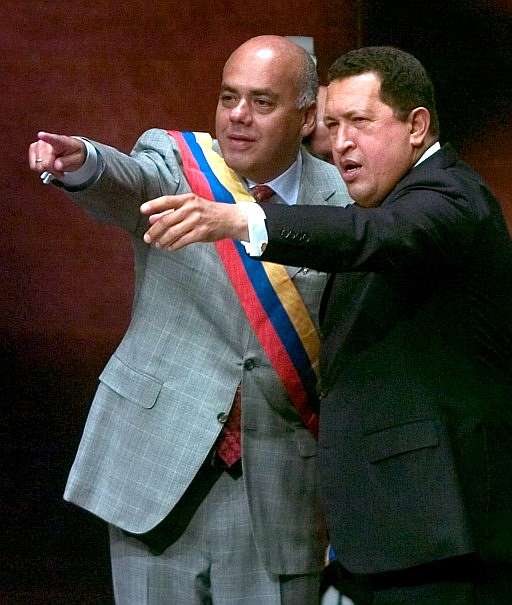
"Mr. Juan Carlos can treat his subjects in that fashion if they permit him to do so. But we Venezuelans are a free and sovereign people constructing our own future. No one can speak vulgar words to deny Venezuela's chief of state the right to speak. Nothing and no one will ever silence him [Chávez]." — Venezuelan vice-president Jorge Rodríguez, November 11, 2007


"Chávez's criticism of Europe was devastating. The same Europe which presumed to give him lessons in rectoría at the Ibero-American Summit." Fidel Castro, "Impressions on the XVII Ibero-American Summit," published in Juventud Rebelde, November 11, 2007

[In Spanish, rectoría means either "rectory" or "rectorship." We think that Castro must have invented a new word from recto, which means "honest" or "upright." Either that or he has confused "rectoría" with "retórica" (rhetoric)].

Notable & Unmanned: Hugo Chávez Reponds to Royal Rebuke

"He [King Juan Carlos] is as much a head of state as I am, with the difference that I've been elected three times with 63% of the vote; the Indian Evo Morales is also as much a head of state as King Juan Carlos de Borbón. No chief of state can tell another one to shut up. I've been told that they had to restrain the king because he was rising from his chair, although I didn't notice it. I was only telling the truth I believe, therefore I have nothing to answer for to the king. That's his problem." — Hugo Chávez, responding to King Juan Carlos' injunction that he "shut up" after repeatedly interrupting President Rodríguez Zapatero's speech at the Ibero-American Summit, held at Santiago, Chile.

Well, this adds an interesting dimension to this story. According to those near to the king, who were obliged to "restrain" him, or so Hugo has been told, His Catholic Majestry was ready to fall upon the red cacique. What a historic moment that would have been! The symbolism alone would have sufficed to make me pass out. For once, a Spain king would be vindicating the rights of the indigenous peoples of the Americas by thrashing one of their own! There are a few pages still to be written in the history of Spanish colonialism in Latin America. That would have been one.

Chávez neglected to mention that besides being a head of state like King Juan Carlos, he also aspires to be a king himself. The upcoming Venezuelan elections will make him "president for life," the first in the Americas since "Papa Doc" Duvalier. Before Chávez is through he may well crown himself, you know, so that old kings won't pick on him anymore since he'll be their "cousin."

BTW, I guess there's not going to be any Grand Cross of Isabel the Catholic in Hugo's future.

Chávez Is Given the Raspberry at Ibero-American Summit by Spain's King and President (While Castro Is Wildly Cheered)

The Babalunians are rejoicing, albeit cynically, because King Juan Carlos of Spain and Socialist President José Luís Rodríguez Zapatero stood up to Hugo Chávez at the Ibero-American Summit in Santiago, Chile. Well, even if they are doing so for the wrong reasons, they are still right to rejoice. All freedom-loving Cubans should rejoice when the chief of state and head of government of a kindred people give a public demonstration of dignity in the face of bullying and provocation, completely unexpected from either party but highly satisfactory in both cases. The king's rebuke, "¡Por qué no te callas!" [Why don't you shut up!], was addressed in the familiar "tú," which in Spanish is reserved for close friends, children and menials. We know that Juan Carlos is not Chávez's "friend." Chávez certainly is the Spanish president's, but even Zapatero felt compelled to give his Venezuelan counterpart a much-needed lesson in manners and diplomatic etiquette, which is sure to go unheeded.

In 1992, the 500th anniversary of Columbus' discovery, Castro condemned Spain as the artifex of all of Latin America's woes (prior to the founding of the United States) and declared himself a spiritual Indian. No one in Spain remonstrated against Castro. Perhaps they were actually happy that Castro had picked up the banner of the Black Legend because no one was less fit to carry it than a gallego turned "spiritual Indian" who had re-colonized Cuba as his own private fiefdom.

It was quite another thing for Chávez to start singling out Spanish "fascists" in the presence of Juan Carlos and Zapatero: the one a felicitious creation of Franco's (the "son" that Franco never had and for whom he displaced Juan Carlos' first-cousin, the Duke of Cadiz, father of Franco's great-grandsons, as heir to the Spanish throne) and the other the beneficiary of Franco's decision to bequeath democracy to his country. Zapatero is no less a creature of Franco's (one of the the "demon children" of reason's sleep, as another gallego put it), even if, unlike Aznar, he disclaims the connection. In fact, in his revanchist policies and exploitation of national divisions for his own benefit, Zapatero is more of a "fascist" than Franco ever was and certainly more than Aznar. (As a historical footnote, if Castro had attended the Summit, he would have been the only other leader there besides Juan Carlos who decreed national mourning when Generalissimo Franco died).

The King and Zapatero's indignation at Chávez's continuous and calculated allusions to former prime minister Aznar as a "fascist" shows, also, that they are not amused by the more apish caricature of the original simian, and that whatever it was that made Castro personally immune to such desplantes (literally, knocking someone off his feet unexpectedly), Chávez, much as he tries to emulate him, has not quite hit on the right formula of arrogance and braggadocio, and Castro, who holds the patent, has either forgotten the right formula or is reluctant to share it with his overanxious disciple, who can do nothing lately but allude to Castro's imminent demise and is reciting eulogies over him while his body is still tepid. If Chávez weren't a generous tipper, Castro would surely take these maledictions as maledictions.

Would it be an exaggeration to say that this public slap — which must surely be only a slight indication of what has been said privately — was administered to the "heir apparent" in order that it should be passed around until it reaches his mentor? It is Castro, after all, whose work of hemispheric conflict and disunion Chávez is advancing, and Castro, too, whose involuntary absence at the summit put Chávez in command of the "progressive forces" there. Yes, it probably is a bit of an exaggeration. But we can be sure that if Castro had been there the King and Spanish prime minister would have been more circumspect if only from the fear that Castro would have tried to top Chávez, and Castro, of course, knows where all the dirty laundry is buried in Spain's history of the last 50 years.

Although he could not make it to the summit, Fidel would not have been Fidel if he had let this opportunity go by without at least trying to upstage everybody there. So, to everybody's surprise, except Carlos Lage's and Chávez's, Castro placed a cellphone call to Chávez while he was in the middle of his speech, which Chávez interrupted to take the call and relay a message of solidarity from Castro to the Chilean people. The Chileans present responded with sustained applause and cheers, finally breaking out, at Chávez's prodding, into a chant of "Fidel, Fidel, qué tiene Fidel, que los imperialistas no puden con él." ["Fidel, Fidel, what has he got, that has the imperialists in a knot"]. When he resumed his speech, Chávez, besides attacking Aznar as a "fascist," focused on the "abuses and crimes" of Spanish corporations in Latin America. He was echoed by Nicaragua's Daniel Ortega. Having had enough of this, King Juan Carlos retired from the conference table; but the host of the summit, Chilean President Bachelet, persuaded him to return for the closing ceremony.

Like Castro, Val and Henry condemn the Spanish people for the sins of their rulers, unconscious, of course, that others might use that as a pretext to condemn the Cuban people for Castro's doings. No, "unconscious" is not the right word; the Babalunians themselves lead the pack in blaming the Cuban people for things outside their control, including Castro's perpetuation in power. It would be better to say that the Babalunians condemn Spaniards for the sins of their leaders but do not give them credit when their leaders do the right thing. In that sense, they have picked up the banner of the Black Legend which Castro relinquished to Chávez and Ortega.
Saturday, November 10, 2007

Norman Mailer (1923-2007)

Is everybody of Fidel Castro's generation destined to die before he does? Sometimes it seems that way. The latest celebrity to predecease him, at least, does not cause us any grief. Norman Mailer is dead at 84.

It would be honoring Norman Mailer's memory if I wrote one word about him as a writer, and so I won't. I am concerned strictly with Norman Mailer the mountebank, the poseur, the radical by proxy and fool by choice; and, specifically, how all these facets of his execrable personality reacted to Fidel Castro, whom Mailer called "the first and greatest hero to appear in the world since the Second War." Mailer was himself a veteran of World War II which makes his praise even more odious. A tinpot dictator and psychopath as the heir and continuator of "The Greatest Generation?" Well, Mailer never ceased to shock to no effect.

Fidel Castro has always been a magnet for [p]sycophants, but rarely has any stuck so tenaciously to him as did Norman Mailer. Eminently ridiculous in everything that he ever did or said, Mailer's praise of Fidel sounds laughable today because it was laughable then. Did Mailer really think when he compared Fidel Castro to an "erect penis" in an extended metaphor that the passage of time, let alone Castro's conduct, would redeem such an "extravagance?" Or this other conceit: "[With Fidel Castro] it was as if the ghost of Cortez had appeared in our century riding Zapata's white horse." I will not try to parse that sentence but will let our Mexican friends make of it what they will. Surely it is the first time that Hernán Cortés was ever confounded with Emiliano Zapata (the scourge of the indigenous population with its champion). The choice of historical personages, however, does show that Mailer could no more tell a Cuban from a Mexican than he could Cortés from Zapata.

Now Norman Mailer and Fidel's other great American literary admirer, Allen Ginsburg, can wait for their idol to join them in the nether regions, where each may satisfy, individually or together, their fascination with him.

Friday, November 9, 2007

Notable & Quotable: Cuba is Exporting the Best and Consuming the Worst (As Usual)

"Yes, [my wife] did take pictures [of her recent trip to Cuba], but mostly inside her mom's house as the authorities called her to task when she was filming the streets in Guantánamo and the sad state of disrepair of the houses in the town. But she filmed the road from Guantánamo to Holguín and that road was a disaster. Her stories about life in Cuba are enough to fill a big book of horrors. But here is one of them [that stands out].

One of her relatives works in a hospital in that city, and she injured herself and had sought medical help to see an orthopedician and to have her arm X-rayed. She was told there were no specialists to look at her problem and she was told to wait for 4 months for an appointment to see the doctor. Meanwhile her own husband was in Venezuela as a medical doctor earning $9,900 for the Cuban regime while being paid $50 dollars a month. Also my wife was told by the same relative that the Cuban doctors inflate the medical bills presented to the Venezuelan Govt. for the patients they attended with X-rays, electrocardiograms etc. even though they sought help for a minor ailment such as a ingrown nail. The doctors themselves feel very bad about this but they are told they have to fulfill a certain quota of tests and check-ups to pad the bill and enlarge it for Chávez. So while in Cuba the people cannot find a specialist doctor and are being attended by last-year medical students or recent graduates from the School of Medicine, the Venezuelan patients are being treated by all sorts of doctors and specialists sent from Cuba to bill the Clown Chávez for these services. She searched for over 3 days to find toilet paper to purchase with dollars at a shopping! Finally, after 3 days she went to another city and found 4 small rolls for 1.80 CUC the quality of which, according to her, was not even near the worst paper we find here. All of this of course at a price so far out of reach for the average Cuban to make it impossible for them to buy it. She found the situation so bad she was ready to leave after only 5 days into her visit. Naturally, if one was to place this comment on the Cuban Triangle, for example, the likes of commenters like Leftside would say that all of these are lies and made-up stories.
— Agustín Fariñas, comment on "Fred Thompson" thread, RCAB, November 9, 2007

Around the time that beef became unavailable in Cuba and its unauthorized possession a criminal offense, a friend related to me that supermarkets in Spain were stocked with imported Cuban beef, which sold at a lower price than did the local product. The Cuban beef, he reported, was of excellent quality and much preferred by Spaniards of limited means who could not otherwise afford beef. This was in the 1960s when Spain was on the road to becoming a developed country and Cuba had embraced underdevelopment as its future. My friend never ceased to be astonishment at the fact that he re-discovered Cuban beef in Spain. He was also reintroduced to Cuban coffee, guava paste and other foodstuffs which had long ago disappeared from the ration card or been offered sporadically and in miniscule amounts which reminded one of the taste but could not satisfy the craving for them.

In the late 1970s, when eggs, coincidentally, no doubt, suddenly became available "por la libre" for the first time in 20 years and the last time since, Cuba was able to corner the international blood plasma market. This was accomplished by harvesting its slaves, who were expected to donate blood in solidarity with their internationalist brethren who were bleeding for the Revolution in Angola and everywhere else in the Third World. Except that the blood that Cubans donated was sold on the international plasma market, where Cuba became the "superpower." It was better to donate a pint of blood than a pound of flesh. For prisoners there was not even a choice; the country's most underfed and least healthy population were the "front line" in this campaign, pumped for hundreds of thousands of pints every week. The advent of AIDS killed this market, although by quaranteening patients with HIV the regime attempted, unsuccessfully, to retain its hold on it.

It was then that it occurred to the Castroites that they didn't have to harvest the blood drop by drop but could rent its surfeit of doctors to the Third World, thereby putting a resource to use that realized no profit in Cuba while at the same time representing itself to the world as philanthropic and humanitarian. The Castro regime had to conceal its participation in the plasma business; but there was no need to hide the Cuban doctors. After all, the Revolution had made them them doctors, right? Who would dare suggest that it could possibly be exploiting them? And, to tell the truth, most newly-minted doctors were anxious to get the hell out of Cuba since they figured that their lives could not possibly get worse anywhere else. This also afforded them with the possibility of travelling and even of escape (not as great as they had imagined). The pittance they were given as allowances they could use to buy items abroad that were not available at home at any prize — simple things, like an electric razor or a thermos.

As Agustín points out, it is no longer the "surfeit" of doctors which is being exported to Venezuela and elswewhere by Cuba. What happened to buses a long time ago in Cuba is now happening to its medical personnel: they are being salvaged for pieces. Hospitals in Cuba, such as they are, are literally being disbanded and the heads of departments and other specialists shipped abroad on "internationalist missions" while the desperate needs of the populace are ignored so that the Smith Brothers of tyranny can attend to the health of their Venezuelan patron's own slaves — to the great consternation, we may add, of Venezuela's doctors, who have been displaced by socialized medicine and their professional careers effectively ended. This is not just a case of robbing Peter to pay Paul. Paul is as much a casualty of the "largesse" imposed on him as Peter is of the misery.

Thursday, November 8, 2007

Blog Review: El Güicho Crónico

I am gifted with a "genius radar." It is the ability to process as little as one paragraph of prose through an unpatented internal mechanism too complex to explain and not altogether understood by me, which, in a matter of seconds, provides me with the writer's IQ. Of course, we should never confuse IQ with utility. Hyperintelligent people are rarely useful to society. The smartest man who ever lived collected trolley car transfers and wrote the authoritative text on them, the greatest monument to misplaced scholarship since St. Thomas Aquinas calculated the number of angels that could fit on the head of a pin. That much said, I believe I have discovered the greatest intellect in the Cuban-American blogosphere. No, it is not Val Prieto. A joke like that would make me an imbecile.

As it happens, the genius to whom I refer doesn't take himself too seriously, which is a good thing. In a country where someone who reads books is considered a little odd and one who writes books the oddest of the odd, it would hardly do to parade one's intellectual endowments without at least buttressing same with a considerable layer of regular guy bravado. This our genius does a little to excess, but then again he has a lot of genius to cover. In the autobiographical sketch appended to his blog, he reproduces the grateful exhalations of various women in flagrante delicto, a broad slice of humanity — German, Peruvian, French, Argentine, Brazilian, etc. — attesting to the universitality of his libido if not his genius. Do not be fooled: the genius lurks behind the jerk, who exists only to enable the genius to exist. This genius calls himself a "precocious retard," which, socially speaking, most geniuses are; but we believe he is just undercompensating.

This genius is not very prolific. He started his blog in September 2007 and has produced some 25 posts to date. Of course, the biggest fools in blogdom are the most prolix. Quantity can never supply the place of quality, though it is often mistaken for it by even bigger fools.

The name which this newest Cuban blogger goes by is El Güicho Crónico. I am going to refer you to my favorite post from El Güicho which provides the key to who we are as a people and what the future holds for us. Having read it, you will never see our country the same way again. Whether that is a good or bad thing, I will leave to your discretion.

http://guicho-cronico.blogspot.com/2007/10/blog-post.html

Wednesday, November 7, 2007

Fred Thompson Shoots Himself in the Foot (And Cuban "Suitcase Terrorists" Have Nothing to Do With It This Time)

When William F. Buckley was running on a lark for mayor of New York City in 1965 on the Conservative Party ticket, he was asked what he would do if he won the election. "Demand a recount!" he famously replied. Fred Thompson has taken a page from Buckley's old playbook; but unlike Buckley, who could afford to be flippant because he had no chance of winning and probably improved his showing with his candor, Fred Thompson did not do himself a favor and certainly did not amuse his fanatical followers when he admitted that he was unelectable. That he did so on camera and before an audience only made matters worse.

Thompson was waiting to be interviewed on the air by FOX News, which should have been an easy venue: these MSM folks, at least, wanted to make him look good but Thompson would not collaborate. It had taken longer than expected for the interview to get underway and reporter Carl Cameron quibbed to his producers: "The next president of the United States has a schedule to keep." Without missing a beat, Thompson interjected: "And so do I." Apparently, Fred Thompson must have thought that he was still on Saturday Night Live. His "people" cringed in disbelief and forced themselves to smile for the cameras, which is a trick they have learned to perfection. The host chided Thompson, "You can't do that kind of stuff!"

Thompson's followers always believed that their man actually had a chance even if Thompson himself never seemed particularly energized for the race. If he didn't get the nomination, Thompson at least had a good chance of being asked to share the ticket with Guiliani as a sop to conservative Republicans. Now, however, his chances of being on the Republican ticket, in any capacity, have plummetted from slim chance to fat chance.

For my part, it was the first time that I ever found Thompson likable or that he reminded of Ronald Reagan. Indeed, in some ways it seemed a re-play of Reagan's faux pas, when, during a rehearsal for a speech, the Gipper, unscripted, gave mock orders to nuke the Soviet Union which went over a live feed. What a holiday the MSM had at the old cold war warrior's expense! The Bulletin of Atomic Scientists even set the "Doomsday Clock" to 3 minutes before midnight because of Reagan's remark, which supposedly revealed his heart's "black secret." In a few years, of course, the Soviet Union would be no more and the nuclear clock would be put in mothballs even if the nukes themselves were not.

This political gaffe is not going to end Thompson's candidacy or even create a national sensation, because, let's face it, the gravitas level in this election campaign is not exactly set on high. He'll continue to prod his way on the road to Also-Ran, which is not a town in Mongolia, though it might as well be.

Personally, I don't mind that Fred Thompson is Reagan-Lite. What worries me is that he is also Tancredo-Lite and Newt Gingrich-Lite. If he were elected president, it would be greatest calamity that could befall Hispanics short of Tancredo or Gingrich themselves being elected. Thankfully, those "shining lights" are pretty much extinguished and Thompson's own bulb is flickering.

I guess that with Newt Gingrich out of the race and Fred Thompson hoisted on his own petard, Henry Gómez and the other Babalunians will have no choice but to support Tom Tancredo.


POSTSCRIPT:

The "Doomsday Clock" is still ticking, after all. In fact, on January 17, 2007, the Board of Directors of the University of Chicago even moved the clock forward two minutes to just 5 minutes before midnight. This change had nothing to do with the nuclear threat, however. For the first time since it was created in 1947, the clock was advanced because "the dangers posed by climate change are nearly as dire as those posed by nuclear weapons." Yes, now the world is threatened by so-called global warming, not thermonuclear warming. I think we can all breath a sigh of relief, even it that's not what these nuclear "Seventh-Day Adventists" intended.

Also see:

Henry Explains Fred Thompson to Us

Fred Thompson: Cuban "Immigrants" Are Suitcase Bombers

Tuesday, November 6, 2007

Another Satisfied (Foreign) Customer of Cuba's Health Care System

Here's a follow-up on Diane Paul, the 520 lb. Canadian who went to Cuba in October for knee replacement surgery because local doctors refused to operate on her unless she lost half her body weight. We advised her at the time to forget about the operation and get on the "Cuban diet" which was certain to succeed where all other diets had failed. On the "Cuban diet" you don't need to rely on your own willpower to resist food, which is the chief obstacle to losing weight in countries where food is actually available. In Cuba, the State supplements your willpower with its willpower. It not only tells you what to eat, when and how much, but requires everybody else to follow the same regimen whether they need to lose weight or not. No need to fear being tempted with goodies in your own house, or your neighbor's house, or, indeed, anywhere that ordinary Cubans may frequent in the course of the day; and all the exercise that you could possibly need will expended in a year-round, decades-old "Easter egg hunt" which, of course, encompasses all foods, not just eggs. In fact, the quest for food will pretty much consume your life to such an extent that the actual consumption of food will be the briefest episode in that quest. Of course, for the "Cuban Diet" to work Diane would actually have to consent to eating as Cubans do. Even healthy individuals like Anita Snow have found that a bit of a challenge. The New York Times reporter, who went on the "Cuban Diet" as a lark, had a penchant for green leafy stuff and was content if she could get her daily requirement of chlorophyl. We suspect that Mrs. Paul has other cravings which may be more challenging to satisfy in Cuba. That is, though she may look like a cow, we doubt that she eats like one. Still, since the Cuban regime — well, actually the Cuban people — are picking up the tab for her operation in exchange for the publicity, the least she could do in Cuba is eat as the Cubans do. But no, she went to Cuba so she could be ambulatory and 520 lbs.

Diane Paul didn't get new knees in Cuba, which didn't surprise us either. She's lucky she wasn't the recipient of the world's first knee transplant surgery. Real knees can be had readily enough in Cuba, though perhaps a little worn from all that kneeling; but titanium knees are rather hard to come by. As we noted when Mrs. Paul first announced her quest for new knees in Cuba, she should ask to see them before they were implanted. Improvisation is the great resourse of Cuban medicine. A patient with bone cancer recently had a section of his legbone replaced with a broomstick. The operation was successful. New bone actually grew over the broomstick. No doubt the news of this revolutionary achievement would not have been made public if the operation had failed. Maybe it failed many times before this success. Still, we warned Mrs. Paul to be wary or she could end up with wooden clogs for knees.

Well, she seems to have taken our advice. There was no double-knee replacement in Cuba. The Cuban doctors determined that their Canadian and American colleagues were wrong. Mrs. Paul did not need to have her knees replaced, after all. As reported in a publicity release, they "instead treated her legs with massage therapy, drained water from her knees and realigned her leg, including surgery to attach small bolts to her knees." Perhaps the Cuban doctors should have attached big bolts to her jaw. Those bolts would have made the other bolts unnecessary. I am going to take it for granted that my reader can detect for himself the insanity of attaching bolts, even small ones, to knees that have essentially turned to jelly, which is why they needed to be replaced in the first place.

There is a strange twist to this story (well, another one, anyway). Mrs. Paul's husband Vern, who accompanied her to Cuba for "moral support," was so impressed by "the high quality of care" which his wife was afforded that he decided to have surgery, too. Mr. Paul underwent an elective blepharoplasty. No, it's not what you are thinking, although a man with a 520-pound wife should seriously consider having surgery to enable him to bring the mountain to Mohammed or at least get under it. But no — a blepharoplasty is a cosmetic surgery to remove the bags from under one's eyes.

The Pauls are reportedly satisfied with the treatment they were accorded in Cuba. "Everything is wonderful. My God, it is absolutely amazing the outstanding care that I am receiving. The only pain that I have now is a slight pain in my kneecap, but my doctors tell me that they will go away soon. I felt good enough that I went out to see Old Havana yesterday," Diane enthused. Her husband is equally pleased. "Our treatment has gone beautifully, absolutely beautifully," Vern said.

And so, without the knee-replacement surgery that she desperately needed but with a younger looking spouse (which she didn't need), Diane Paul returns to Canada to sing the praises of Cuban medicine in her new position as spokeswoman for Winnipeg-based Choice Medical Services, which "helps Canadian and U.S. patients to access Cuban healthcare." For anybody who might be interested, their toll-free number is: 866-672-8284 [their press release requested the plug].

Cuban Shorts
Anita Snow the Hunger Artist, or The New York Times' "Snow Job"

What is the Answer?

fantomas said...

We are fucked, Manny... What is your recommendation then?

Or are we doomed... another 50 years of a one-party controlled state?

Dime.
11/05/2007 11:24 PM


Manuel A.Tellechea said...

fantomas:

A very acute observation: we are royally "fucked-up." The last Cubans to have voted in an indisputably democratic election in Cuba are now 80 years old. The Cubans who left at age 20 in 1959 are now almost 70. Most who left who were older than 30 are already dead. We have in fact buried more Cubans over the last 48 years than lived on the island in 1959. For the first generation of exiles it's practically over already. The second generation are in their 60s. The average age of Cuban exiles is 45, or twice that of other Hispanics in this country. 45 may still entertain some hope of seeing a free Cuba — as old men, perhaps.

So, yes, fantomas, most of our lives have been sunk in waiting for that precious "Cambio" which children now sport on wristbands in Cuba to their great detriment.

There is no reason to hope except that hope is all that we have left. Fidel and Raúl will die and we will not have to wait another 50 years for them to die. Then we will see if the plutocracy they have created in Cuba can survive them or not.

The best hope — practically the only hope — is that the system will implode as it did in the Soviet Union. There were a few White Russians who lived to see the fall of Communism. There will no doubt be a few of us left who will also see that day in our country. "No hay mal que dure mil años..." as we have told ourselves for 48 years as if we had 1000 years to spare.

Monday, November 5, 2007

Notable & Demonic: A Disagreement at Babalú on Whether Cubans Should Commit Collective Suicide

"It’s frustrating to sit on this side of the puddle and wonder why the Cubans living on the other side just don’t do something. Anything! Ok, so some kids wore some “cambio” bracelets and got arrested. Quietly. Big deal! Have you seen the protests in Venezuela? The hell with bracelets. We need protests like those. Thousands screaming with signs, tear gas, rubber bullets, brutality, beatings, blood." — Gusano, "Cuban Philosophizing," Babalú, November 5, 2007

Babalú newbie Gusano is actually being sarcastic; he does not endorse this point of view but is merely illustrating its cynicism and cruelty. As he later comments, "The best swimmer is the one that isn't in the water."

Ironically, Gusano's boss, Val Prieto, also suggested last week that Cubans commit collective suicide but he wasn't ridiculing this position; on the contrary, he was advocating in deadly earnest that Cubans on the island submit themselves to "bullets, brutality, beatings and blood," to use Gusano's nice stretch of alliteration. Or, in Val's own inimitable words, which I compared then to an oration of Patrick Henry's slightly modified ("Give me Liberty and Give Them Death"), this is what Val wants Cubans on the island to do:

"Freedom isn't going to knock on [the Cubans'] doors and ask to come in. It isn't going to arrive in a package from Hialeah or in the suitcase of a family member coming from abroad. Freedom is going to hide behind hunger. It's going to hide behind pain, it's going to hide behind sacrifice. It's going to hide behind bruises and in a pool of blood. And it's only going to be found when it is painstaking[ly] sought after, sought after with extreme hunger and empty bellies, with broken bones and bloody hands and with sheer desperation. There are 11 million people in Cuba, yet you see merely a handful standing firm in their convictions and against their government. Until that handful exponentially increases, not a damned thing will change." — Val Prieto, judging the Cuban people and passing sentence on them, Babalu blog, October 25, 2007

I suppose that Val is still not pleased. The Cuban people have yet again failed to live up to his lofty expectations. Last week he was excoriating them for not producing "torrents of blood" to sweep away Castro, or, more likely, to increase the number of his victims exponentially. Either outcome would be acceptable to Val: whether freedom for Val or fewer "cowardly" Cubans. Instead of the requisite "torrents of blood," Val got 70 Cuban young people wearing plastic wristbands emblazoned "CAMBIO." Castro's uniformed goons fell on them like Batista's soldiers on the terrorists who attacked the infirmary of the Moncada barracks in the first action of the Revolution.

Cambio: such an innocuous little word and subject to so many interpretations! Yet for the regime it has only one: its elimination, and so it reacted as it always does to all challenges great or small to its authority, swiftly, relentlessly and disproportionately. It requires an open and basically free society — as was Batista's Cuba — for a revolution to be launched and succeed. In a police state such as Communist Cuba, the option of revolution, at least from within, doesn't exist. Communism in Cuba must implode as it did in the Soviet Union, or it must be defeated from without. To expect hostages to free themselves, when their captors control every phase of their lives, and, of course, the means of repression (which is also the means of rebellion), is the ne plus ultra of cynicism and conduces to nothing but martyrdom, and more martys is the one thing that Cubans don't need.

Read more here:

Notable & More Delusional Still: "Patrick Henry" Prieto Rides Again

Sunday, November 4, 2007

The 1936 Berlin Olympics Redux: Or When In China Do As the Chinese Tell You to Do


Those of us who still find it incredible that the Olympics were once held in Berlin with Hitler as host and the whole world in attendance now have proof (as if proof were needed) that the world is still myopic when it comes to evil and can only appreciate it in its real dimensions when it is too late to do anything about it. What difference is there between holding the Olympics in China in 2008 and holding them in Berlin in 1936? Morally there is no difference. If we parse evil, however, there is a great difference: In 1936 Hitler had not yet embarked on his campaign of extermination nor yet provoked World War II. An objective observer could have seen what was coming, and many in fact did; but most of the world was still in denial about Hitler in 1936. Denial then meant refusing to take Hitler at his word, because he was nothing if not candid about his plans. In China's case, however, the evil is completely consummated. Holding the Olympics there next year is more closely analogous to holding them in Berlin in 1944, not 1936. And yet the whole world is now preparing to do precisely that with great enthusiasm and no moral scrupples. Not one nation has refused to participate in protest and no one has even attempted to organize a boycott.

Many presume that capitalism has mitigated the worst excesses in China, when, in fact, it has only perpetuated them and solidified the Communist system of repression, as no doubt the introduction of the free-market into Cuba would extend the shelf life of Castroism indefinitely while not altering its basic ingredients.

If anyone requires proof that the Red Chinese are still the Red Chinese, they should follow closely the preparations for the 2008 Beijing Olympics. The organizers have just published a list of "prohibited objects" in the Olympic Village where the athletes will be staying. Yes, of course, video cameras have been prohibited: they sell them to us but won't allow them to be used in their "controlled environment." But that is not the worst. Bibles are also on the list of prohibited items and the athletes themselves are forbidden from wearing any religious insignia including crosses at the Olympic Village. No word yet whether they will be prohibited from praying or holding religious services there, though for Christians the latter would be difficult to do in the absence of Bibles and crosses. Difficult but not impossible: the 15 Catholic bishops and religious imprisoned by China still manage to say mass in their cells.

Is this what the Olympic spirit has devolved into — Peace and unity through enforced atheism? Well, China is still a Communist state and one can hardly expect it to cease to be a Communist state for the duration of the Olympics. Yet that is precisely what the International Olympic Committee thought would happen if it awarded the games to Beijing. Guess what? China outlawed extraterritoriality a long time ago. When in Red China, you must do as the Red Chinese tell you to do whether "white devil" or no.

Saturday, November 3, 2007

Jimmy Carter Filler: His Biggest Secret and Greatest Claim to Fame


What shall our "Jimmy Carter Filler" be today? We have several items to choose from:

* Jimmy Carter is a lifelong bottle collector. He digs for them in old dumps and abandoned outhouses.

* Jimmy Carter did not allow his daughter Amy to have a pet dog at the White House. Instead, Amy had a pet tree.

* In his first day in office, Jimmy Carter pardoned all Vietnam War evaders.

* While a midshipman at Annapolis, Jimmy Carter was hazed for refusing to sing "Marching Through Georgia," Sherman's storied war song.

All those are all good choices, though perhaps not quite as good as his UFO sighting or his execrable poetry.

No, something better is required and I have it:

The greatest service that Jimmy Carter could do for this country would be to admit something which he and his entire family have concealed for generations, but which is clearly visible and unmistakable. It would have been much better if he had acknowledged it before, certainly there was no reason to conceal it after he became president; nevertheless, he did conceal it and continues to conceal it to this day. All the good works that are attributed to him with hammer and nails, the peace treaty which he secured by bribing Israel and Egypt, anything else of value which he may have done for his country or humanity, however exaggerated, would pale in comparison to the monumental impact which he could have had on the social evolution of this country and the consolidation of its people, had he admitted the truth in season.

The one real opportunity which Carter had to change this country for the better and assure himself an honorable place in its history rather than in the annals of political opportunism, he disregarded and squandered; still, no further documentation is required than what Nature imprinted on his face, his mother's face and his daughter's face. The emperor's clothes (or lack thereof) were never so evident as Carter's African-American origins. In Cuba, he would have been known as a jabao; here, the comparable term is "high yellow" or "blue-veined" (that is, the blue veins are still visible through the skin). This heritage should be a source of pride to him and any of his race who would acclaim the worst president in U.S. history as the first black president. That alone would immediately increase his stature and perhaps even overtake the Iran hostage crisis as the best known event of his presidency (even if it was a non-event).

Bill Clinton may have been America's first temperamentally-black president, as many African-American pundits have asserted; but the first genetically black president, at least in the modern era, was Jimmy Carter, who made a journey unheralded that others are still trying to undertake under the apprehension that they will be the first to break the presidential color barrier.

Come out of the racial closet, Mr. President, it's safe for you and your family now. 83 years is long enough to hide.

A Prayer to Blessed Fray José López Piteira


Blessed Fray José López Piteira, imprisoned and martyred at the hands of the Communists for the Holy Faith, we who are your countrymen and brothers in Jesus Christ, beseech you in His name to intercede for us before God the Father. To you, Blessed Martyr, who refused to plead your Cuban nationality to save your life because you desired to die alongside your brothers in Christ, we humbly invoke our own to ask you to save our brothers and deliver our country and church from the scourge of Communism, in the name of the Father, the Son and the Holy Spirit. Amen.

This is a prayer for the faithful of Cuba which will never be sanctioned in Cuba or heard in any Catholic church there while Jaime Cardinal Ortega is archbishop of Havana and primate of Cuba. In Cuban churches today only prayers for the health and recovery of Fidel Castro are permitted and none allowed for the deliverance of the Cuban people from Communism and of the Cuban church from its shameful silence of 5 decades.

The disgraceful prelate has gone so far as to say that he doesn't consider Blessed Fray José López Piteira to be a real Cuban ("cubano cubano") because his parents took him back to Spain at age 5. Ortega is apparently unaware that Martí's parents also took him to Spain at age 5. If Blessed Fray José, who was only 23 at the time of his martyrdom, had lived to be ordained as a priest, he would have returned to his native Cuba with hundreds of Spanish priests whom Ortega's master deported in 1962. What really irks Cardinal Ortega, of course, is that the first Cuban to be beatified and the first Cuban likely to be canonized died heroically at the hands of the Communists. Ortega, on the other hand, has lived handsomely and after his manner by never standing up to them, not even when they sent him to an UMAP re-education camp in the 60s. So abject is he in his submission to the State that he declined to attend Fray José's beatification ceremony in Rome, placing himself, as he has always, at the side of the verdugos (henchmen); or, perhaps, the archbishop feared that he might miss the opportunity to give last rites to Fidel or even eulogize him.

A church that does not defend its people and a people who do not rely on it to defend them is yet another legacy of Fidel Castro's rule; but Castro, personally, is not responsible for the moral cowardice of the Cuban hierarchy and clergy. The heroic virtue of the Spanish clergy in the Civil War (1936-39), 8000 of whom died as martyrs for the faith in 3 years, among them the Cuban Blessed Fray José López Piteira, is a living reproach to the passivity, complicity and collaboration of the Cuban church over the last 50 years (and, indeed, throughout its history). Penance after the fact can be expected of it; courage before that fact cannot. We sincerely hope that Blessed Fray Jose's first miracle will be to deliver our country from Communism; but even if he were only to redeem the Cuban church from its sins of commission and omission and transform it into a church militant, it would be enough.


POSTSCRIPT:

[The Latest News] Blessed Fray José López Piteira's canonization is imminent. As a martyr he requires only one miracle to be declared a saint. Such a miracle has already been attributed to him. In May 2006, the Papal Medical Consultative Committee determined that the cure of 6-year-old Daniela Cabrera Ramos from stage 4 of Burkitt's Disease, which is always terminal, could not be explained scientifically or attributed to human agency. The child's parents had prayed to Fray José for a cure. All that remains now is for the Theological Committee to confirm the findings of the Medical Committee and certify the cure as a miracle. The Theological Committee has been waiting for the beatification to make its formal announcement, which is now expected soon. Then the pope will issue a decree authorizing the canonization and we shall have the first native-born Cuban saint.

http://www.conexioncubana.net/index.php?st=content&sk=view&id=6474

Friday, November 2, 2007

Stuck on the Palmetto's Rick is Deleting Posts and Cannibalizing His Readers

Those who are most obsessed with their own privacy are usually the least respectful of the privacy of others. Such is the case with Stuck on the Palmetto's Rick, one half of that blog's anonymous duo. On October 31, Rick aimed his vitriol at a faithful commenter named "El Chino" whose offense appears to have been that he spends too much time on SotP, up to 12 hours per day, even visiting in the wee-morning hours to see if anyone has responded to his comments. Whereas other bloggers would cherish such misplaced loyalty and waste of time, Rick lashed out against the poor man as if he were a circus owner and El Chino was trying to sneak under the tent for the fifth time without paying admission. Rick even copied the actual reports from his stats counter to prove that El Chino spends almost all his waking hours nesting on SotP. As another commenter observed this smacks too much of Big Brother. To me it indicates two things: first, Rick, like El Chino, has a great deal of time to waste on minutiae; and second, Rick is at least as obsessed with El Chino as El Chino is with SotP. This is known clinically as co-dependency, and it is not at all unusual for one of two parties in this abnormal relationship to lash out irrationally against the other because he finds the attention stiffling, completely unaware that he is also enabling it. The implication in Rick's sarcastic recognition of El Chino as SotP's "Model Reader" is that El Chino has no life besides SotP, and must be some kind of wastrel. Well, if El Chino is a wastrel, then what is it that he is wasting his time on? Rick and Alex. And what does that make them: a waste of time.

These thoughts, prodded by his readers' comments and El Chino's own pleas, caused Rick to delete the offensive post and offer an apology: "It was a mistake because it was mean-spirited on a level that I'm personally uncomfortable with and that I regret" (this is noteworthy because no one ever suspected such a level existed). Of course, being Rick, he credits no one for his decision but his own innate compassion and elevated humanity. Rick has on more than one occasion chided Babalú, and rightly so, for deleting or altering posts at will without explanation. Rick is only partially guilty of Babalu's offence as he did announce that he had deleted the post and offered an explanation for doing so. He did not, however, explain why he had posted "Our First SotP Model Reader Award" in the first place. Anyone who is aware of Rick's animus towards Cubans will need no explanation. In fact, he provides the clue in the post itself when he says that he "has been engaged in an extended back and forth" with El Chino regarding Ron Paul's recent comments about Cuba, which Rick quoted with approbation: "Let's stop the hysterics about the freedom of Cubans – which is not our government's responsibility – and consider freedom of the American people, which is. Americans want the freedom to travel and trade with their Cuban neighbors, as they are free to travel and trade with Vietnam and China." El Chino demolishes Ron Paul and Rick on that thread with great finesse and persistence and Rick is reduced to defending himself and Ron Paul by asserting that Osama Bin Laden is worse than Fidel Castro (which besides being irrelevant is also untrue: 3000 vs. 104,000 killings). Of course, in Rick's reckoning, 3000 American lives are worth more than 104,000 Cuban ones:

el chino said...
Sure, the people should decide [for themselves if they should travel to Cuba], not the government, so if an American wants to sell weapons to Al Qaeda he should be free to do so, right? Sheesh, what a moron.

Rick said...
Yes, el chino, because we all know that Fidel Castro is the equivalent of OBL. Just like him. Nice to see you made a stop at SotP on the way to babalu, EC. Thanks.

Rick's apology for his attack on El Chino is not much of one. As we have already observed, it is simply an opportunity for him to pat himself on the back on how fair he is. El Chino, who was quick to forgive Rick — remember, it's a co-dependent relationship — also requested that Rick delete the apology as well, since Rick repeats in the so-called "apology" all that was offensive in the first post and even suggests that readers unacquainted with the first post search for it in Google's cache, where it can still easily be found. I should not be surprised if Rick deletes the second post as well with its even more intrusive allusion to El Chino as "supposedly disabled and unemployed." But, really, what would be the use? El Chino should quit while he's behind: a second "apology" from Rick is sure to finish him off for good.

In another post that day Rick invited his readers to ask personal questions about him and Alex, in order to balance, I suppose, his personal inferences about El Chino. Of course, the questions would be asked of two anonymous people who would, naturally, reply as anonymous people. Very enlightening, to be sure. Rick agreed to answer one of the questions from those submitted by his readers. If nothing else Rick has proved that one can be anonymous and a megalomaniac at the same time. Rick also revealed that he and Alex had gone incognito to bloggers' conventions and turned down "numerous" interviews from "varied media" because the reporters insisted on using their full names and they "needed" to retain their anonymity. Of course, I could have answered all the questions that were asked of Rick and Alex for them. But it would not have been gentlemanly to pull off their masks, and I am nothing if not a gentleman even when dealing with a scoundrel like Rick. If Rick were one too (a gentleman, that is), he would not have used his position as blogmaster to ambush an innocent reader or been obliged to apologize for it.

Thursday, November 1, 2007

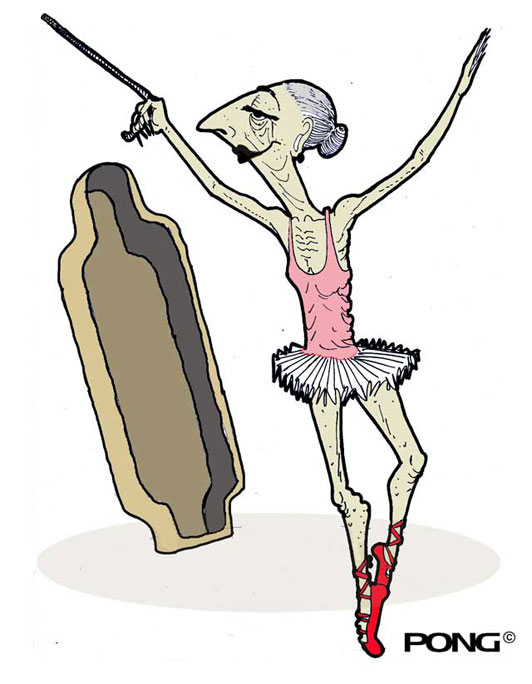
From the Tellechea Newspaper Archives: Alicia in Wonderland (1987)


Morley Safer Tiptoes Around a Mercenary Ballet Star

By: Manuel A. Tellechea
The New York Tribune
Commentary Section, p. 9
March 28, 1987

Ballet was danced for the first time in Cuba in the 18th century; the same European troupe that introduced it to Philadelphia brought it to Cuba. Moreover, Cuba was the first Latin American country to have its own ballet company (at the time there were no more than a dozen in the world). Alicia Alonso was reared and nurtured in that milieu, some 70 [now 85] years ago; she did not, as the Sixty Minutes puff that aired on March 22 [1987] asserted, "give birth to ballet in Cuba." Whatever Alonso's achievements in that sphere may have been (and I will not belittle the artist because the woman is a creature of Communism, though not one formed by it), she owes her success in no small way to the pre-revolutionary society that she now belittles and condemns. She was introduced to ballet in Cuba, where she studied with the Russian master Yavorski at the ballet school of the Fine Arts League of Havana. The education she received there was good enough to make her one of the greatest ballerinas of her day, which says as much for the education as it does for Alonso. Significantly, Alicia Alonso as a teacher has not been able to produce a comparable artist for Cuba. Maybe she hasn't wanted to. Still, she is the most famous cultural icon of whose allegiance the Revolution can boast.

Alonso was a name before 1959 and her decline may be dated from that year; not a whit of fame has attached to her since except as a curiosity: a dancer at 70 who is partially blind and rheumatic. She should have retired 30 [50] years ago, and, indeed, she did — after a long and distinguished career that saw her hailed as the definitive "Giselle." For a brief period in the 1950s she at least recognized that her age and failing vision had deprived her technique of the excruciating exactness that once defined it.

Unfortunately, Alonso's retirement was short-lived; she found a new patron who valued her for something other than her dancing, and returned to the stage in 1959, and has remained there ever since, unforgiving decade after unforgiving decade, having discovered that the masses (her "new audience") couldn't tell between the exactness of perfection and the exactness of impairment, and, frankly, didn't care.

As one of the handful of Cubans to have achieved international celebrity, Alonso's return to the stage was hailed from all quarters, and since it coincided with the coming to power of Castro, many chose to regard it as a political statement on her part rather than as a statement of opportunism. Needless to say, she encouraged the political interpretation. Whether by design or personal good furtune, she had returned to the ballet not merely as a dancer but as a symbol of nationalism at the historic moment when nationalism was at its apex in Cuba. Castro found time in that first year of the Revolution between the signing of execution orders and the wrecking of Cuba's economy to award by decree official status to the Ballet Nacional founded by Alonso in 1947.

Alonso was introduced by Morley Safer on Sixty Minutes as "the one unsevered link between the U.S. and Cuba (because she's allowed to dance here on occasion), as if 1.5 million Cuban exiles counted for nothing, nor the ties of history and mutual affinity that existed between our two peoples before that ill-omened year of 1959.

To become Castro's roving ambassador of culture, Alonso had to alter completely her vita curriculum. Her father had been a major in Cuba's pre-revolutionary Army; she disowned him. The film of Alonso's performance at Batista's inaugural ball in 1955 vanished from both the national archives and the collective memory of the nation, as did also the diamond collar from her neck that Batista had presented her on that occasion. Her fortuitous retirement in 1957 was transformed belatedly into a "protest against the Batista tyranny."

Alicia's checkered past has never been thrown at her face by any correspondent. Morley Safer was no exception. He might confront his own mother but not the "one unsevered link between the U.S. and Cuba." Not that the subject of Alonso's apocryphal "boycott" didn't come up. The fairy tale of the courageous dancer that refused to tip her toes to Batista while her countrymen were waging their revolution was submitted for our consideration and applause.

"Why didn't you dance," asked Safer. "Because killing is intolerable to me," replied Alonso. For one moment, I hoped Safer would counter, "Why do you find killing more acceptable now than you did before 1959." In truth, Alonso has always found killing tolerable — before and after the Revolution.

She retired from the stage from 1956 to 1958 precisely because she approved of killing but not of being killed herself. During those years the rebel underground achieved its greatests success bombing theatres and nightclubs. Alonso could have condemned these killings, as did almost all Cuban entertainers; instead, she retired from the stage and let Castro and his terrorists bomb away. Although sympathetic to the rebels, in the back of Alonso's mind must have lurked the thought that they might score their greatest coup by blowing her to smithereens.

When Castro came to power, she naturally had no objection to the continuation and escalation of the killing, now with her society friends as the victims. Nor did she even object when her own troupe became the focus of Castro's insecurity and bloodlust. Throughout the 1960s, Castro's persecution of homosexuals usually began with the National Ballet. Alonso never spoke out on behalf of her "spirit children," many of whom she had rescued from orphanages and raise to be her dance partners. In 1965, the whole male ensemble of her ballet, or what was left of it, defected while on a tour of France. This, some may recall, was the opening scene of Improper Conduct, the acclaimed documentary that exposed the homophobic side of Castro's character to his liberal devotees. Safer did not embarrass Alonso with the recollection of her role in these decidedly unprogressive happenings.

Cuban culture owes very little to Alicia Alonso — except a black eye. Communist Cuba has not yet achieved the sophistication of Communist Russia, where tsars like Peter the Great, writers like Dostoevski and composers like Tchaikovsky have been rehabilitated as examples of the superiority of the Russian nationality. By contrast, in Cuba everything before 1959 is still considered backward and counter-revolutionary. Just as Communist economists must depict pre-Castro Cuba as underdeveloped and Communist moralists denounce it as hedonistic, Alonso is expected to portray Cuba's past as devoid of popular culture and art. Her pronouncements against pre-revolutionary culture are given wide currency in the U.S. media because it would be incongruous that so famous an exponent of Cuban culture should fail to recognize — let alone demean — that which she herself represents. The explanation that Alonso lies from self-interest — because it is in her interest to be wellspring of Cuban culture — is simply overlooked.

For much of the 20th century (that is, until 1959), the music and dance of Cuba were the music and dance of the world. If you are between 50 and 100 years of age, you have partaken richly of Cuban culture even if you are not Cuban. Of what other cultures can the same be said?

The rumba, the mambo, the conga and the cha-cha-cha: who will say — and who can prove? — that these are manifestations of backwardness or that ballet is more refined and worthy? If so, Cuban dance is a wonderful "backwardness" in which the whole world shares, unlike ballet, which is for the few and the nimble. How remarkable that this supposedly nationalistic revolution has replaced Cuban folk music and dance with the elite Soviet sport of ballet!

What has the arid and stupefying cultural climate in Castro's Cuba produced in the latter half of this century? Since I am not objective commentator on the "achievements" of the Cuban Revolution, I will led British historian Hugh Thomas do this sad office for me:

"Along with the fine arts, popular culture in Cuba, that is, the music, literature, art, dance, theatre, and film enjoyed by the broad sections of the population, has lost its creative zeal under a regime that respicts artistic freedom and individualism. Cuba, which prior to Castro was one of the leading centers of Latin dance music, has since failed to contribute to the rich body of Latin American popular music. Tragically, the Cuban Revolution cannot offer a single notable novelist a famous poet, a penetrating essayist, nor even a fresh contribution to Marxist analysis. Censorship and fear have smothered creativity in Cuba. What is left on the island is merely the incessant voice of official propaganda."

Is ballet the exception that has survived the death of all the arts in Cuba? Not unless a ballet company that features a 70-year old ballerina can be said to be anything other than a freak show. Alicia Alonso is Cuban ballet as she was in 1940, and there's the rub. After Alonso, what? Let us hope Fernando Bujones — the exiled great of Cuban ballet — in a free and democratic Cuba [Bujones died of cancer at age 50 in 2005].


POSTSCRIPT:

New York Times columnist A.M. Rosenthal also commented on Safer's 1987 interview with Alicia Alonso on 60 Minutes [March 26, 1987]. Since this is one of the few ocassions that The Times ever complained about somebody else's misrepresentation of the Cuban reality, it is worth quoting:

On "60 Minutes" Morley Safer is interviewing Alicia Alonso, the great Cuban ballerina. Alonso is 65, nearly blind, a heroine and beloved teacher in Cuba, admired deeply by the world of ballet at home and in the United States, to which she travels often.

Mr. Safer points out that although she had a privileged position under the dictator Batista, during his regime she carried out her own protest against his brutality. Dancers are not just horses, running in blinders, she says. So she protested by refusing to dance for several years until, as Mr. Safer said, "the revolution succeeded."

Now she is a national figure in Cuba, and lives a queenly life.

No, not one word. Not one word from her and not one question from Mr. Safer about how she feels now about horses, or Mr. Castro's imprisonment of poets, painters and writers. An unquestioning plug for Mr. Castro and a rewriting of history by omission.

Mr. Safer is skilled enough, sophisticated enough, to know better. He does. He told me that he did indeed ask the ballerina questions about Castro tyrannies. But she was wordy and polemical so he thought he would cut that part. It made for a better show, he said. A judgment call, he said.

Alicia Alonso: The Cuban Sphinx


Babalú newbie Alberto de la Cruz hits a home run with his post on prima ballerina assoluta (obsoleta is more like it) Alicia Alonso, who has just been placed at the entrance of "Monsieur Castro's Wax Museum" so that she can denounce the U.S. trade embargo as a "siege" while Culture Minister Abel Prieto announces plans for celebrating the 60th anniversary of Cuba's National Ballet (60th anniversary? Yes, it was founded before the Revolution, as was Alonso's star and legend).

Alonso is truly as wretched a human being as ever lived upon the earth and was a mentor to Castro not just a groupie. In the 1960s she fed her "children" (the male dancers she trained as arm-rests) to the UMAP concentration camps. Still, she is lavishly praised when she performs in this country by the very people who are hailing the $11 million fine imposed by a jury on a Christian Church that opposes homosexuality and exercises its constitutional right to protest it peacefully if in poor taste.

Twenty years ago, I wrote that it was inconceivable that Alonso could still be performing in her seventh decade. Now she is in her ninth, and nothing is inconceivable to me anymore. They might well embalm her and keep her on stage forever. Certainly, she won't be any less animated than she is now.

I will look for the article. It was entitled, if I remember correctly, "Giselle and Fidel." Or did I change my mind and call it "Alicia in Wonderland?" Today I would call it "When Greatness Becomes Baseness and Finally Self-Parody."

Alicia Alonso's greatness as an artist belongs to the time she was a human being. She stopped being a human being (and an artist) 50 years ago and that is the anniversary they should be commemorating in Cuba.

A long life is not always the best thing especially if one negates in old age the accomplishments of one's youth. Ask Marshall Petain. Ask Alicia Alonso but don't wait for an answer.